Working Memory
- Miller's seven, revised down to fournot yet tested
- Short-term memory, the seconds-long scratchpadnot yet tested
- Chunking and mnemonics as memory aidsnot yet tested
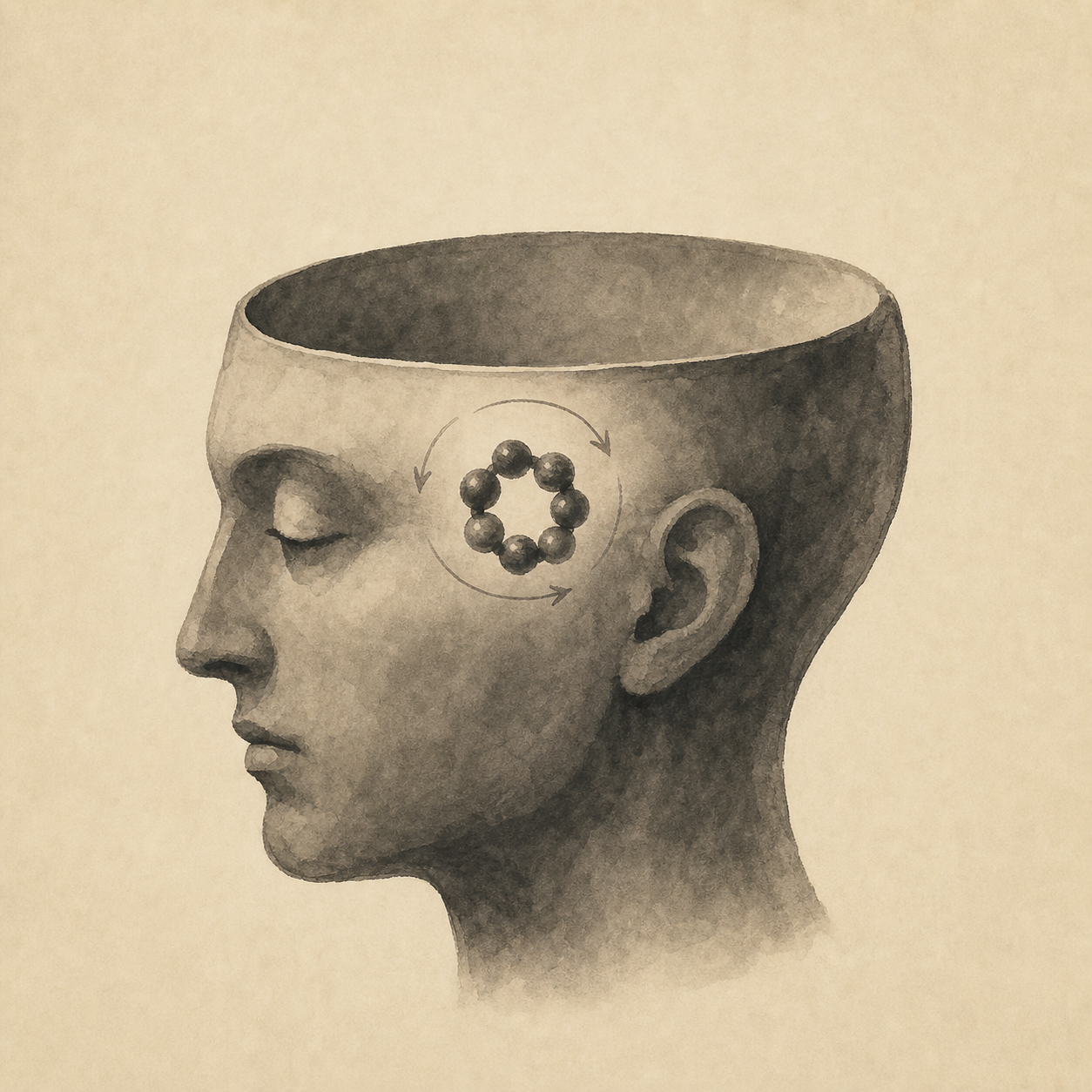
In 1956, the cognitive psychologist George A. Miller published a paper at Harvard with the deliberately conversational title The Magical Number Seven, Plus or Minus Two: Some Limits on Our Capacity for Processing Information. Miller had noticed something strange about human cognition: across many domains — recalling digits, distinguishing tones, identifying tastes — performance crashed at around seven items. The number seemed to be a fundamental feature of human information-processing capacity. Subsequent work (especially Nelson Cowan's 2001 review) revised the number downward: closer to four, when chunking is controlled for. Working memory — the cognitive scratchpad where information is held actively for ongoing tasks — has a hard, small, surprisingly stable capacity, and that capacity bounds nearly every act of complex reasoning a human being can perform.
Working memory is the active maintenance and manipulation of information over a span of seconds to a minute, distinct from passive short-term storage on one side and durable long-term memory on the other. Alan Baddeley and Graham Hitch's 1974 architecture, refined since, describes it as a central executive — attentional control, conflict resolution, task switching — coordinating a small set of specialized buffers: a phonological loop with a sub-vocal rehearsal mechanism for verbal material, a visuospatial sketchpad for visual and spatial material, and an episodic buffer added later to integrate across modalities and link to long-term memory. The capacity, at any given moment, is around four learned chunks. The expert's apparent expansion of capacity is mostly chunking in disguise: where a novice sees a chess board as twenty-five individual pieces, a master sees a handful of strategic chunks, each compressing a familiar pattern. The cellular substrate is persistent firing in prefrontal and parietal cortex, where individual neurons hold stimulus-specific information across a delay even after the stimulus is gone.
The narrow capacity has cascading consequences across cognition. Working-memory measures correlate with fluid intelligence at around 0.5–0.7, one of the strongest relationships in cognitive psychology, and individual differences in capacity predict reading comprehension, mathematical performance, and academic achievement. Reasoning requires holding premises while operating on them, so deeply nested arguments rapidly exhaust the buffer, and arithmetic is sharply bounded by how many partial results can be juggled mid-calculation. Expertise substitutes long-term-memory chunks for working-memory load, which is why a domain expert can reason about much more elaborate situations than a novice in the same domain — they have offloaded the storage. The capacity Miller noticed in 1956 is, in retrospect, the bottleneck through which most of conscious cognition has to pass, and it is mostly fixed.