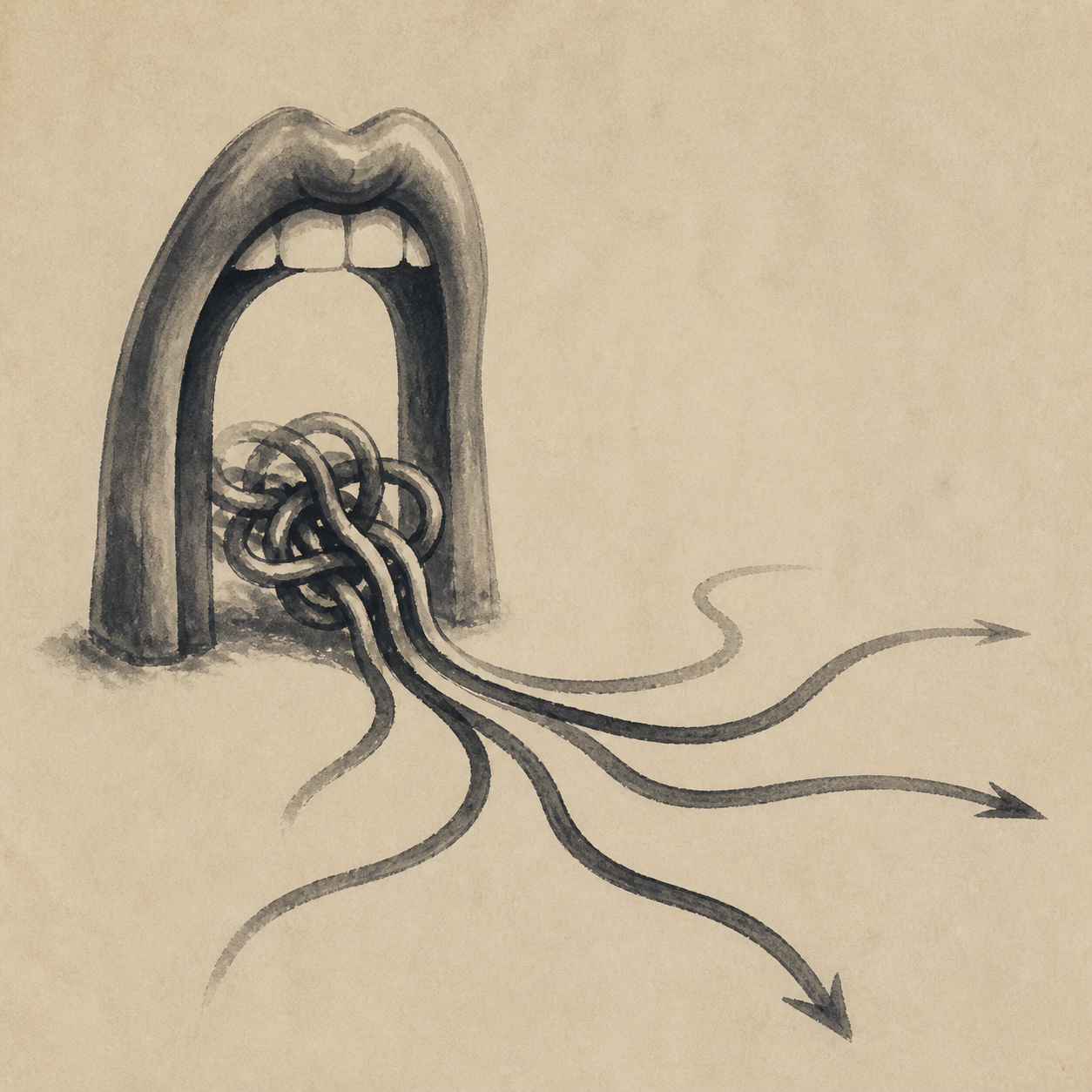
Wittgenstein & Philosophy of Language
- The Tractatus: language pictures factsnot yet tested
- Meaning is use: games and family resemblancenot yet tested
- One author, two opposed philosophiesnot yet tested
- From Frege to LLMs and distributional meaningnot yet tested
Ludwig Wittgenstein, youngest son of one of Vienna's wealthiest industrial families, served as an Austrian artillery officer in the First World War, working out a philosophical system in a notebook he carried in his pack. Captured by the Italians in 1918, he carried the finished manuscript into a POW camp at Cassino, and from there got it to Russell. Tractatus Logico-Philosophicus — seventy-five pages of numbered aphoristic propositions — appeared in 1921. Wittgenstein believed it had solved the problems of philosophy, gave away his share of the family fortune, took a teaching position in rural Austrian schools, and considered himself done. Three decades later, after a return to Cambridge, his executors assembled Philosophical Investigations (1953, posthumous). The two books share an author's name and contradict each other on nearly every methodological point.
The Tractatus (1921) is built around the picture theory of meaning. Propositions are pictures of facts; the world is the totality of facts, not of things. A meaningful sentence shares its logical form with the structure of the fact it represents — names correspond to objects, the arrangement of names to the arrangement of objects. A sentence is true if the arrangement it pictures is actual. Meaningful propositions are contingent empirical claims; ethics, aesthetics, and the meaning of life lie outside the world and cannot be said but only shown. The book ends with proposition 7: whereof one cannot speak, thereof one must be silent. Carnap, Schlick, and the Vienna Circle read the Tractatus as the manifesto for logical positivism, which dominated analytic philosophy from the late 1920s into the 1950s.
Wittgenstein's later work — the manuscripts that became the Philosophical Investigations — rejected the picture theory entirely. Language is a toolkit of practices embedded in human life. Meaning is use: a word means what its use in language is. There is no abstract Meaning of game — but a family resemblance of overlapping similarities holds the concept together without a common essence. Language games are bounded practices with their own rules. The private language argument attacks the Cartesian assumption of strictly private sensation-language: a language requires rules, rules require the possibility of getting them wrong, and that requires public practice. The broader lineage runs from Gottlob Frege's 1892 sense/reference distinction through Bertrand Russell's 1905 theory of descriptions, W. V. Quine's 1951 attack on the analytic-synthetic distinction, and Saul Kripke's 1972 Naming and Necessity.