Volcanism
- Rifts, subduction, and hotspots as magma sourcesnot yet tested
- Silica viscosity and effusive versus explosive eruptionsnot yet tested
- Molten rock at the surface and the rock it formsnot yet tested
- VEI, supervolcanoes, and years without a summernot yet tested
On the morning of August 27, 1883, the island of Krakatoa in the Sunda Strait exploded with a force estimated at 200 megatons of TNT, the loudest natural sound in recorded history. The blast was heard 4,800 kilometres away. Pressure waves circled the Earth seven times before damping out. Some 36,000 people died, most from pyroclastic flows and tsunamis as the volcano partially collapsed into the sea. The eruption's stratospheric sulfate aerosols lowered global average temperature by about 1.2 °C the following year. Sixty-eight years earlier, the April 1815 Tambora eruption had been even larger — VEI 7 — and caused 1816 to become the year without a summer across the Northern Hemisphere: crops failed, food riots erupted in Europe, Mary Shelley wrote Frankenstein in a darkened Lake Geneva villa during what should have been a normal June.
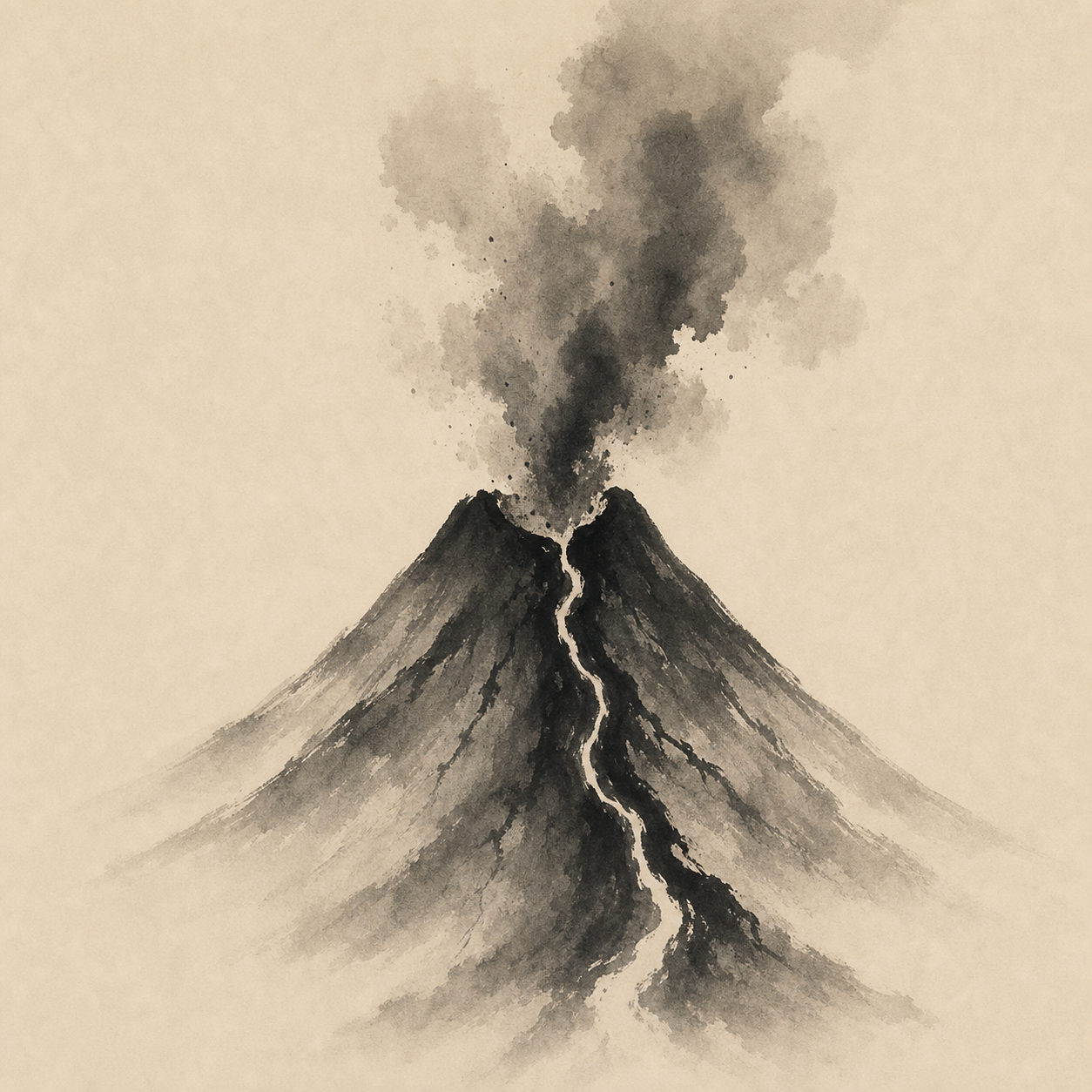
Volcanism is the surface expression of Earth's internal heat engine — primordial heat plus radiogenic heat from uranium, thorium, and potassium decay in the mantle — driving mantle convection, which drives brief 189 plate tectonics. Three settings produce magma. Divergent boundaries (mid-ocean ridges, the East African Rift): as plates pull apart, mantle rises and decompression melting produces basaltic magma; most volcanism by volume happens here, mostly underwater. Convergent boundaries (subduction zones): water released from the descending slab lowers the mantle wedge's melting temperature, producing the andesitic and rhyolitic magmas that build the Pacific Ring of Fire — Vesuvius (Pompeii AD 79), Krakatoa 1883, Pinatubo 1991. Hotspot plumes: narrow upwellings that punch through plates and produce island chains as the plate moves (Hawaii, Yellowstone, Iceland). Magma chemistry controls eruption style. Basaltic magmas (low silica, low viscosity) erupt effusively as lava flows; andesitic and rhyolitic magmas (high silica, high viscosity, high gas) trap gas under pressure and erupt explosively. The Volcanic Explosivity Index classifies eruptions logarithmically: Mount St. Helens 1980 was VEI 5; Krakatoa 1883 and Pinatubo 1991 were VEI 6; Tambora 1815 was VEI 7. Supervolcanic eruptions (VEI 8) — Toba ~74,000 years ago, Yellowstone, Taupo — eject thousands of cubic kilometres and force global climate cooling on multi-year scales. Large Igneous Provinces — the Siberian Traps (~252 Mya), Deccan Traps (~66 Mya) — are flood-basalt provinces tied closely to mass extinctions through climate disruption.