Vectors
- An arrow from the origin, written as componentsnot yet tested
- Addition, scaling, dot, and cross productsnot yet tested
- Vector spaces: anything you can add and scalenot yet tested
- Feature vectors and embeddings in MLnot yet tested
In the early 1840s, the Irish mathematician William Rowan Hamilton spent fifteen years trying to extend complex numbers — which describe the geometry of the plane — into a similar algebra for three-dimensional space. He kept failing. On October 16, 1843, walking with his wife along the Royal Canal in Dublin, the answer came to him: give up on three dimensions and use four. He carved the multiplication rules of the resulting quaternions into the stone of Brougham Bridge. Quaternions worked, but they were strange — multiplication was non-commutative, and the apparatus was heavier than physicists wanted. By the 1880s, J. Willard Gibbs in America and Oliver Heaviside in England had stripped Hamilton's machinery down to vectors and scalars, with two products (the dot product and the cross product) that handled the geometry of 3D space cleanly. Modern vector notation is essentially their compromise.
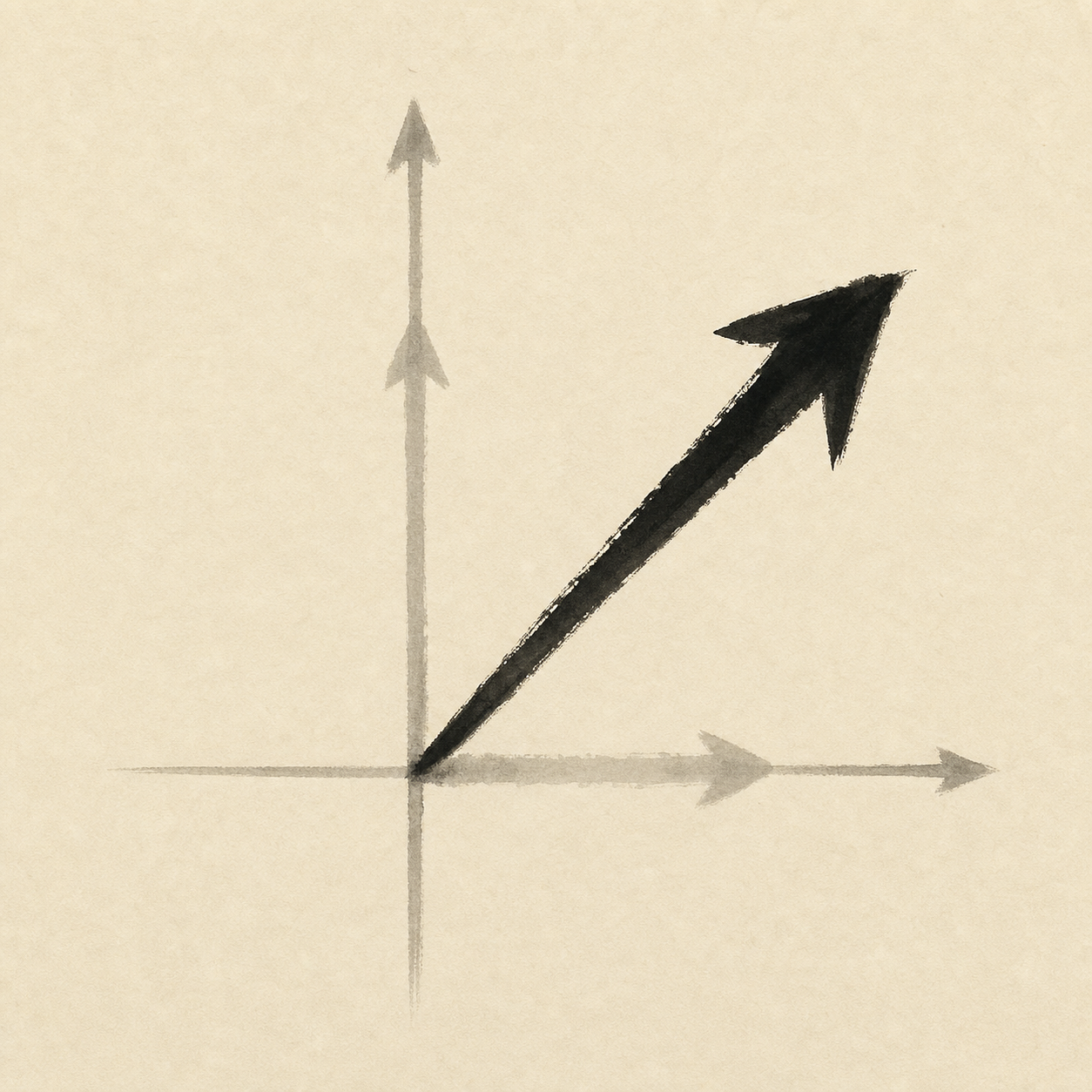
A vector is, intuitively, an arrow with a tail at the origin — an object that has both magnitude (length) and direction. Algebraically, in n-dimensional space, a vector is an ordered tuple of numbers (v₁, v₂, ..., vₙ) — its components along chosen coordinate axes. From this minimum, three operations are defined. Addition: vectors add component-wise, geometrically by placing one's tail at the other's head (parallelogram law). Scalar multiplication: multiplying a vector by a number stretches it (or flips it if the scalar is negative). Dot product: u · v = u₁v₁ + u₂v₂ + ... = ‖u‖·‖v‖·cos(θ), simultaneously a measure of projection and of angle between vectors — and the source of the magnitude formula ‖v‖ = √(v · v), Pythagoras dressed up. Cross product (3D only): u × v is a vector perpendicular to both u and v, with magnitude ‖u‖·‖v‖·sin(θ); it captures area, torque, angular momentum, and the right-hand rule of physical conventions. The conceptual leap from Hamilton/Gibbs to modern mathematics is the vector space: any set of objects that can be added together and scaled by numbers, satisfying eight axioms (associativity, distributivity, identity, etc.). Functions form a vector space. Solutions to a linear differential equation form a vector space. Quantum-mechanical states form a vector space — a complex one, called a Hilbert space. Linear algebra is the study of these spaces and their linear transformations, and it turns out that almost any computational problem you can solve cheaply, you can solve cheaply because it is linear.