Universal Gravitation
- Which way gravity pulls; the equal-fall rulenot yet tested
- g ≈ 9.8 m/s² at Earth's surfacenot yet tested
- Kepler's third law: T² ∝ a³not yet tested
- Escape velocity √(2GM/r)not yet tested
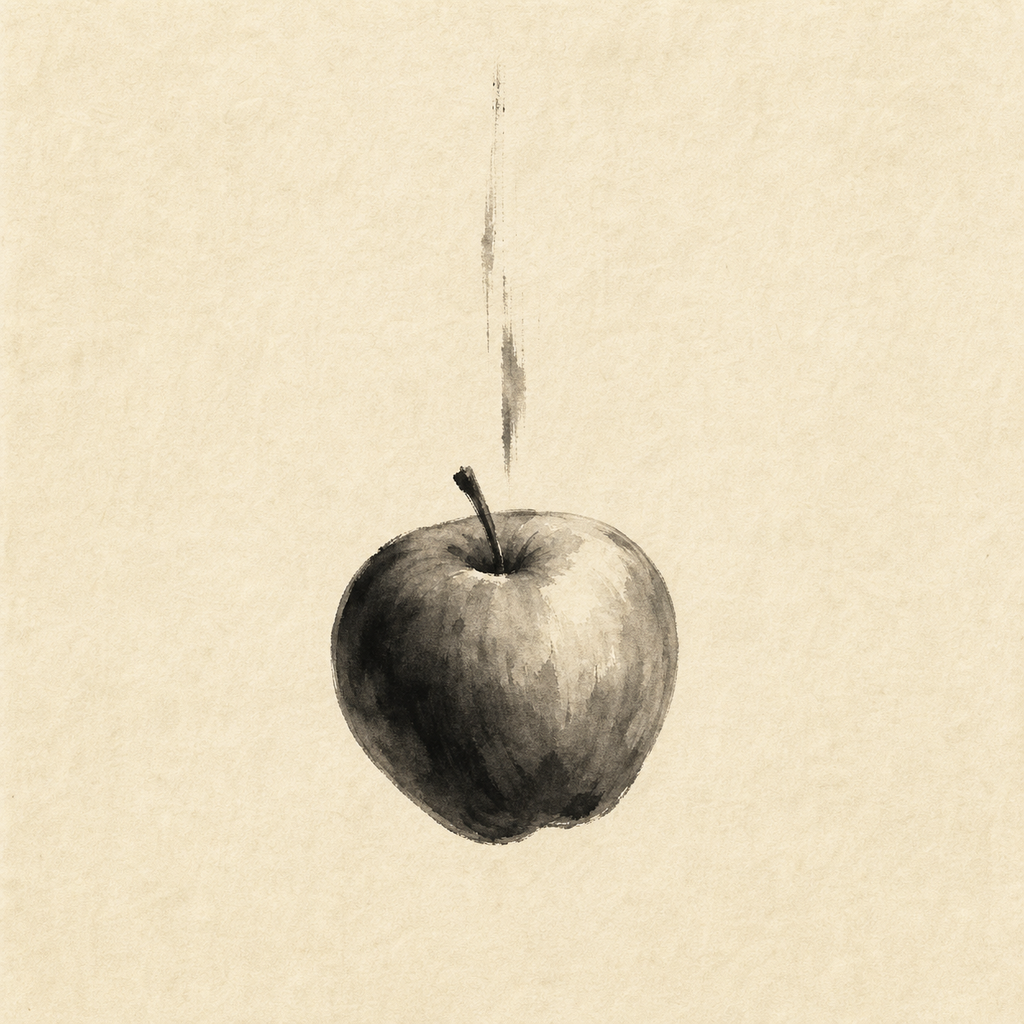
There is a story — embellished if not invented by Newton himself, late in life — of an apple falling from a tree in his mother's garden in Lincolnshire during the plague year of 1666. The young Newton, sent home from Cambridge while the universities were closed, watched the apple fall and asked: does the same force that pulls the apple to the ground also hold the moon in its orbit? He worked out the answer that summer. Yes. The same inverse-square law of gravitational attraction governs the apple and the moon — and, by extension, every object in the universe. Universal gravitation — one law, applied everywhere — was the first time humans had glimpsed a regularity at cosmological scale, and it founded the modern conception of the universe as a single physical system governed by uniform laws.
Newton's law of universal gravitation: every two point masses attract each other along the line between them with a force proportional to the product of their masses and inversely proportional to the square of their distance. F = G·m₁·m₂ / r², where G ≈ 6.674 × 10⁻¹¹ N·m²/kg² is the gravitational constant — the universal scaling factor of gravity, measured first by Henry Cavendish in 1798 with a torsion balance, with a precision unmatched for nearly a century. The law applies to point masses but extends to spherically-symmetric distributions: a planet acts gravitationally as if all its mass were concentrated at its center (Newton's shell theorem, proved in the Principia with a ferocious geometric argument). Combined with Newton's second law (F = ma), universal gravitation produces Kepler's three laws of planetary motion as theorems: planetary orbits are ellipses with the sun at one focus; the line from sun to planet sweeps equal areas in equal times; the square of the orbital period is proportional to the cube of the semi-major axis. Tides on Earth are explained by the differential gravitational pull of the moon (and to a lesser extent the sun) on the near and far sides. Escape velocity, orbital mechanics, the precession of equinoxes, the return of Halley's comet (predicted by Halley using Newton's law) — all were Newtonian victories. The framework was almost perfect, and where it failed, the failures were small enough to be argued about for two hundred years before general relativity explained them. The most famous discrepancy: Mercury's perihelion precession differed from Newton's prediction by 43 arcseconds per century, an anomaly Le Verrier identified in 1859 and that astronomers tried for decades to explain by a hypothetical inner planet Vulcan. There was no Vulcan. Mercury's anomaly was Newton's law breaking down where the sun's gravity is strongest, and the explanation had to wait for Einstein.