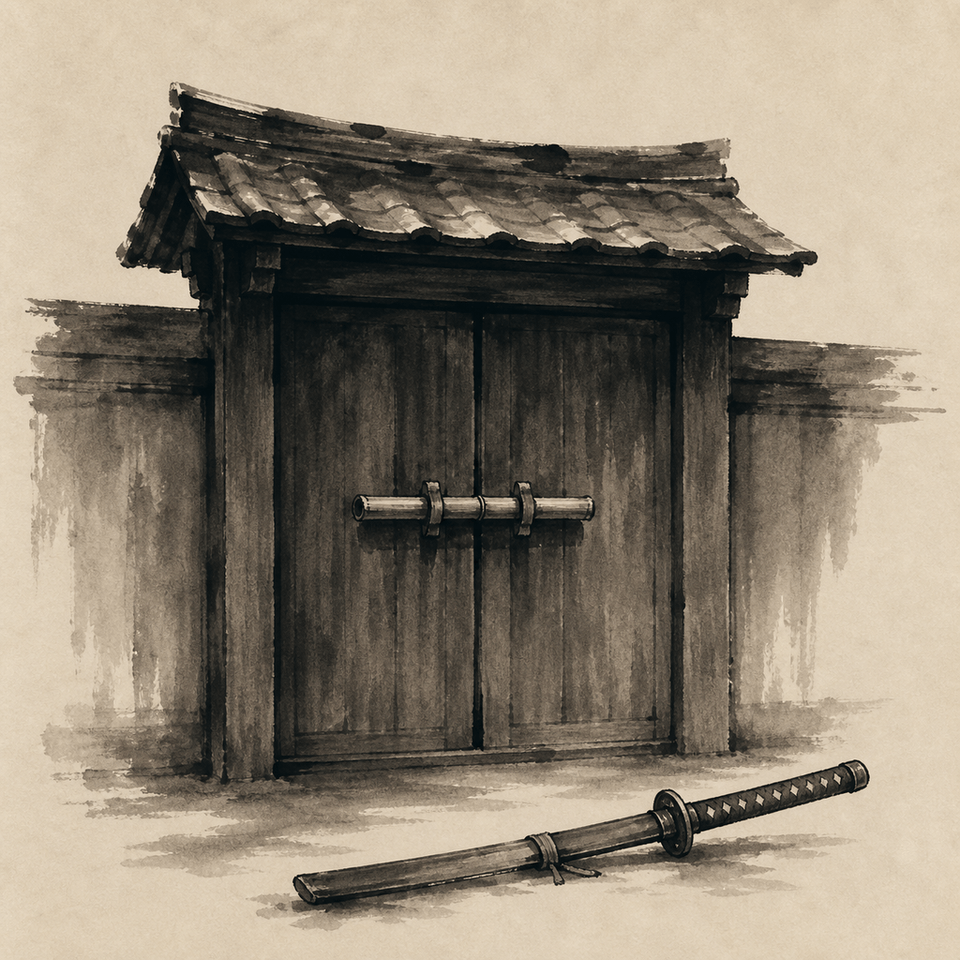
Tokugawa Japan
From 1639 to 1853 — 214 years — Japan was deliberately, almost completely closed to the outside world. After the Christian-led Shimabara Rebellion (1637–38), the Tokugawa shogunate expelled the Portuguese and Spanish, banned Christianity on pain of execution, and confined the Dutch to Dejima, a fan-shaped artificial island of barely two acres in Nagasaki harbour — the country's sole licensed window onto Europe. Japanese subjects were forbidden to leave on pain of death, and ocean-going ships were proscribed. It is the most successful policy of managed isolation in modern history. Yet the country that emerged from it in 1868 would industrialize faster than any non-Western nation ever had — a paradox that still puzzles anyone who assumes openness is the precondition for progress.
Tokugawa Japan was not stagnant during sakoku. Internally it ran a sophisticated cash economy with rice-backed credit instruments at the Osaka exchanges, a literate urban culture — Edo held perhaps a million people by 1700, likely the world's largest city — and manufactures of formidable quality. Two centuries of enforced peace under the Pax Tokugawa hollowed out the warrior's role: the hereditary samurai caste, stipended and disarmed in practice, became bureaucrats and accountants, many deep in debt to merchants they nominally outranked. Male literacy may have reached 40 percent, exceptional for a pre-industrial society. When Commodore Matthew Perry's American steam frigates forced the harbours open in 1853–54, the response was not prolonged resistance but the Meiji Restoration of 1868 — a top-down reorganization that abolished the domains, conscripted a national army, built railways and a constitution, and dispatched the Iwakura Mission to study the West directly. The reformers copied Western industrial, military, and legal forms while wrapping them in restored imperial and Shinto legitimacy. By 1895 Japan had beaten China; by 1905, at Tsushima, it destroyed a Russian fleet and stood as a great power. The structural lesson: prior literacy, administrative depth, and political unity let a society absorb a technological shock rather than be shattered by it.