The Water Cycle
- Evaporation, condensation, and the three phases of waternot yet tested
- Latent heat of vaporization as poleward energy transportnot yet tested
- Water vapor, humidity, and the Clausius-Clapeyron feedbacknot yet tested
- Reservoirs, aquifers, and runoff to the seanot yet tested
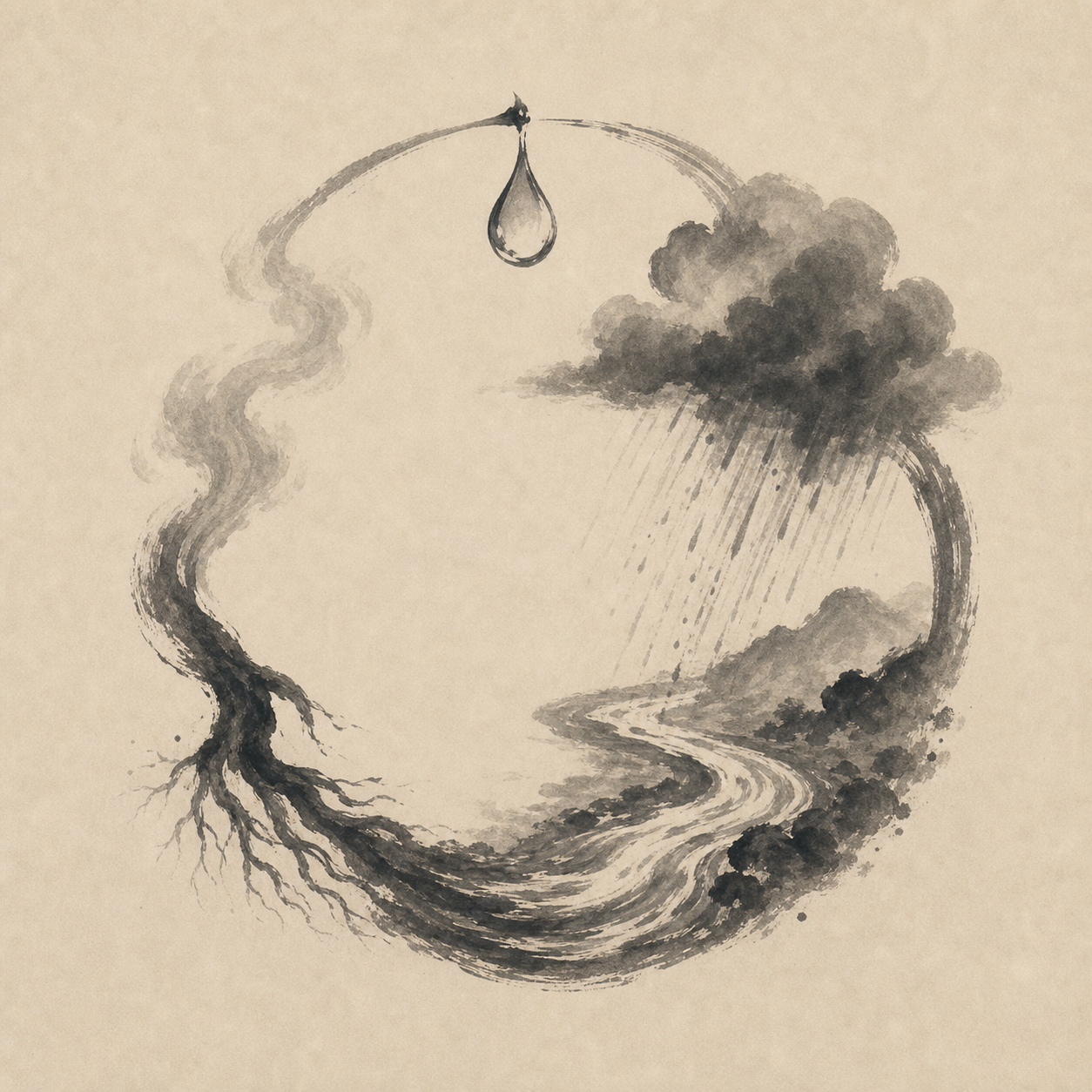
An average water molecule evaporated from the ocean spends about nine days in the atmosphere before falling as precipitation somewhere on Earth. Over land the average annual precipitation is roughly 750 mm, average evapotranspiration roughly 480 mm, and the difference — about 270 mm — runs off to the ocean as rivers; regional numbers vary enormously (Sahara ~25 mm/yr, Amazon basin >2,000 mm/yr, Cherrapunji in Meghalaya ~12,000 mm/yr) but the cycle is the same. There is essentially no new water on the planet — the water filling your glass once flowed through dinosaurs, dripped off Roman aqueducts, and existed as ice in a proto-Earth. What we have is what we cycle.
The reservoirs are lopsided: oceans hold ~96.5% of Earth's water, ice sheets and glaciers ~1.7%, groundwater similarly, the atmosphere a vanishing 0.001% — except the atmospheric reservoir cycles ~37 times per year and does almost all the work. That work is energy transport: water exists in three phases, and the latent heat of vaporization (~2,260 kJ/kg) is so large that vapor lifted in the tropics and condensed at higher latitudes carries vastly more heat poleward than direct sensible-heat flow — by a factor of five — making latent transport the largest single energy flux in atmospheric circulation. Water vapor contributes the largest share of the natural greenhouse effect in many decompositions (~half the total effect vs CO₂'s ~20%), but its residence time is days and its concentration is set by temperature via the Clausius-Clapeyron relation (saturated vapor pressure rises ~7% per °C). That makes water vapor a feedback, not a forcing. Precipitation patterns reflect circulation: the Hadley cell concentrates rain in the tropics and bakes the subtropics dry; orographic lift produces rain shadows (Seattle 950 mm/yr, Yakima 200 km leeward gets 200). Below the surface, aquifers recharge on timescales from years to millennia; the Ogallala under the US Great Plains is being pumped faster than it can recharge. Sea-level rise integrates the perturbation — ~3.7 mm/yr over 2006–2018 vs ~1.4 mm/yr in the twentieth-century average — thermal expansion ~30%, glacier and ice-sheet melt ~50%.