The Urban Revolution
Around 3500 BCE, in the marshy delta between the Tigris and the Euphrates, a settlement called Uruk swelled past a threshold no human community had crossed before. At its height it may have held forty to eighty thousand residents inside a nine-kilometre wall — vastly more people than any one of them could possibly know by face or name. They came from different villages, spoke variations of the same Sumerian tongue, worshipped overlapping gods, and somehow had to cooperate without being kin. No instinct prepared a primate for life among tens of thousands of strangers; the deepest social wiring we carry assumes a band of a hundred or so faces, all of them known. The city is the form humanity invented to make life among unknown faces survivable.
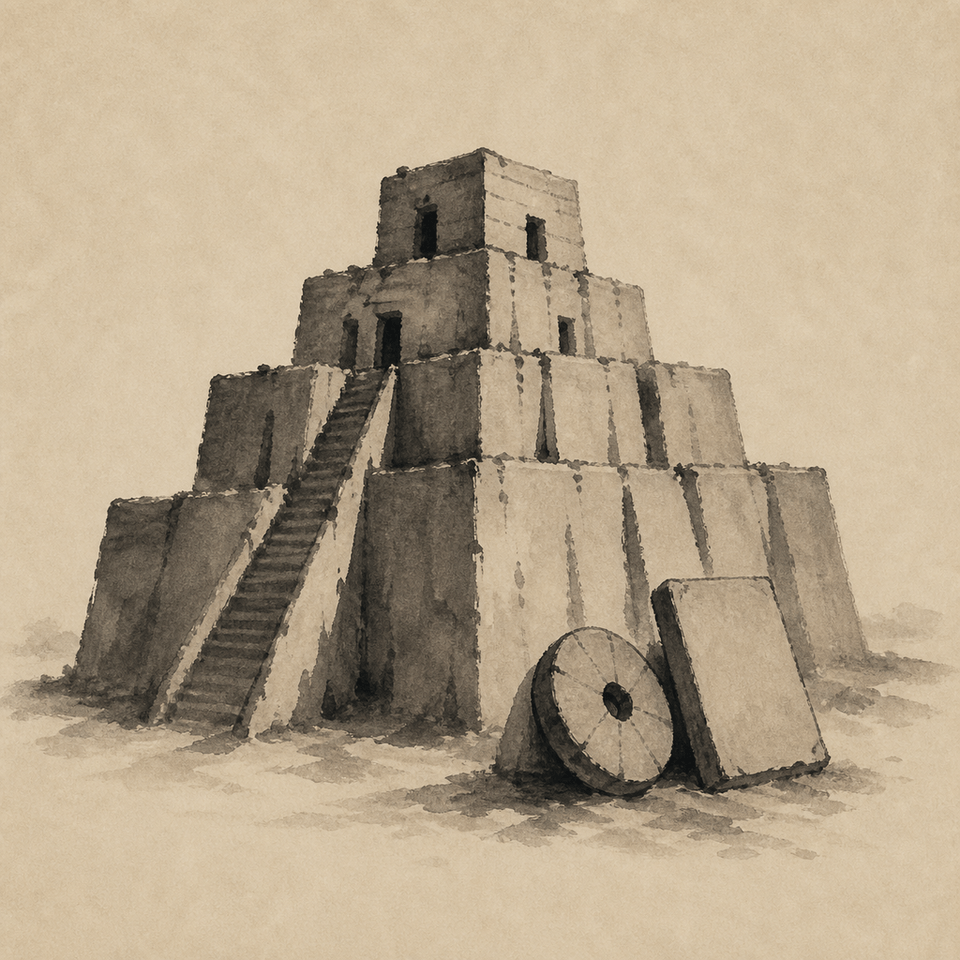
Once strangers live wall to wall with strangers, you need new technologies very quickly. Written records to track who owes whom; a temple-and-palace bureaucracy to mediate the disputes kinship no longer settles; standardized weights and measures so trade does not collapse into argument; a shared calendar to coordinate planting, festival, and tax; defensive walls that mark the inside from the outside. All of these emerged at Uruk in roughly the same few centuries — cuneiform writing itself was likely born here, in the temple of the goddess Inanna, to keep accounts. Cities also produce something villages cannot: a class of full-time specialists — scribes, priests, smiths, merchants, soldiers — fed by a surplus their own hands never grew. Their bread is grown by someone they have never met and never will. That dependency, the willingness to trust an unseen farmer for tomorrow's food and an unseen official to keep the records honest, is the psychological foundation of every state since. It also flipped the engine of progress: when thousands of unlike minds are packed together and forced to exchange goods, gossip, and grievances, ideas collide and recombine far faster than in any scattered countryside, so the city became history's accelerant — the place where writing, the wheel, the law code, monumental architecture, and mathematics were refined almost in parallel. The price was permanent stratification: the same walls that kept enemies out fixed inside them a hierarchy of priest, official, artisan, and labourer that the village had never needed.