The Sublime
- Burke's terror contemplated from safetynot yet tested
- Kant's mathematical and dynamical sublimenot yet tested
- Friedrich, Turner, and the Romantic landscapenot yet tested
- Land art, cinema, and the AI sublimenot yet tested
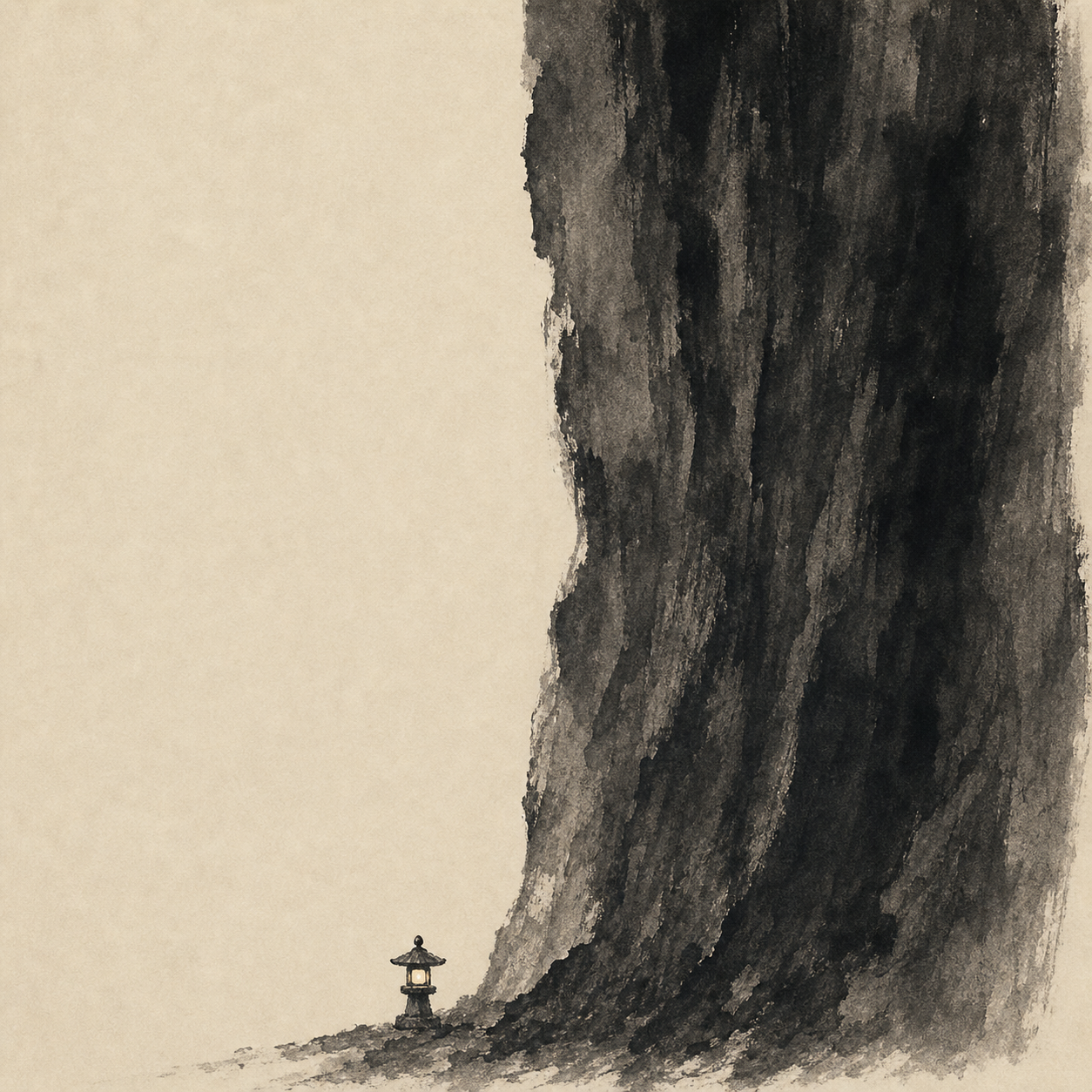
In 1757, the Irish-born statesman Edmund Burke published A Philosophical Enquiry into the Origin of Our Ideas of the Sublime and Beautiful, splitting aesthetic experience into two categories. The beautiful is small, smooth, delicate — producing love and pleasure. The sublime is vast, rugged, obscure, powerful — producing astonishment, fear at a safe distance, and the awe that comes when one's own scale is dwarfed: the thunderstorm seen from a sheltered window, the alpine peak, the cathedral's overwhelming interior. Thirty-three years later, Immanuel Kant's Critique of Judgment (1790) gave a more rigorous account, distinguishing the mathematical sublime (vastness exceeding our capacity to comprehend) from the dynamical sublime (power exceeding our capacity to resist). The sublime — beauty's older, more dangerous twin — became the defining aesthetic concept of Romanticism.
Burke's empirical psychology identified the sublime's conditions: terror at a distance (actual danger destroys the response, but contemplated danger produces it), obscurity, power and vastness in space, time, or intensity, and the darkness and solitude that let the mind contemplate the overwhelming. His list of sublime objects ran from the ocean and vast plains through mountains to the King James Bible, whose language he believed uniquely sublime. Kant's reframing in the Critique of Judgment was that the sublime is not a property of objects but a response of the mind to objects that exceed its capacities. The mathematical sublime arises from what is too large to comprehend in a single intuition — the starry sky, the geological deep time of the Grand Canyon. The dynamical sublime arises from what is physically overwhelming but observed from safety — the thunderstorm from shelter, the volcano at distance. For Kant both kinds ultimately produce a positive feeling because, in the moment of being overwhelmed, the mind recognizes its own supersensible powers. Romanticism deployed these concepts directly. Caspar David Friedrich's Wanderer above the Sea of Fog (1818) is the canonical image — a single figure, back to viewer, contemplating an overwhelming mountainous vista. J.M.W. Turner's late paintings approached the sublime through atmospheric dissolution; the Hudson River School of Thomas Cole, Frederic Church, and Albert Bierstadt applied a wilderness sublime to American landscape painting; Beethoven's late symphonies produced musical sublimity through scale and the deliberate breaking of formal expectation; Wordsworth in the Prelude and Shelley in Mont Blanc gave it poetic form. Schopenhauer (1819) made the sublime the temporary recognition of metaphysical will; David Nye's American Technological Sublime (1994) extended the category to bridges, dams, rockets, and the atomic bomb. The category survives the standard objections because what it names — overwhelming experience that is not beautiful — keeps recurring.