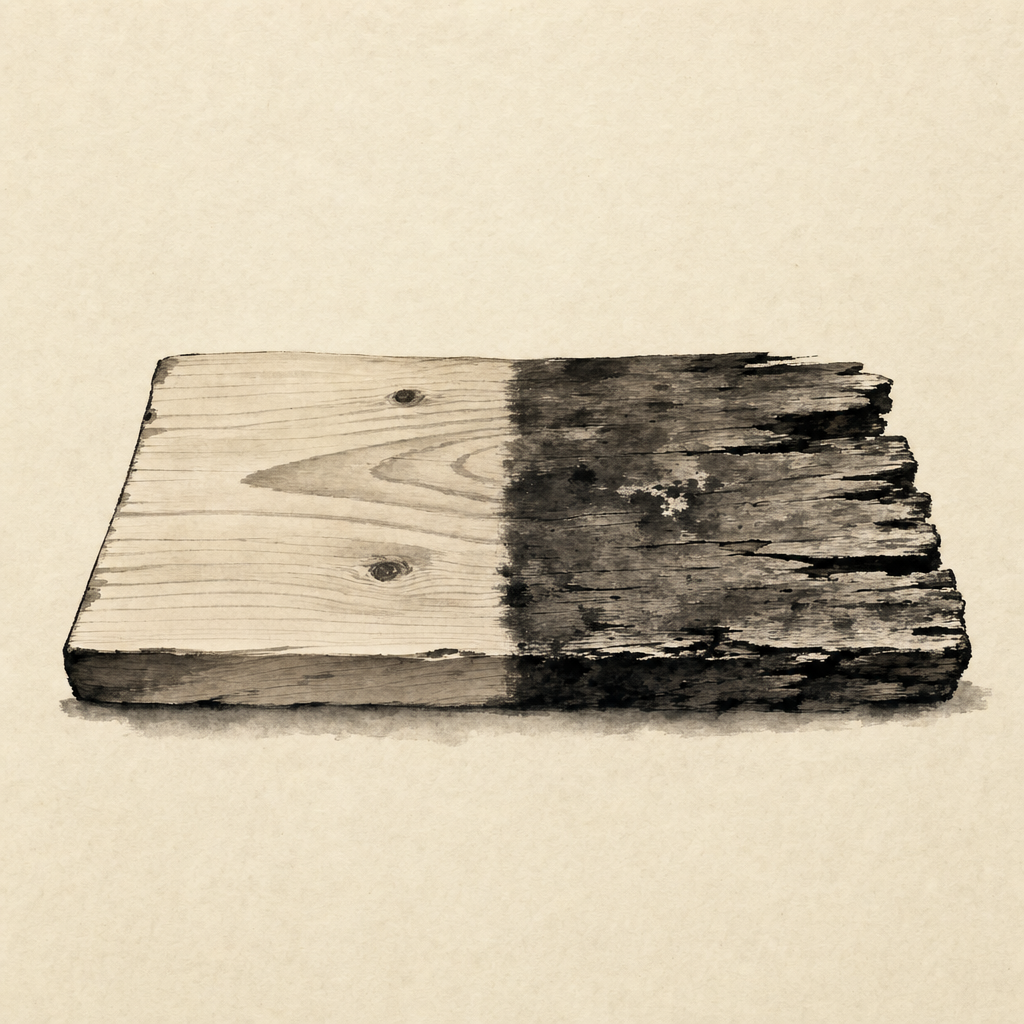
The Ship of Theseus
- Replace every plank — same ship?not yet tested
- From planks to persons over timenot yet tested
Plutarch, writing early in the second century CE, reports that the Athenians preserved the ship in which Theseus had returned from Crete, replacing each plank as it rotted so that it could be sailed in commemoration year after year. Eventually, every plank had been replaced. Was it still the same ship, or had the gradual swapping quietly produced a different vessel that merely wore the old one's name? Hobbes asked the harder version: imagine the original planks had been gathered as they were discarded and reassembled into a ship. Now there are two candidates — a continuous one built of new wood, and a reconstructed one built of the very timbers Theseus sailed. Which one is the ship of Theseus? Continuity of form points to the first; continuity of matter points to the second. The puzzle is two thousand years old, has many proposed solutions, and refuses to resolve.
The Ship of Theseus is the canonical case for problems of identity over time. The intuitive criteria — material continuity, form continuity, causal/historical continuity — give different answers depending on which you weight, and most candidate criteria can be made to conflict in some scenario. The deeper trouble is that our everyday concept of sameness bundles these strands together and only comes apart under pressure. Locke's psychological-continuity theory of personal identity (you are the same person if memory and personality persist) and Parfit's reductionist view (personal identity is less important than we think; only the underlying physical and psychological connections matter) extend the ship problem to persons. Modern variants are everywhere: am I the same person as the version of me ten years ago, given that nearly every cell has been replaced and most beliefs have shifted? Is the brain in a transplant the patient? Is a teleported person the original or a copy? Is a gradually digitized mind the same mind? Is Apple the same company it was in 1976 when none of its founders, original products, or premises remain? Is a restored building the original after every stone has been recut? Is a theory the same theory after Kuhnian paradigm shifts? The ship is not just a thought experiment; identity-over-time is the underlying problem in personhood, organizational continuity, legal liability, intellectual-property succession, biographical narrative, and quite a bit of metaphysics. Philosophy offers several serious answers — four-dimensionalism (objects are spacetime worms, and the puzzle dissolves once you stop privileging an instant), the relativity of identity (sameness holds only relative to a sortal), and competing mereological views about how parts compose wholes — but no consensus has settled the question.