The Royal Society
In November 1660, twelve men met at Gresham College in London after a lecture by the young astronomer Christopher Wren and resolved to found a society for the experimental investigation of nature. A royal charter followed in 1662. Their motto was Nullius in verba — 'take no one's word for it' — and their method was to subject every claim about the physical world to replicable demonstration before witnesses. No prophet, no ancient, no church could settle a question that the apparatus could be made to answer in the room. More than any single institution, the Royal Society is where modern science was operationalized — turned from a private virtue into a public procedure.
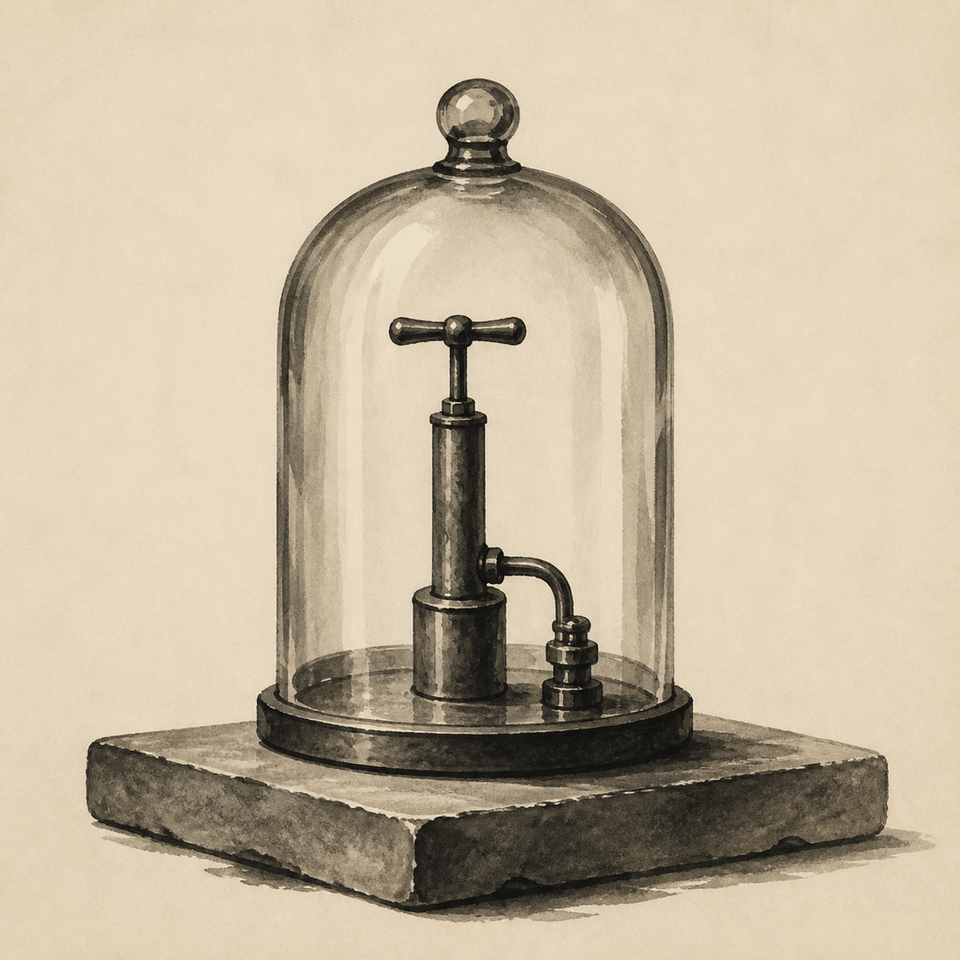
The Society's innovation was not the experimental method itself, which Bacon had codified and Galileo had practised. It was the machinery of distributed verification. Its early fellows were the working core of the Scientific Revolution — Robert Boyle, whose air-pump trials set the standard for the controlled experiment, alongside Wren the architect-astronomer and the polymath Robert Hooke. The Philosophical Transactions, launched in 1665, became the world's oldest continuously published scientific journal — a venue where results were communicated, replicated, criticized, and extended by an international community rather than guarded as trade secrets. This is what made science cumulative in a way no prior knowledge tradition had been. Its first secretary, Henry Oldenburg, ran a one-man clearing house, corresponding with natural philosophers from Lisbon to Moscow and weaving a continent-wide research network; he also pioneered dating submissions to establish priority and circulating them to expert readers — the ancestor of peer review. Robert Hooke served as curator of experiments, contractually obliged to stage three or four fresh demonstrations before audiences each meeting, teaching a sceptical public to trust what could be shown; his Micrographia (1665), with its giant engraved flea, made the new instrument-based science a popular sensation. The Society also enforced a plain, witnessed prose — Thomas Sprat's 1667 history urged members to strip away rhetorical ornament so that a report could be trusted as a record of fact. Newton's Principia (1687) was published under the Society's imprimatur, midwifed and partly financed by Edmond Halley when the cash-strapped Society itself could not pay for it; Isaac Newton would serve as its president from 1703 until his death.