The Roman Empire & Pax Romana
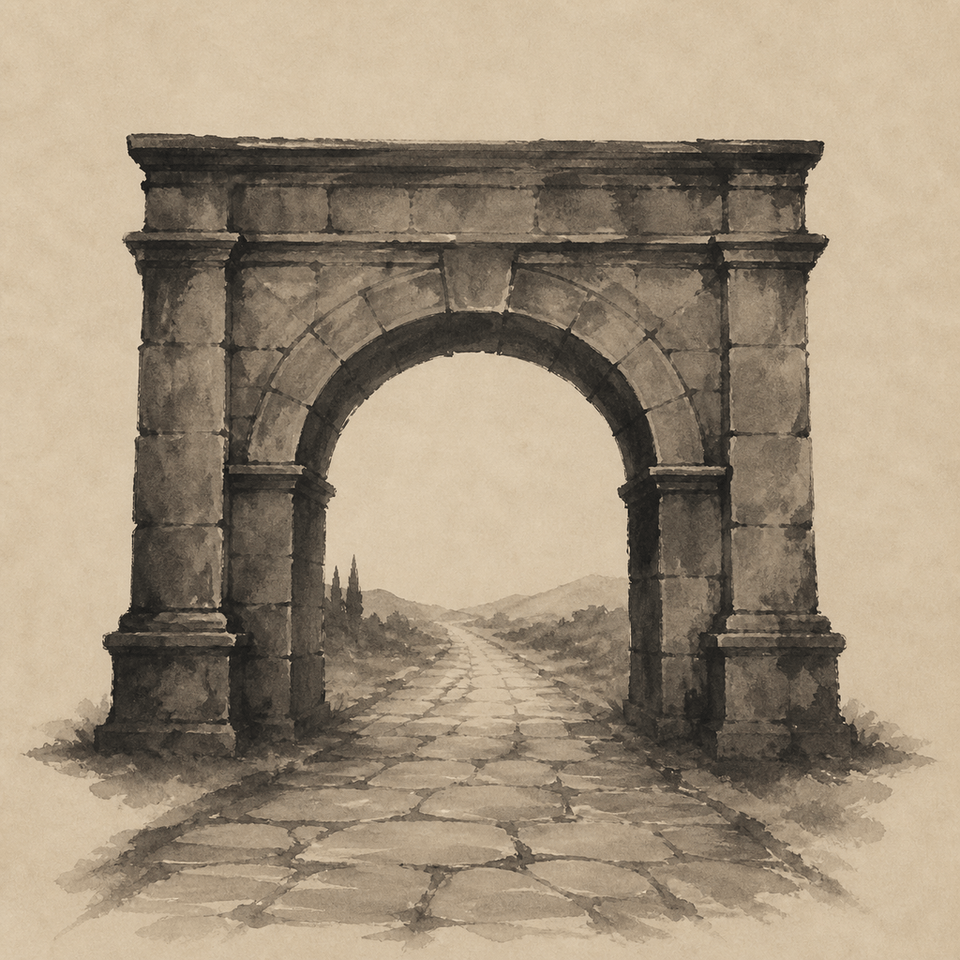
From 27 BCE, when Octavian took the name Augustus, until 180 CE, when Marcus Aurelius died on the Danube frontier — a span of two centuries — the Roman Empire administered the entire Mediterranean basin, half of Europe, and large stretches of the Near East as a single, internally peaceful, politically stable polity. A merchant could travel from Hadrian's Wall to the Euphrates speaking only Latin and Greek, paying in a single silver coinage, judged under one body of law, on stone-paved roads the army kept open. Perhaps sixty million people lived inside the frontier, among the largest populations ever held under one administration to that point. No subsequent regime has matched it — not in scale, not in duration, not in the sheer ordinariness of the peace.
The Pax Romana was bought with several specific compromises. Augustus replaced the Republic's contested institutions with monarchical rule disguised as restored tradition; he held no crown, only an accumulation of offices — tribunicia potestas, imperium proconsulare, the consulship taken at will — and called himself merely princeps, first citizen, leaving the Senate to ratify what he had already decided. The army was professionalized into roughly twenty-eight legions, stationed at the frontiers, paid and pensioned from the centre through a dedicated military treasury, which made loyalty flow to the emperor rather than to ambitious generals who had once raised private armies and turned them on the city. Conquered elites were progressively enfranchised; provincial aristocrats entered the Senate and, by Trajan and Hadrian, the throne itself, until in 212 CE the Constitutio Antoniniana extended citizenship to every free inhabitant. Trade flourished because piracy had been crushed and tariffs harmonized: Egyptian grain fed Rome's million inhabitants under the state annona, and goods from India reached Gaul. The period produced influential Latin authors and a growing body of juristic writing later used in Justinian's compilations. Cities across the empire adopted forums, baths, theatres, and basilicas in locally varied combinations rather than from one template. The cost was the end of self-government: a quiet, centuries-long bargain in which security and prosperity were traded for political voice, and succession was never solved — no fixed rule decided who followed, so each transfer of power was a latent crisis. When the bargain frayed in the third century — plague, debased coinage, frontier pressure, and emperors made and unmade by the legions — the system that had suppressed civil war began to manufacture it instead.