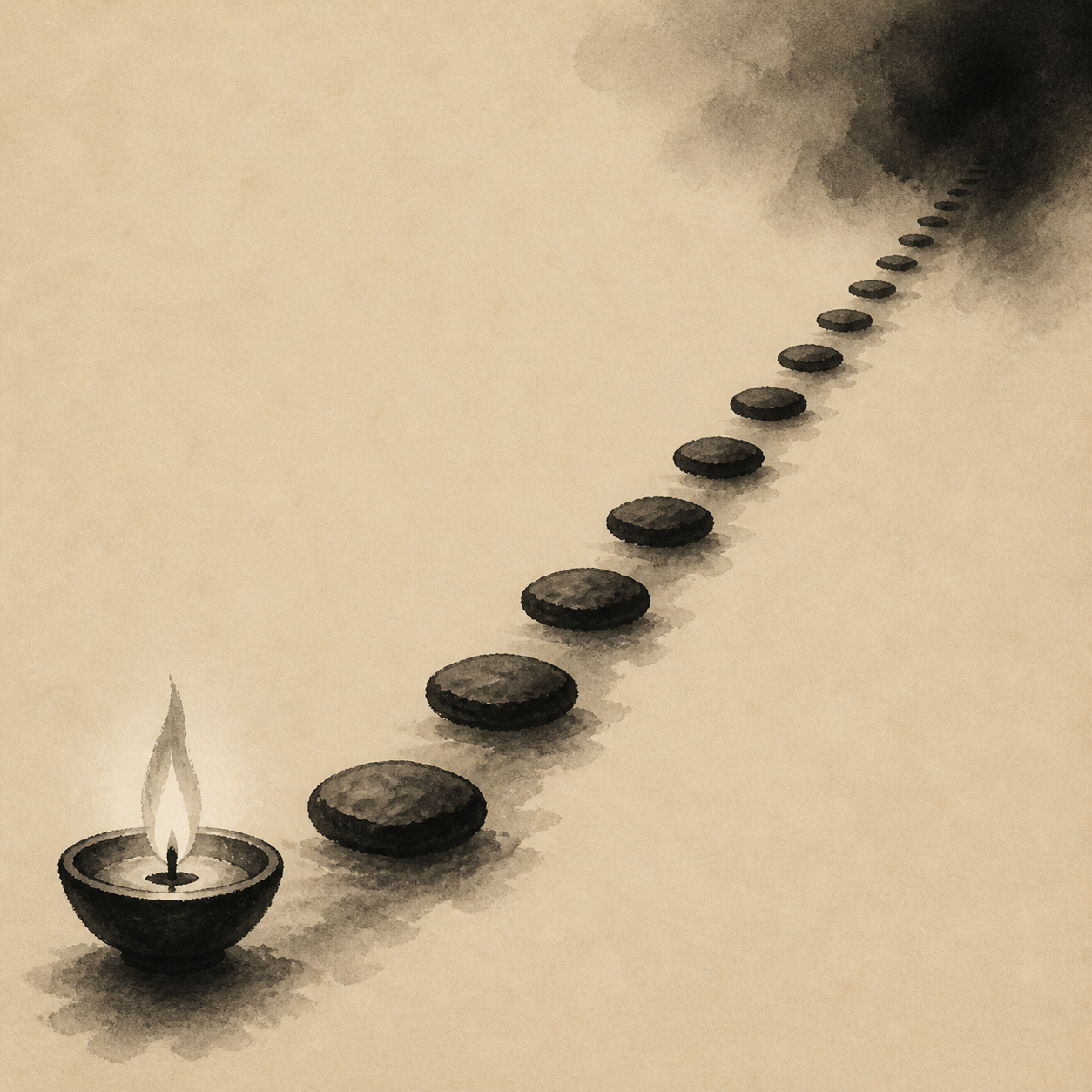
The Problem of Induction
- David Hume, the Scottish philosopher of 1739not yet tested
- Inferring the future from the pastnot yet tested
- Constant conjunction as habit, not proofnot yet tested
David Hume published A Treatise of Human Nature in 1739, at twenty-eight. The book fell dead-born from the press, his own phrase, and was largely ignored for fifty years. Inside it was a question that, once stated, could not be unasked: what justifies our belief that the future will resemble the past? Every empirical inference — that the sun will rise tomorrow because it has always risen, that fire will burn because it has always burned — assumes a uniformity of nature we cannot prove except by appealing to the very assumption we are trying to justify. Hume's argument is short, devastating, and as alive today as the day it was written.
Hume's argument: all reasoning concerning matter of fact (as opposed to relations of ideas, which are deductive) ultimately rests on causation. We see one billiard ball strike another and expect the second to move; we have no direct perception of necessary connection between cause and effect, only the constant conjunction of the two events. From repeated observation we develop a habit of mind that expects the conjunction to continue. The expectation has no logical justification: deductively, no number of past observations entails any future one (the inference from "every observed swan is white" to "all swans are white" is famously falsified by the discovery of black swans in Australia); inductively, the inference presupposes the very uniformity-of-nature principle it is supposed to support, which is circular. The problem is not that induction is unreliable in practice — it works astonishingly well, and any creature that didn't induce would not survive — but that it has no rational foundation deeper than psychological habit.
The subsequent literature is vast. Karl Popper (1934) reformulated science as falsification rather than confirmation: no number of confirming observations proves a theory, but a single observation can disprove it. Pragmatists (Peirce, James, Dewey) accepted the lack of foundation and argued induction is justified because it works. Bayesian epistemologists formalize induction as probability updating, but this relocates the problem rather than dissolving it: where do priors come from? Solomonoff induction proposes that the prior should be 2⁻K(h) (lower Kolmogorov complexity → higher prior), a provably-optimal-in-the-limit but uncomputable framework. Nelson Goodman's new riddle (1955): why project green to future emeralds rather than grue (green-before-t-or-blue-after)? The data are equally compatible. Goodman's riddle exposes that induction requires a prior choice of which predicates count as natural — a question pure logic cannot settle.