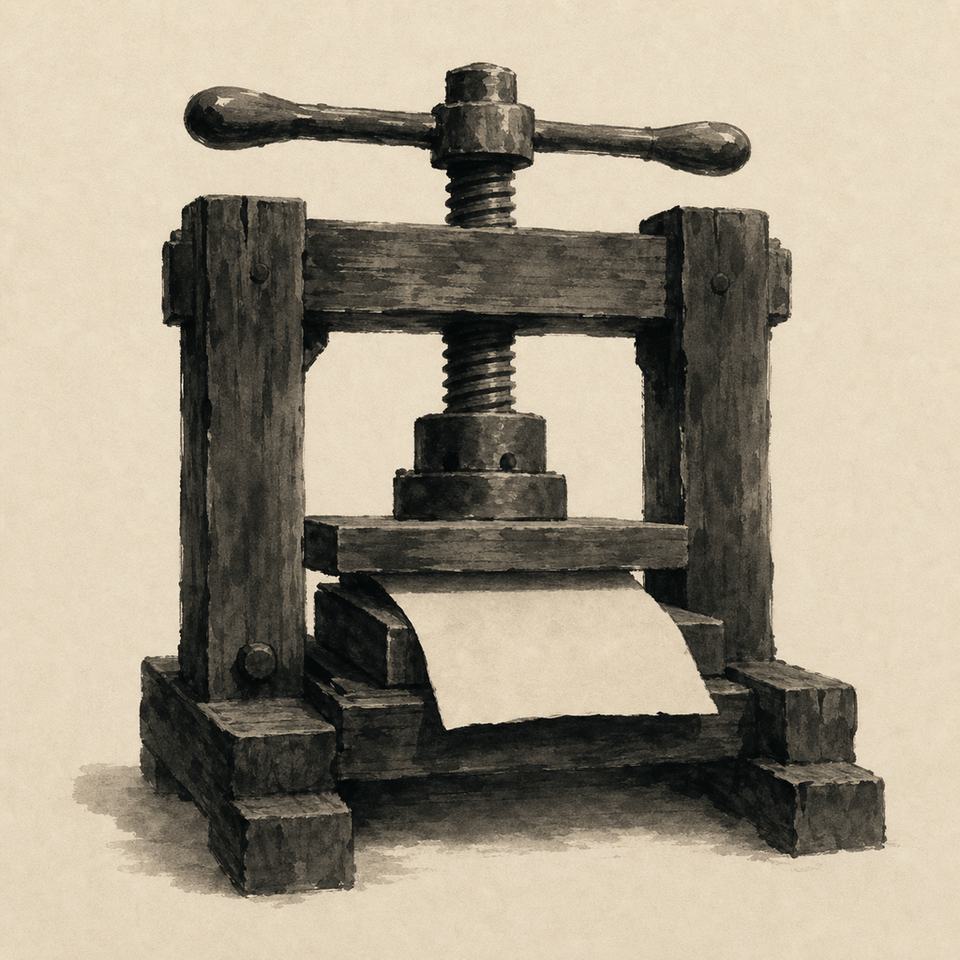
The Printing Press
Johannes Gutenberg was a goldsmith. He understood metals, oils, and patience. Around 1450, in Mainz, he combined a wine press, an oil-based ink that would cling to metal, and — most importantly — movable cast-metal type, cast from a reusable hand mould, into a machine that could produce identical copies of a book at roughly 200 times the rate of a human scribe. His masterpiece, a two-volume Latin Bible of some 180 copies, was technically flawless and commercially ruinous: he lost the workshop to his financier, Johann Fust, in a 1455 lawsuit and died nearly forgotten. His business eventually went bankrupt. The technology did not — and that gap between the inventor's fate and the invention's is the whole story.
Within fifty years, every major European city had at least one press; by 1500 they had produced perhaps twenty million volumes — more books than all of Europe's scribes had copied in the previous millennium — and the period's output is still catalogued under its own name, incunabula. The book, previously a luxury object hand-copied by monks and costing as much as a horse, became something a literate craftsman might own; the price of information collapsed. Cheap pamphlets followed. Then newspapers. Then, in 1517, a German monk named Luther nailed his theses to a door, and within months they were being read in Paris, London, Krakow, and Stockholm. No one had to convert him; the press did the persuading. The mechanism was not just speed but uniformity: identical copies meant a reader in one city could cite the same page as a reader in another, which made cumulative scholarship — and coordinated dissent — possible for the first time. The Reformation, the Scientific Revolution, the Enlightenment, the rise of the vernacular novel, the standardization of national languages, the public sphere itself — none would have been remotely possible without movable type. Authority based on the control of texts — the church's, the crown's — survived for another century by sheer institutional momentum, then collapsed once cheap print made censorship a game of whack-a-mole against a thousand presses, each of which could reprint a banned book faster than censors could seize it.