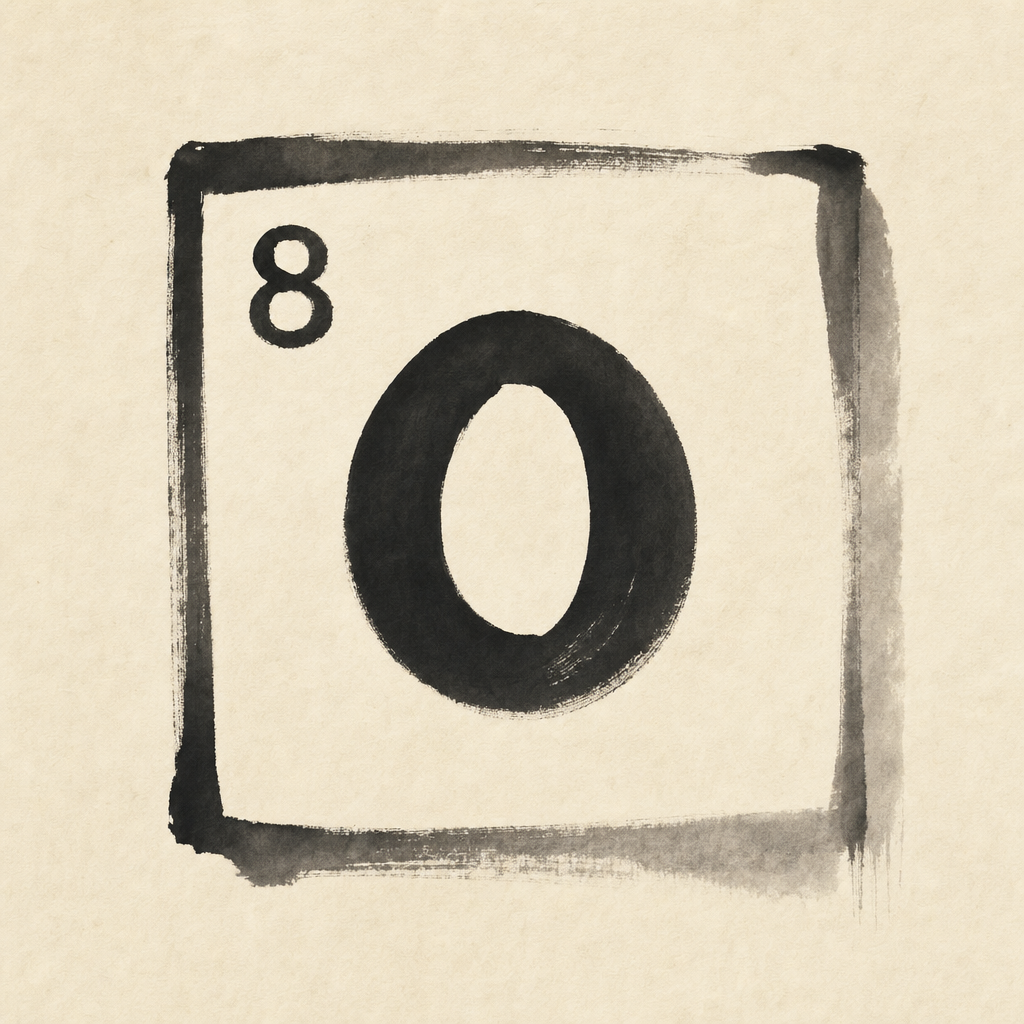
The Periodic Law
- Periods across, groups downnot yet tested
- Closed shells, repeating chemistrynot yet tested
- Latin-rooted element symbolsnot yet tested
- Proton count defines the elementnot yet tested
In 1869, the Russian chemist Dmitri Mendeleev arranged the 63 known elements by atomic weight in a table — and noticed that chemical properties recurred periodically as atomic weight climbed. Others had glimpsed the same rhythm, but Mendeleev did something braver: he left gaps in the table where the pattern predicted elements should exist but had not yet been discovered, and — in the act that turned a tidy chart into a falsifiable theory — predicted their properties in detail, naming the missing entries eka-aluminium and eka-silicon after the elements above them. Gallium was discovered in 1875, scandium in 1879, germanium in 1886, each matching Mendeleev's forecasts of weight, density, and oxide chemistry with eerie precision. The empty cells had been filled exactly as foretold; the periodic table was vindicated as a deep regularity of nature, and chemistry had its first organizing principle.
The reason the table works was not understood until quantum mechanics in the 1920s. Elements have shells of electrons; the chemistry is dominated by the outermost (valence) electrons; new shells start at predictable atomic numbers, producing the periodic structure. Periodicity, in other words, is not a numerical coincidence but the visible trace of a recurring electronic architecture — every so often, as electrons fill in, the outer arrangement repeats, and with it the element's chemical character. The columns of the table reflect similar valence-electron configurations: the alkali metals (column 1) all have one loose s-electron, the noble gases all have a closed shell — which is precisely why a group shares its reactions, its valences, its family resemblance, with lithium, sodium, and potassium all reacting violently with water for the same structural reason. The Pauli exclusion principle, the aufbau principle, and the quantum numbers governing electron orbitals all conspire to give the table its specific shape — eight columns in the main groups, ten in the d-block transition metals, fourteen in the f-block lanthanides and actinides. The modern table is organized by atomic number (proton count), not atomic weight, after Henry Moseley's 1913 X-ray work; ordering by mass had produced stubborn anomalies — pairs like tellurium and iodine sitting in the wrong order — and Moseley's spectra showed that the true ordinate was the nuclear charge, which fixed them at a stroke and revealed exactly how many elements remained to be found. Element synthesis then extended the table beyond the 92 naturally occurring elements (uranium being the heaviest) into the transuranic actinides (neptunium, plutonium, americium, etc.) and now into superheavy elements with atomic numbers above 100 — most of which exist only for milliseconds before decaying. The current table extends to element 118 (oganesson, named for Yuri Oganessian, one of the few people to have an element named after them in their lifetime).