The Opium Wars
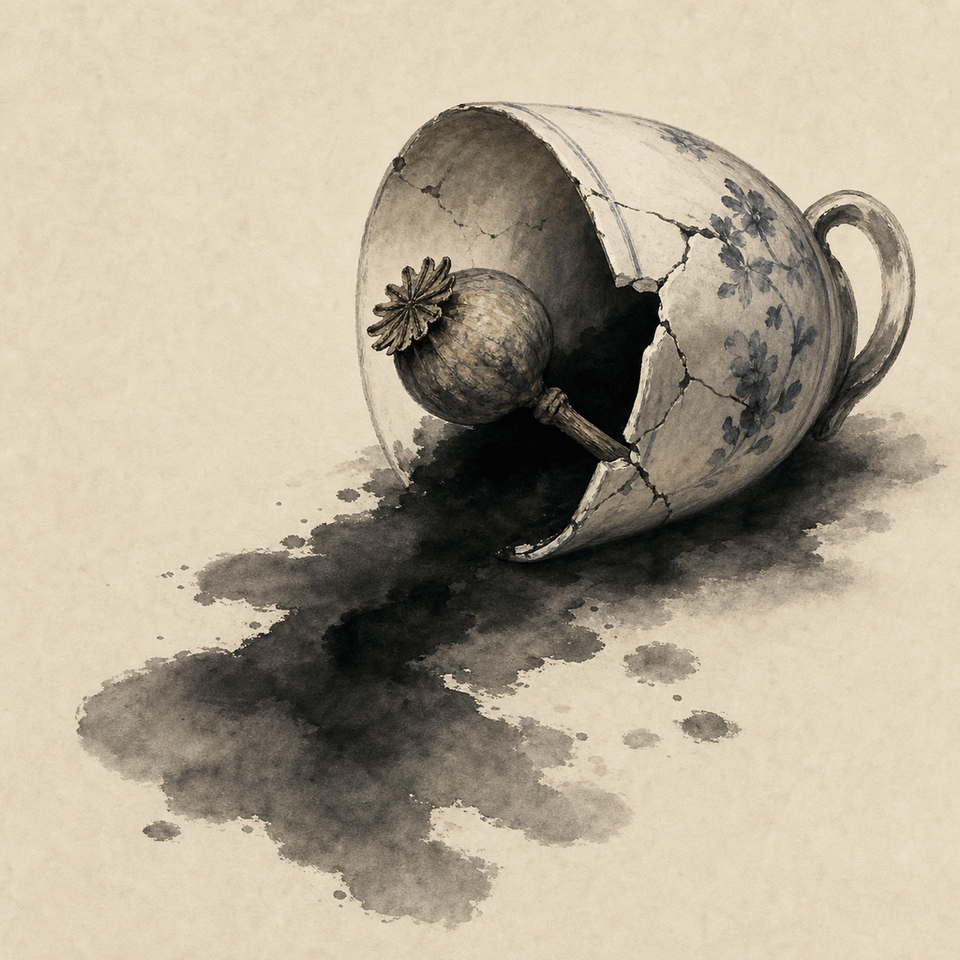
By the 1830s, the British East India Company had a problem. Britain wanted Chinese tea, silk, and porcelain. China, under the Qing, wanted very little Britain produced and confined all trade to the single port of Canton, demanding payment in silver. The drain of silver was unsustainable. The Company's solution was to grow opium in India and smuggle it into China, exchanging the addictive drug for the silver they needed to buy tea. By 1839, China had millions of addicts, a hemorrhaging treasury, and a Confucian state that decided to stop the trade: the commissioner Lin Zexu seized and destroyed some 1,200 tons of opium at Canton. Britain went to war to defend its drug-trafficking operation.
Britain won the First Opium War (1839–42) easily — Chinese coastal forts and war-junks had no answer to the Royal Navy's steam-powered gunboats, the iron-hulled Nemesis foremost among them, which could steam up rivers against wind and current to strike the Grand Canal and choke Beijing's grain supply. The resulting Treaty of Nanking forced China to open five treaty ports to British trade, pay a 21-million-silver-dollar indemnity, cede Hong Kong, and fix its own tariffs by treaty; a supplementary treaty the following year added extraterritoriality — that British subjects in China would be tried under British rather than Chinese law. The Second Opium War (1856–60), joined by France, extended these unequal treaties, opened more ports, legalized the opium trade outright, won foreign legations in Beijing, and added the burning of the Old Summer Palace by Anglo-French troops as a punctuation mark. The treaties became a template the United States, Russia, and later Japan all extracted in turn. China called the period that followed the Century of Humiliation — about a hundred years in which the world's largest, oldest civilization was forced to accept its own subordination, lost wars to upstart Japan, ceded territory and railway concessions, was carved into spheres of influence, and watched its political system collapse under the cumulative pressure — through the Taiping catastrophe and the Boxer rising — ending the Qing dynasty in 1911. The Communists who took power in 1949 explicitly framed their revolution as ending the Century of Humiliation.