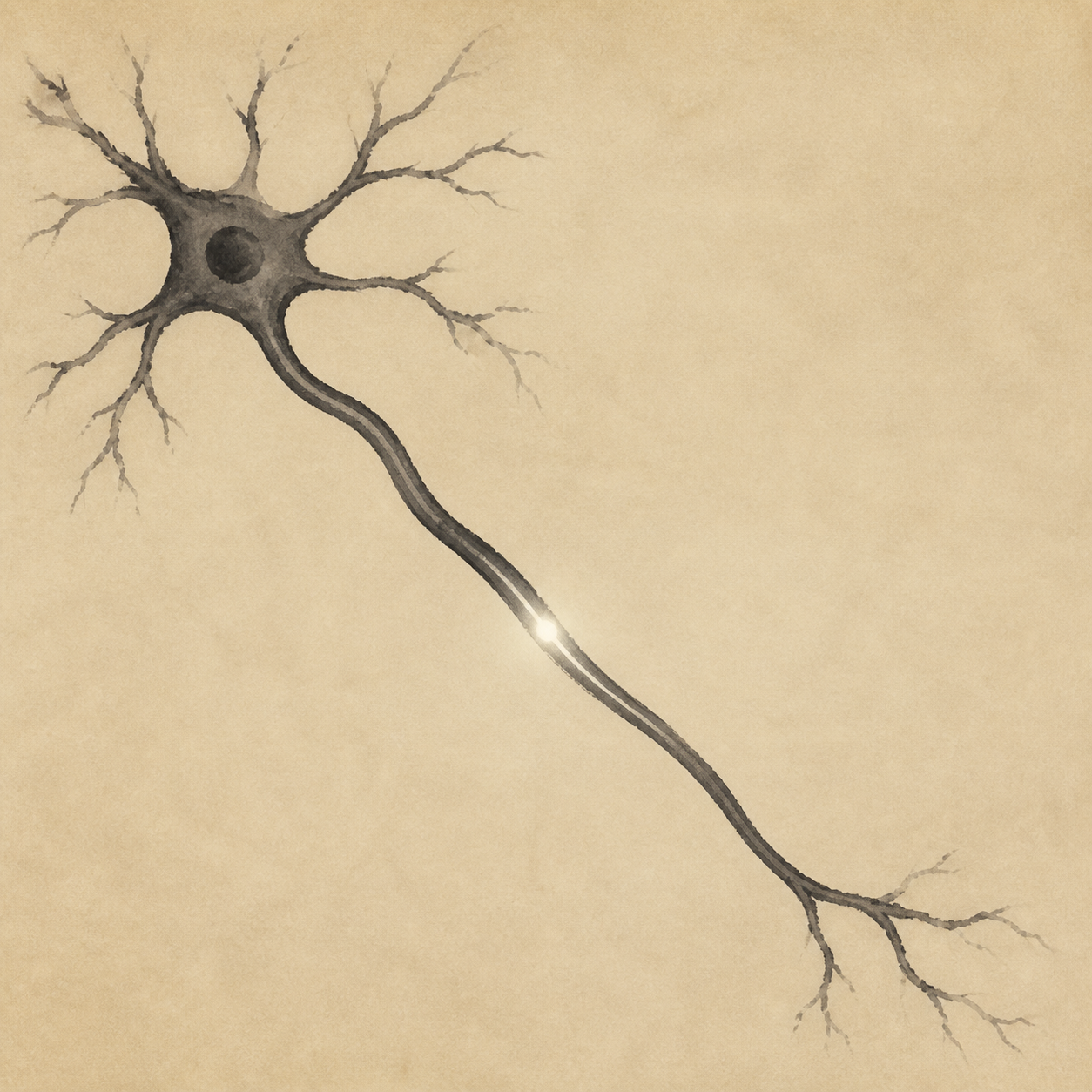
The Neuron & Action Potential
- Neuron anatomy (axon, dendrites, soma)not yet tested
- Resting membrane potential (~ -70 mV)not yet tested
- Action potential & Na⁺ depolarisationnot yet tested
- Synaptic transmission & neurotransmittersnot yet tested
Around 1780, the Italian physician Luigi Galvani noticed that the leg of a dissected frog twitched when touched by two different metals. He concluded that biological tissue contained animal electricity. His contemporary Alessandro Volta disagreed and built the first battery to prove the electricity was in the metals, not the frog. Both were partly right. By the 1850s, Hermann von Helmholtz had measured the propagation speed of a nerve impulse (~30 m/s, far slower than copper-wire electricity). By the 1880s, Santiago Ramón y Cajal — drawing the brain by hand under a microscope, using the Golgi silver-staining method — had established that the nervous system was not a continuous reticulum but a network of discrete cells, the neurons. The neuron doctrine is the foundation on which all modern neuroscience rests.
A neuron is a specialized cell that receives, integrates, and transmits electrical-chemical signals. Its anatomy: a cell body (soma) containing the nucleus; dendrites (branched processes that receive input); a single axon (the output process, millimeters to over a meter long); and axon terminals that contact other neurons at synapses. The neuron's interior is held at roughly −70 mV relative to its exterior at rest, maintained by ion pumps (sodium-potassium ATPase) and selective ion channels. The resting potential arises because the membrane is more permeable to potassium than to sodium. Synaptic input on dendrites depolarizes the membrane locally; these potentials summate as they spread to the axon hillock, the integration zone. If the summed depolarization exceeds threshold (~ −55 mV), voltage-gated sodium channels open, sodium rushes in, and the membrane potential rapidly reverses to roughly +30 mV — the action potential, lasting about 1 millisecond. Repolarization: voltage-gated potassium channels open and the membrane returns to rest, with a brief refractory period before another spike can fire. The action potential travels at ~1 m/s in unmyelinated axons and up to ~120 m/s in myelinated ones (skipping between nodes of Ranvier in saltatory conduction). Hodgkin and Huxley (1952, Nobel 1963) worked out the underlying mathematics in giant squid axons — a system of differential equations for the conductances of sodium and potassium channels that predicts the action potential's shape with extraordinary precision. The action potential is all-or-nothing: any suprathreshold input produces a full-amplitude spike. Information in the nervous system is encoded primarily in which neurons fire, when, and at what rate. The brain has roughly 86 billion neurons, each averaging on the order of 10,000 synaptic connections — yielding trillions of synaptic contacts.