The Neolithic Package
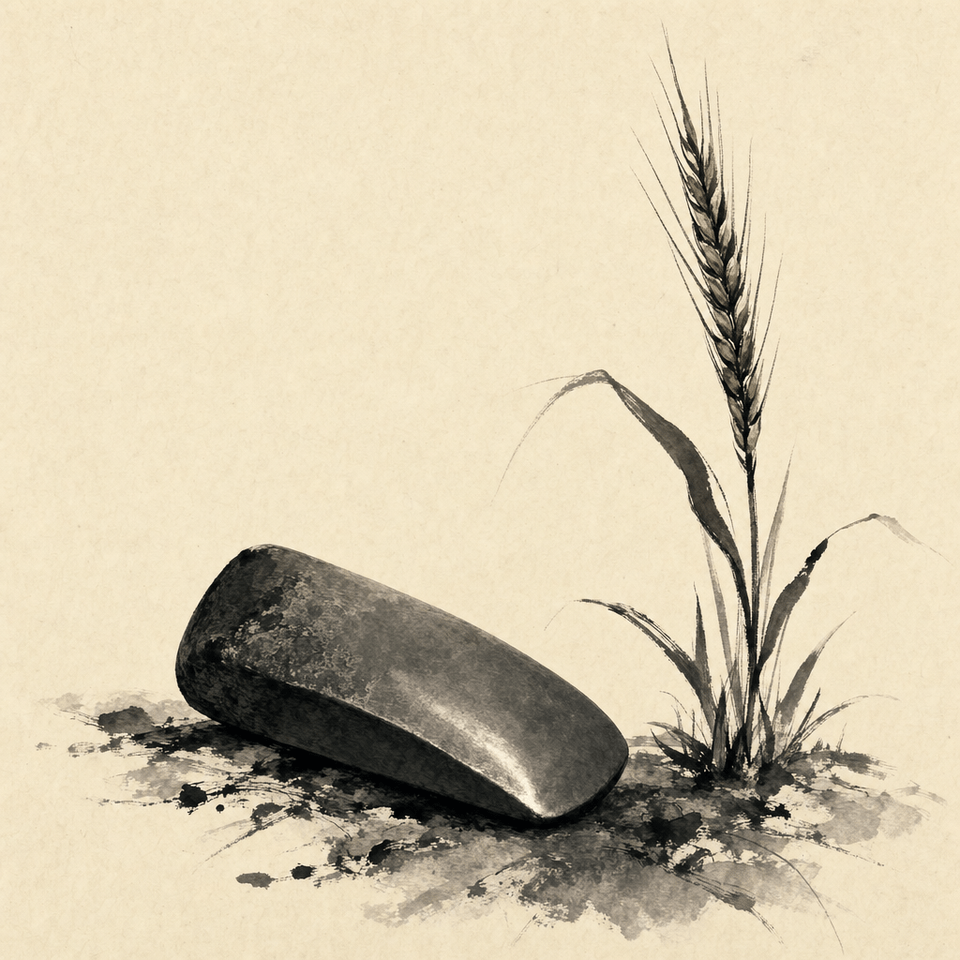
When archaeologists excavate a site from the early Neolithic — almost anywhere on the planet — they tend to find roughly the same kit. Cereal or pseudo-cereal grains. Domesticated livestock. Polished stone axes, ground rather than chipped. Fired pottery. Permanent mud-brick or timber dwellings. Storage pits sunk into the floor. Some trace of spindle-whorls or loom weights for weaving. The same package appears, with local variations, in the Levant around 9500 BCE, in highland Mexico, in the Yangtze valley, in the New Guinea highlands at Kuk Swamp. Crucially, it was invented several times independently, by people separated by oceans and thousands of years who had no possible contact with one another — and who could not have copied a method none of them had yet seen.
This is one of the small set of facts that should make a person take convergent evolution in human culture seriously. Different populations, facing similar pressures and similar opportunities after the last ice age, arrived at strikingly similar bundles of solutions. The Neolithic package was not a single invention diffusing outward from one Near Eastern hearth, the way nineteenth-century scholars assumed; it was the human response to the post-glacial climate — a warmer, wetter, more stable Holocene that suddenly made dense stands of harvestable grasses possible — assembled from whichever local plants and animals happened to be domesticable. In the Old World it was wheat, barley, sheep, goats, cattle. In Mesoamerica it was maize, beans, squash, turkey. In China it was rice in the south, millet in the north, and the pig. The Andes added the potato, quinoa, and the llama. What recurs is not the species but the structure — a starchy staple for calories, a protein animal for fat and labour, storage to bridge the lean season, ground stone to process the harvest, fired clay to cook and contain it. Each element answers a need the others create: a starchy surplus must be stored, stored grain must be cooked, cooking needs vessels, vessels need clay. The bundle is so consistent that it functions almost as a signature of a society approaching agricultural takeoff, whatever the continent, and it tends to drag the same social consequences — sedentism, surplus, hierarchy — in its wake.