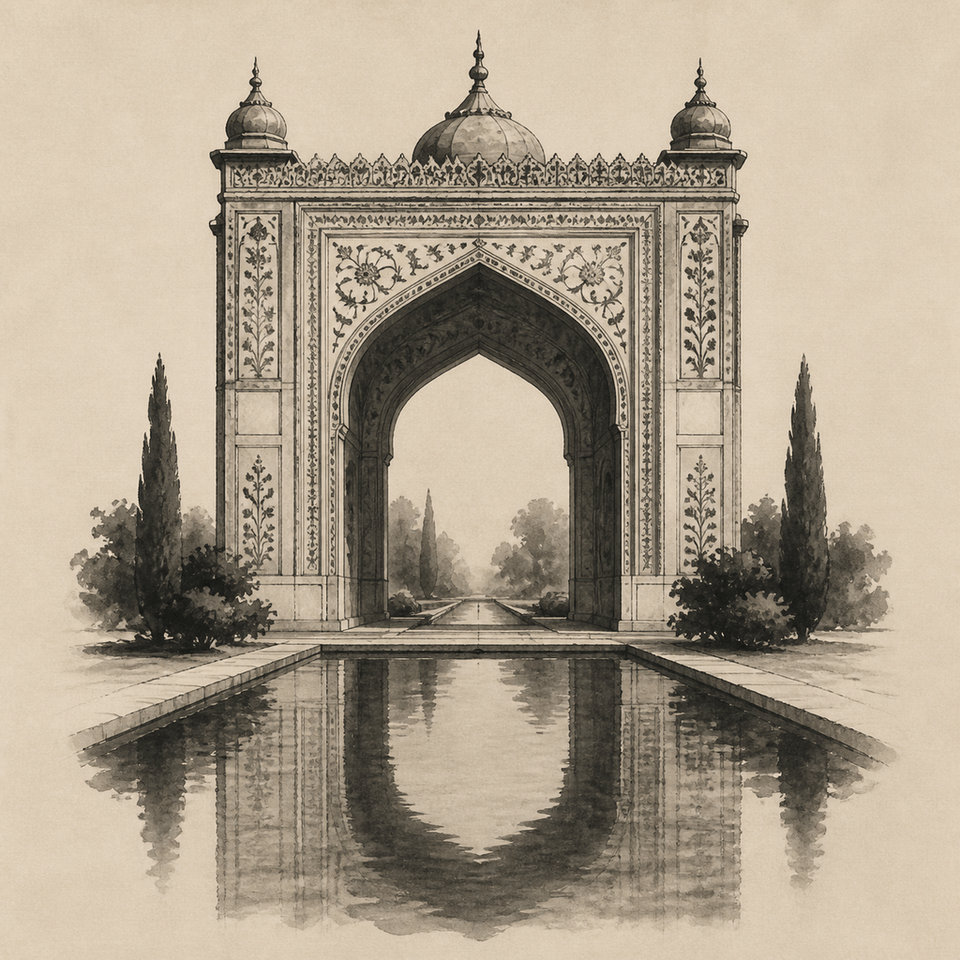
The Mughal Empire
Babur, a descendant of both Genghis Khan and Tamerlane, invaded northern India in 1526 with an army of perhaps 12,000 men and a small artillery train, and at the First Battle of Panipat used field guns and disciplined cavalry to shatter the far larger army of the Sultan of Delhi. The dynasty he founded — the Mughals — governed much of the Indian subcontinent for the next two centuries and reached its greatest territorial extent under Aurangzeb. One influential reconstruction assigns India about 24 percent of world output in 1700, an uncertain aggregate estimate rather than a measure of imperial revenue or living standards. Indian cottons were major exports across Asian, African, and European markets.
The Mughals are the canonical case of a foreign Muslim dynasty governing a Hindu majority — and largely doing so, in their best phases, by strategic accommodation rather than imposition. Akbar (r. 1556–1605), the third emperor and arguably the most consequential, abolished the jizya tax on non-Muslims, married Rajput princesses and folded their kin into the nobility, and built a meritocratic administrative system — the mansabdari ranking of officials, paid from assigned land revenue — that bound a diverse elite to the throne. He sponsored interfaith debates in his House of Worship between Muslims, Hindus, Jains, Christians, and Zoroastrians, and tried to establish an ecumenical Divine Faith (Din-i-Ilahi) centred on the emperor. His successors built the Taj Mahal — Shah Jahan's tomb for Mumtaz Mahal — the Red Fort, and a Persianate court culture that fused Persian, Turkic, and Indian elements into something neither Persian nor Indian alone, including the Urdu language itself. The decline came under Aurangzeb (r. 1658–1707), who reimposed the jizya, reversed Akbar's tolerant policies, and expanded the empire to its largest extent through decades of ruinous Deccan wars against the rising Hindu Maratha confederacy — wars that bankrupted the treasury, broke the army, and left the realm politically fractured. After his death regional governors and the Marathas carved out de facto independence; the Persian conqueror Nader Shah sacked Delhi in 1739 and carried off the Peacock Throne. By the time the British East India Company won at Plassey in 1757, the Mughal emperor was a figurehead in a Delhi others controlled.