The Mole & Stoichiometry
- Avogadro's number, ~6.022×10²³ per molenot yet tested
- Molar mass, water at 18 g/molnot yet tested
- Balanced equations and the mole bridgenot yet tested
In 1811 an Italian physicist, Amedeo Avogadro, proposed that equal volumes of any two gases, at the same temperature and pressure, hold the same number of molecules. He was right, and almost no one listened for half a century — until Stanislao Cannizzaro revived the idea at the first international chemistry congress in 1860 and used it to settle the era's basic confusions, like whether water was HO or H₂O. The number that now carries Avogadro's name, about 6.022 × 10²³, is vast beyond any intuition, and it does one indispensable job: it ties the world of single atoms, where reactions actually happen, to the world of grams on a balance, where chemists actually work.
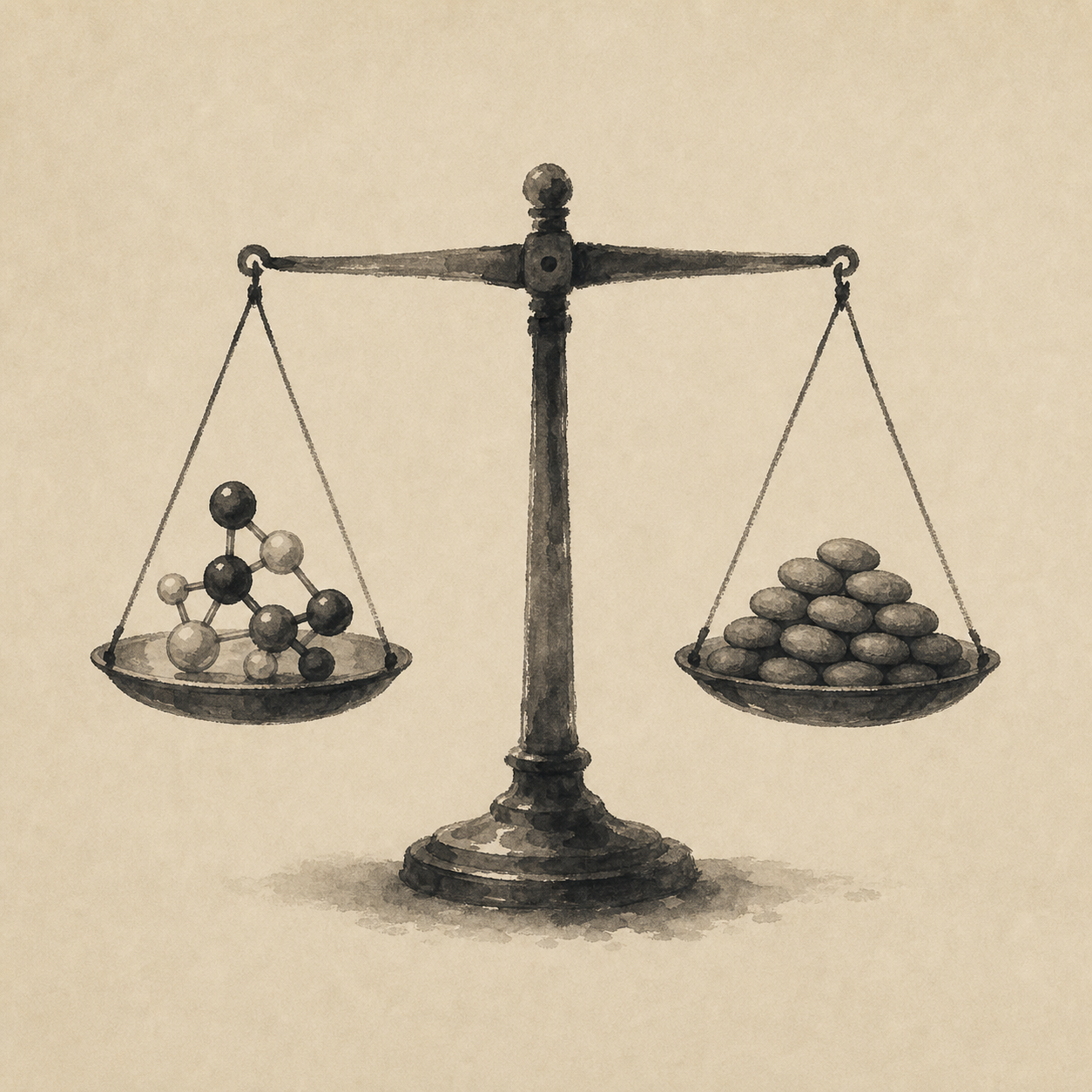
That tie is the mole, and it is best understood as a bridge. A single atom is far too small to weigh; a gram of anything holds unimaginably many of them. The mole simply names a specific, gigantic count — Avogadro's number of things — chosen so that the count becomes weighable: one mole of carbon-12 weighs twelve grams — the definition until 2019, when the SI fixed Avogadro's number itself and left the twelve grams merely (and for any bench, exactly) right, and from that one anchor every element's molar mass follows, a mole of water coming out to about eighteen grams, roughly a tablespoon. The reason for picking so peculiar a number is that it makes a chemical equation literally true as a recipe. When we write that two hydrogen molecules and one of oxygen make two of water, the same line read in moles becomes four grams of hydrogen plus thirty-two of oxygen yielding thirty-six grams of water — a prediction you can check on a scale, and it holds every time. Everything chemists call stoichiometry is just bookkeeping across this bridge: working out which ingredient runs out first and so caps the yield, or how much product a reaction ought to give in an ideal world against the messier amount it really delivers. Before Cannizzaro forced the profession to agree on how to count, chemists could not even agree on molecular formulas, and quantitative chemistry was impossible; the moment one mole meant one fixed number of particles, atomic weights, formulas, and reaction yields all snapped into place together.