The Microbiome
- 38 trillion microbial cells as a quasi-organnot yet tested
- Sequencing the unculturable 99% of gut microbesnot yet tested
- Fermenting carbs, training immunity, gut-brain axisnot yet tested
- Correlation, causation, and fecal transplantsnot yet tested
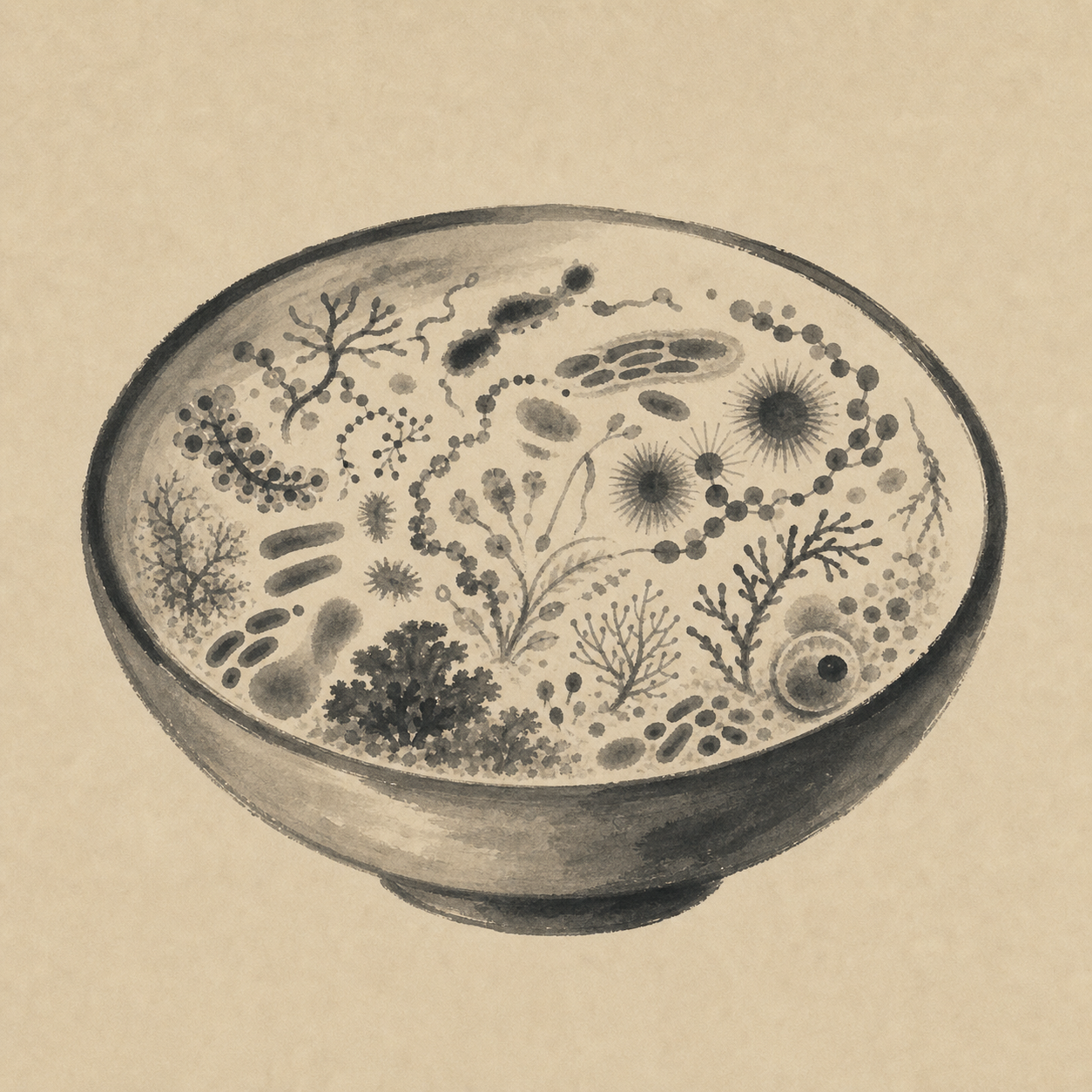
You are not one organism. You are a holobiont — a body comprising your own ~30 trillion human cells and about 38 trillion microbial cells (bacteria, archaea, fungi, protists), most in your gut, with smaller communities on your skin, in your mouth, in your respiratory tract. Until about 2005 this microbial portion of you was largely invisible to science: most gut microbes don't grow on standard culture media, so traditional microbiology missed about 80% of them. Metagenomic sequencing — sequencing all the DNA in a sample without first culturing the organisms — changed everything. The NIH Human Microbiome Project (2007–2016) and the European MetaHIT project sequenced thousands of samples and revealed an ecosystem inside the body that affects metabolism, immunity, mood, neurodegeneration, and possibly aging.
The gut microbiome — the most-studied component of the larger ecosystem — contains roughly a thousand bacterial species across humans — a few hundred in any one gut —, dominated by the Bacteroidetes and Firmicutes phyla and shaped over a lifetime by diet, mode of birth, antibiotic exposure, and geography. What it does for its host is best appreciated by removing it: germ-free mice raised without any microbiota have stunted immune systems, exaggerated allergic responses, and metabolic profiles that drift in characteristic ways; reintroduce a normal gut community and most defects disappear. The microbiome digests complex carbohydrates that human enzymes can't touch (about a tenth of human caloric intake comes from microbial fermentation in the colon), synthesizes vitamins the host doesn't make, trains the immune system to distinguish friend from foe, blocks colonization by pathogens, and produces short-chain fatty acids that nourish the gut wall and signal systemically. The gut-brain axis links it to mood and cognition through the vagus nerve, immune mediators, and microbial metabolites. Functionally it behaves less like a passive passenger and more like a quasi-organ made of someone else's cells.
The public excitement runs ahead of the science, and the gap is mostly causal. Disease associations are easy to find — dysbiosis correlates with inflammatory bowel disease, metabolic disease, several cancers, and a growing list of neuropsychiatric conditions — but whether the altered community causes the disease, results from it, or descends with it from a shared upstream factor is unsettled in most cases. The cleanest causal claim is also the most therapeutically useful: fecal microbiota transplant cures recurrent Clostridioides difficile infection at success rates around ninety percent, and the FDA approved the first standardized FMT products in 2022 and 2023. Connections to depression and autism through the gut-brain axis remain largely conjectural.