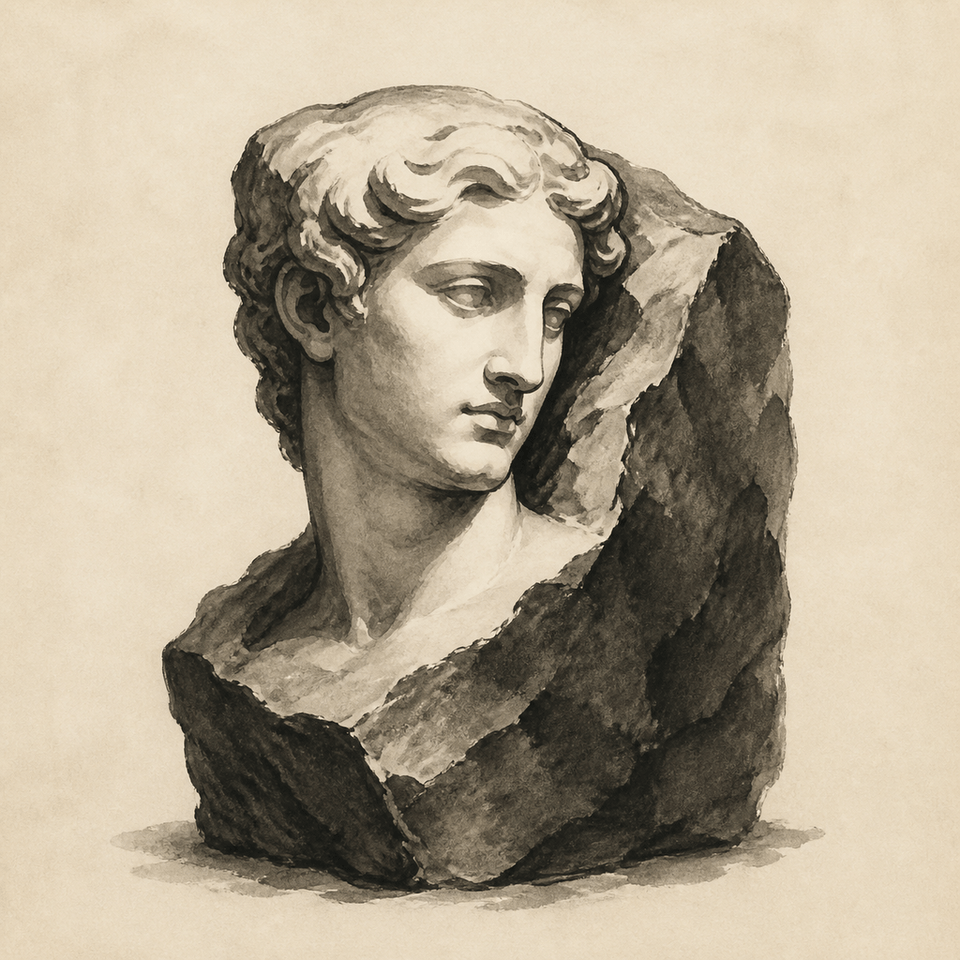
The Italian Renaissance
Between roughly 1400 and 1600, in a handful of north Italian cities — Florence, Venice, Milan, Rome — a few thousand people produced an outsized share of the visual art, political thought, scientific observation, and literary innovation of the next half-millennium. Brunelleschi's dome, raised over Florence's cathedral in 1436 without centering. Leonardo's notebooks. Michelangelo's Sistine ceiling. Machiavelli's prince. The Medici bank, financing it all. Vesalius's anatomy, dissecting the human body as the church looked away. Copernicus, schooled in the Italian universities at Bologna and Padua, drafting heliocentrism in distant Prussia. The cliché is that this was a rebirth of antiquity. The reality is more interesting, and more useful, because what actually happened was not recovery at all.
What the Italians actually did was combine recovered classical learning — much of it transmitted through Arabic intermediaries, and accelerated after 1453 when Greek scholars fled the fall of Constantinople carrying manuscripts Latin Europe had never seen — with the working civic culture of independent city-states, the wealth of Mediterranean trade, the technical confidence of late medieval craftsmen, and the new printing press. The result was not a return to antiquity but a new synthesis that took itself, with characteristic Italian self-confidence, to be a return to antiquity. It produced the modern idea of the artist (signed works, individual genius, mechanical perspective codified by Alberti in 1435), the modern idea of the diplomat (resident embassies, balance of power, pioneered among the Italian states and exported across Europe), and the modern idea of secular civic excellence — the belief that human achievement in this world deserves serious cultivation, not just patient endurance until the next. The money mattered as much as the manuscripts: Florentine wool and banking fortunes, and the rivalry between patrons like the Medici and the popes who hired Michelangelo and Raphael away from each other, turned culture into a status competition that bid up the price of genius. The political instability of the peninsula — perpetually squabbling city-states, overrun after the French invasion of 1494 and broken by the 1527 Sack of Rome — was simultaneously the engine of the flowering and what brought it down. By 1600 the centre of gravity had moved north, to the Atlantic powers the Italians had taught.