The Islamic Golden Age
From roughly 750 to 1258 CE, while Latin Europe could not read most of its own classical past, the centre of world scholarship was the Islamic world. Baghdad's House of Wisdom, fostered by the Abbasid caliphs al-Mansur, Harun al-Rashid, and al-Ma'mun, ran a sustained, state-funded translation movement that turned Greek, Persian, Indian, and Syrian texts into Arabic — and then built on them. Córdoba's caliphal library reportedly held 400,000 volumes when the largest Christian library in Europe held perhaps 600, and the city had paved, lamp-lit streets while Paris was mud. Cairo, Damascus, Bukhara, and Samarkand were each, at their peak, intellectual capitals drawing scholars across three continents.
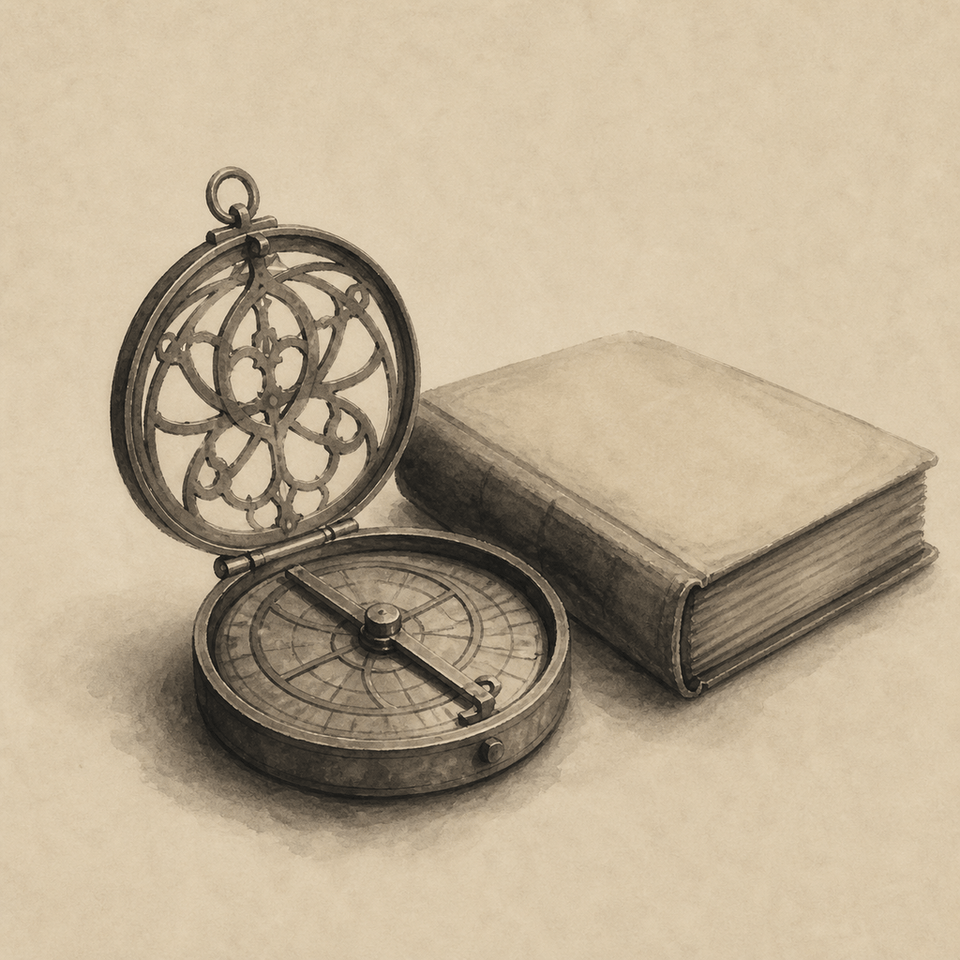
The achievements of the Islamic Golden Age are often listed in the West and just as often forgotten. Algebra — the word is Arabic, al-jabr, "the reunion of broken parts" — was systematized around 820 by al-Khwarizmi at al-Ma'mun's court, whose Latinized name gives us algorithm. The decimal place-value system, with its Indian-derived numerals and the crucial zero, reached Europe through Arab mathematicians, which is why we call them Arabic numerals. Optics was put on an experimental footing by Ibn al-Haytham in eleventh-century Cairo, six hundred years before Newton, with controlled experiments on light, lenses, and the camera obscura, and an insistence that a claim must be tested, not merely reasoned to. Medicine: Avicenna's Canon, written around 1025, was the standard medical textbook in European universities until the seventeenth century; al-Razi had already distinguished smallpox from measles a century earlier. Philosophy: Averroes' commentaries on Aristotle were so influential among the schoolmen that Aquinas's contemporaries simply called him the Commentator. The astrolabe, the basis of Renaissance navigation, was an Arab refinement; the words zenith, nadir, algebra, and alchemy are all Arabic loans, as are sugar, cotton, and cheque. Most of what made the European Renaissance possible was material the Arabs had preserved, translated, extended, and then transmitted west through the twelfth-century translation schools of Toledo and Norman Sicily — often via Jewish intermediaries fluent in both worlds. The collapse came with the Mongol sack of Baghdad in 1258, when the libraries are said to have stained the Tigris black with ink.