The Internet & Packet Switching
- The network of networks, and Wi-Finot yet tested
- IP addresses and the DNS lookupnot yet tested
- HTTP, HTML, and the URLnot yet tested
In 1964, Paul Baran at the RAND Corporation published a series of memos describing how to build a communications network that could survive a nuclear attack. The dominant communications technology of the era was circuit switching — when you placed a phone call, a continuous physical circuit was reserved end-to-end — but Baran proposed breaking each message into small pieces, sending each independently through whatever path was available, and reassembling them at the destination. The idea was independently developed by Donald Davies in the UK, who coined packet switching; in 1969 ARPA funded ARPANET, and in 1974 Vint Cerf and Robert Kahn published A Protocol for Packet Network Intercommunication, which became TCP/IP — the protocols every device on the modern internet still uses.
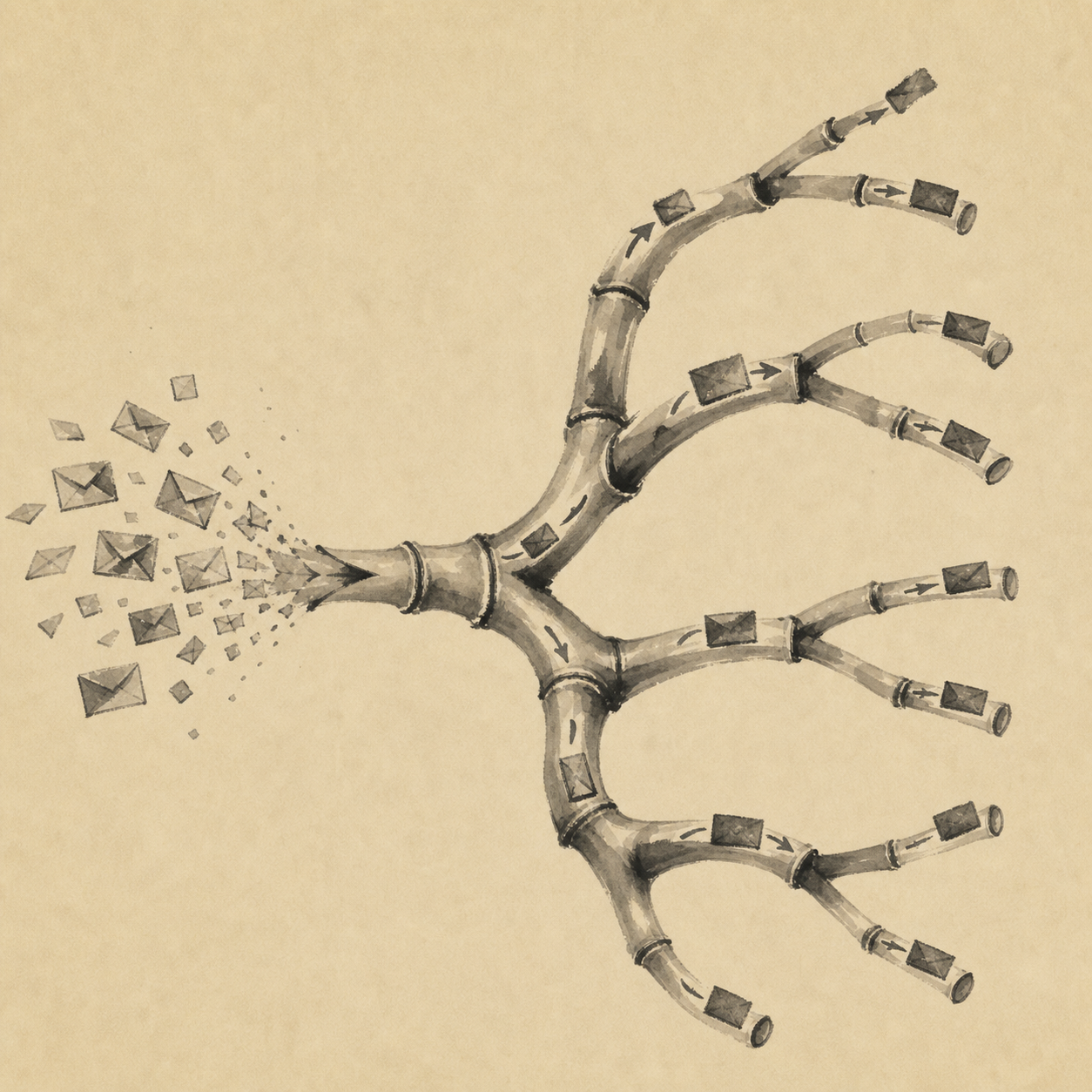
In packet switching, each message is broken into small packets labelled with source, destination, sequence number, and payload, and forwarded independently through the network — so the same conversation's packets may take different routes, may arrive out of order, may be lost entirely, and the receiver reassembles from what arrived. Packet switching won over circuit switching because of statistical multiplexing (many conversations share the same link), robustness (any node failure routes around itself), and the bursty nature of computer traffic. The internet's protocol layers are stacked: physical (cables, fibre, wireless); link (Ethernet, Wi-Fi); network (IP) for routing between any two devices; transport offering TCP for reliable ordered delivery and UDP for fast unreliable delivery; and application (HTTP, SMTP, DNS) — what user-visible programs speak. The end-to-end principle (Saltzer, Reed, Clark, 1984) says keep the network simple and put the intelligence at the endpoints — and this is why the internet has been able to absorb new applications (the web, video streaming, voice, video conferencing, IoT, AI) without major redesign, and why every attempt to build intelligence into the network is politically and architecturally controversial. DNS — the Domain Name System, designed by Paul Mockapetris in 1983 — translates human-readable names into IP addresses through a hierarchical, globally distributed system overseen by ICANN. There is no central authority that knows the full state of the network: routing is decentralized at every level, with each router maintaining its own table and forwarding packets toward their destination on local information.