The Indus Valley
Between roughly 2600 and 1900 BCE, a civilization flourished along the Indus River and its tributaries — covering an area larger than ancient Egypt and Mesopotamia combined, with cities of perhaps 60,000 people, standardized weights and measures, advanced sewerage, and a script that we still cannot read. The two largest sites, Mohenjo-daro and Harappa, were laid out on grids, with covered drains running down brick-lined streets, public baths, and granaries, and conspicuously no royal palaces, no obvious temples, and no monumental military art. Their fired-brick houses were so uniform in size and standard that the whole civilization looks, from the air, less like a kingdom than like a vast committee decision. Whoever ran these cities chose not to celebrate themselves in stone — which is precisely why they have almost no face in our histories.
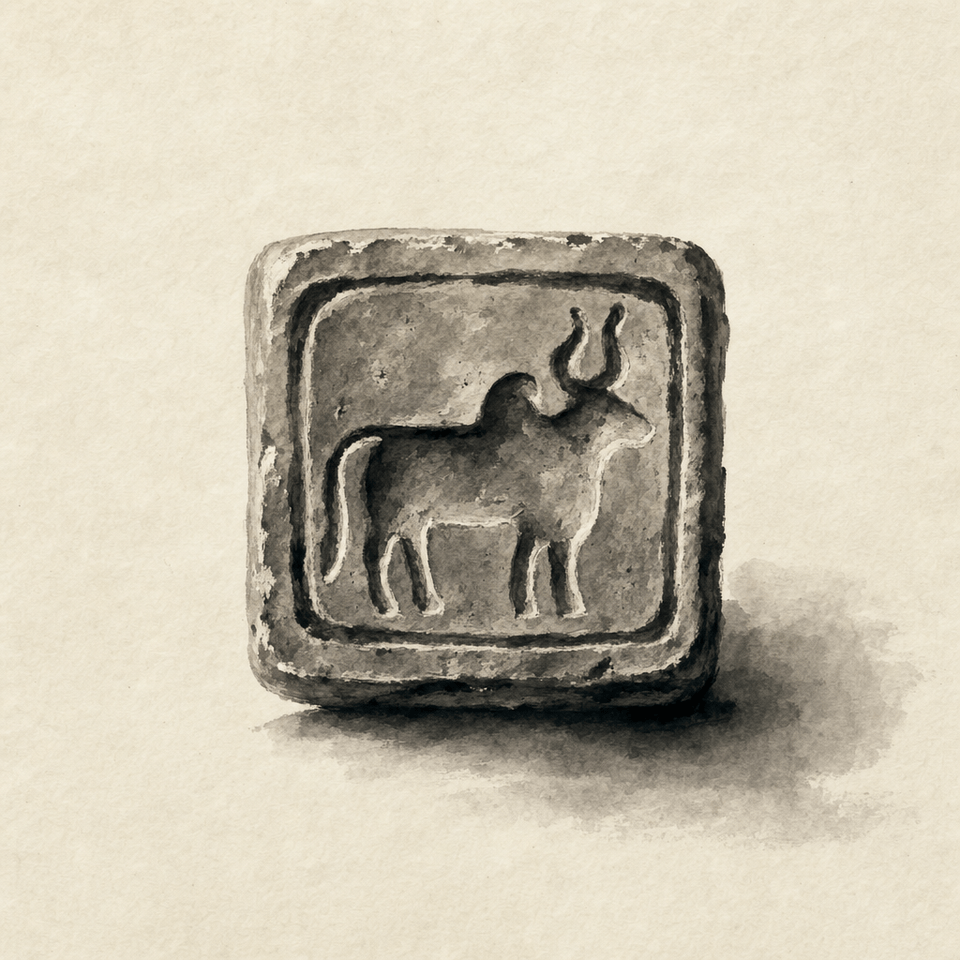
The Indus civilization is the great unsolved puzzle of early urbanism. It traded with Mesopotamia — Sargon of Akkad's inscriptions mention ships from Meluhha, almost certainly the Indus. It had an elaborate craft economy in carnelian beads, copper, and cotton (the world's earliest cultivated cotton), with bricks cut to a consistent 1:2:4 ratio across a thousand kilometres. It produced thousands of inscribed steatite seals — the script survives in roughly 4,000 examples — but the inscriptions average only five signs, the language is unknown, and the corpus may simply be too small and too short to ever crack, with no bilingual Rosetta in sight. Around 1900 BCE the cities were gradually abandoned. The cause is contested: a weakening summer monsoon, the drying and shifting of the Ghaggar-Hakra river system, climate stress that pushed populations east toward the Ganges, perhaps incoming Indo-Aryan speakers. The civilization left no clear successor, no surviving texts, and no remembered name for itself. We do not know what they called their kings, or whether — given the absence of palaces — they had any.