The Harmonic Oscillator
- Frequency, period, and the hertznot yet tested
- Pitch rises with frequencynot yet tested
- Wave speed, medium, and echoesnot yet tested
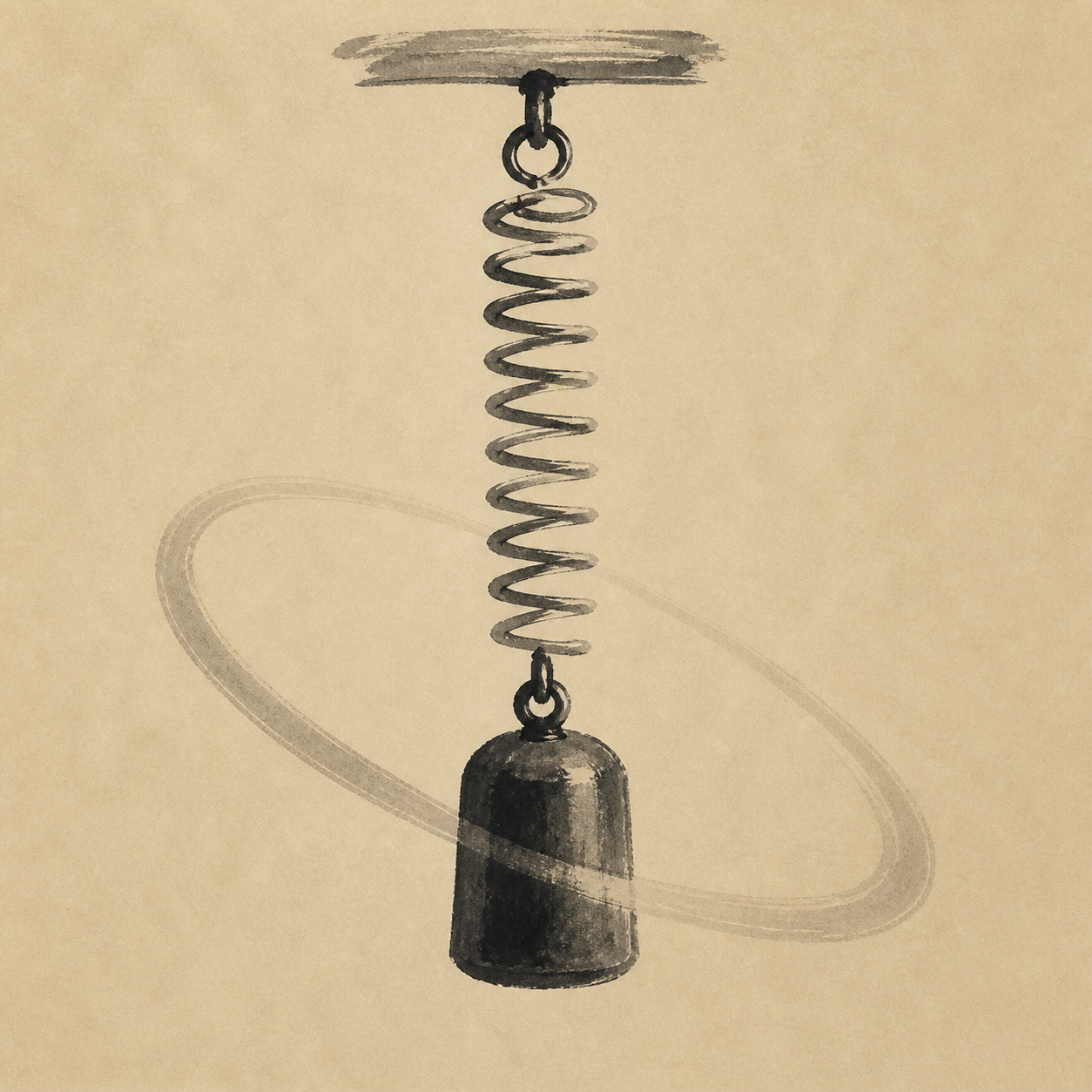
A mass on a spring is the simplest non-trivial mechanical system. Pull it from equilibrium, release it, and it oscillates back and forth in regular, predictable, sinusoidal motion. Galileo timed pendulums in the 1580s using his own pulse and noticed that the period was independent of amplitude. Robert Hooke published the linear restoring force F = −kx in 1676 as an anagram (ceiiinosssttuv), revealing the solution — ut tensio, sic vis — only in 1678, so he could establish priority without giving the result away. The deeper reason for the harmonic oscillator's ubiquity took two more centuries to articulate: every smooth potential, near a minimum, looks like a parabola; every system near equilibrium oscillates like a spring. The harmonic oscillator is the first non-trivial system in nearly every physics course because it is the first non-trivial system in nearly every physical situation.
The equation of motion is m·d²x/dt² = −k·x, where k > 0 is the spring constant and x is the displacement from equilibrium. The general solution is x(t) = A·cos(ωt + φ), where ω = √(k/m) is the angular frequency and A, φ are determined by initial conditions. The motion is periodic with period T = 2π/ω = 2π·√(m/k). Energy oscillates between kinetic and potential forms, with the total ½kA² constant. Damped oscillations: add friction (F_friction = −b·dx/dt); the equation becomes m·ẍ + b·ẋ + k·x = 0, with solutions that decay exponentially while oscillating. Driven oscillations: add a periodic forcing term and the system resonates at frequencies near ω₀, with amplitude inversely proportional to damping at exact resonance. Aeroelastic flutter — resonance's self-exciting cousin — brought down the Tacoma Narrows Bridge (1940); plain resonance is responsible for radio tuning, the way a child pumps a swing, and the destruction of wine glasses by sound at the right pitch. Coupled harmonic oscillators (multiple masses connected by springs) decompose into normal modes — independent oscillations at characteristic frequencies — by diagonalizing the coupling matrix. Continuous systems (vibrating strings, drumheads, sound waves in air, light in vacuum) are limits of infinitely-many coupled oscillators; their normal modes are the Fourier components that decompose any oscillation into a sum of sinusoids. Quantum harmonic oscillator: replace the classical equation with the Schrödinger version, and the energy levels become quantized — Eₙ = (n + ½)·ℏω for n = 0, 1, 2, …, including a zero-point energy of ½ℏω at the ground state. Quantum field theory treats every field as a continuum of harmonic oscillators, one per momentum mode, whose quantized excitations are the particles of the theory. The harmonic oscillator is the most-solved equation in physics — solved exactly in classical mechanics, exactly in quantum mechanics, exactly in quantum field theory, and approximately in nearly every regime where solutions are wanted.