The Greenhouse Effect & Radiative Balance
- 240 W/m² in, 255 K vs 288 K outnot yet tested
- Water vapor, CO₂, and methane as the absorbersnot yet tested
- Absorption bands and the rising emission altitudenot yet tested
- Warming per doubling of CO₂not yet tested
In 1859, the Irish physicist John Tyndall measured the infrared absorption of various atmospheric gases. Nitrogen and oxygen — the bulk of the atmosphere — were transparent to infrared, while water vapor, carbon dioxide, methane, and ozone, trace gases by volume, strongly absorbed it. Tyndall correctly inferred that changes in trace-gas concentrations would change Earth's climate. Thirty-seven years later, in 1896, the Swedish chemist Svante Arrhenius performed the first quantitative climate calculation, estimating that doubling CO₂ would warm Earth by 5–6 °C (he thought it would be a good thing for Sweden). His number was high but in the modern range (best estimate now ~3 °C per doubling), and the physics he used has not been overturned in a century.
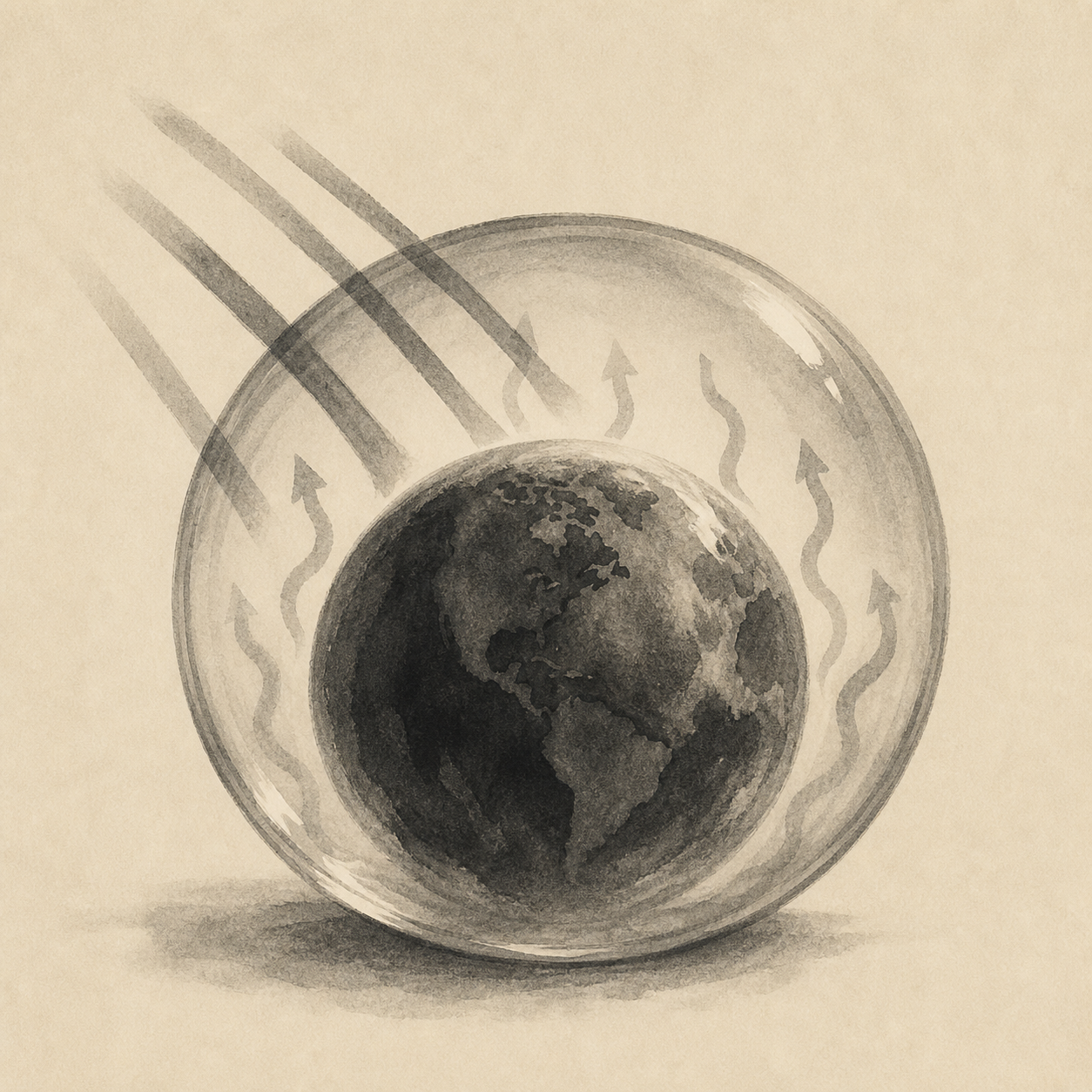
Earth receives roughly 340 W/m² of solar radiation averaged over its surface. About 30% is reflected by clouds, ice, and bright surfaces — Earth's albedo — and the remaining ~240 W/m² is absorbed and must be re-radiated to space as infrared. Without an atmosphere, the temperature required to radiate 240 W/m² by the Stefan-Boltzmann law is roughly 255 K, or −18 °C. Earth's actual surface temperature averages 288 K. The 33 °C difference is the natural greenhouse effect. Most outgoing infrared passes through the atmosphere unchanged, except in specific absorption bands where greenhouse-gas molecules absorb it and re-emit in random directions, with some sent back to the surface. Outgoing IR is delayed and redirected, so the surface must be warmer to radiate enough total IR to balance incoming sunlight. Water vapor is the largest single greenhouse contributor but with a residence time of about nine days cannot drive long-term change — it acts as a feedback via Clausius-Clapeyron (~7% per °C). Carbon dioxide is the dominant forcing gas, with a residence time of centuries to millennia; pre-industrial concentration was 280 ppm, 420 ppm by 2024, and still climbing. Methane is ~80× more potent than CO₂ per molecule on a 20-year horizon but residence-times out in ~12 years. Climate sensitivity — the equilibrium warming for a doubling of CO₂ — is the central uncertain number, with the IPCC AR6 likely range of 2.5–4 °C and most residual uncertainty in cloud feedbacks. The skeptic claim that CO₂ is saturated misunderstands the band physics: adding CO₂ pushes the effective emission altitude higher into colder air.