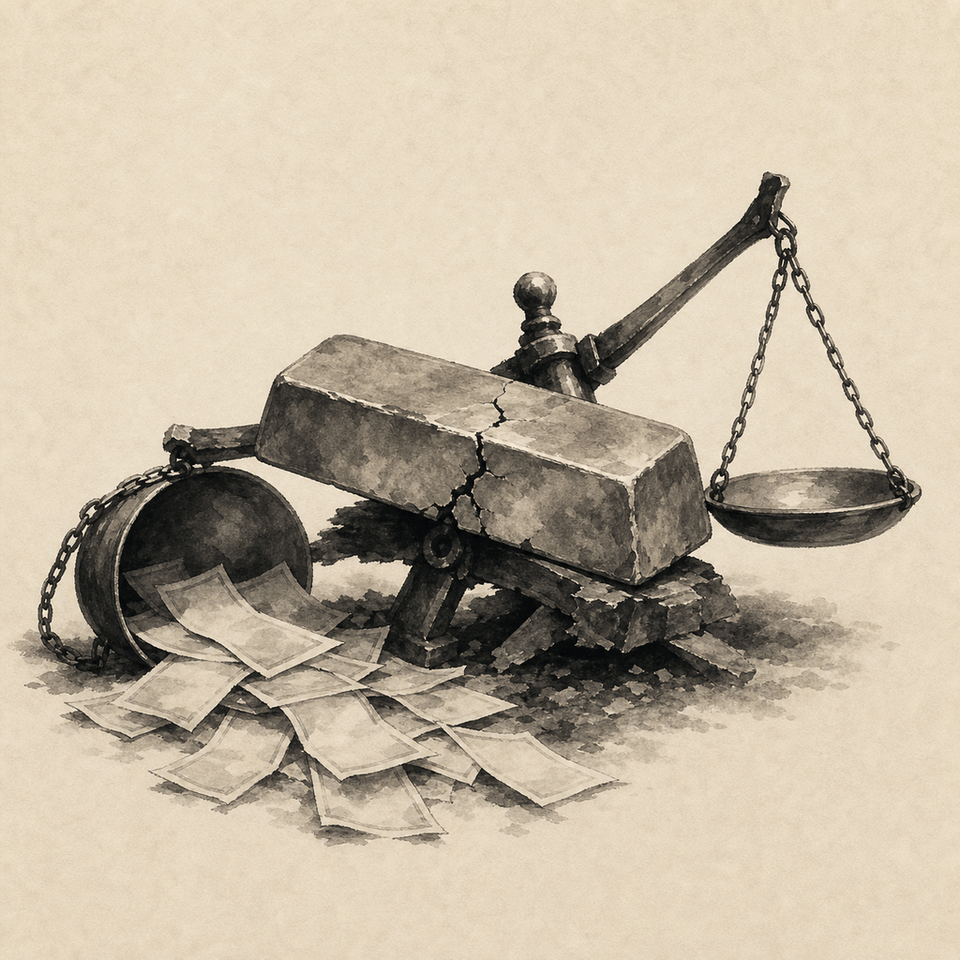
The Great Depression
On October 24, 1929 — Black Thursday — the New York stock market lost eleven percent of its value in a single morning, and the following week erased years of gains. By 1932, US industrial production had fallen by half, unemployment had reached 25 percent — one worker in four — and the global financial system had effectively unravelled. Banks failed in waves as panicked depositors pulled their savings; some nine thousand US banks went under. International trade collapsed by two-thirds. Germany, which had been recovering on American credit, was thrown into a political extremity that handed Hitler his majorities. Liberal capitalism, in 1932, did not look like the future of anything.
The Depression was not a normal recession; it was a structural failure of the post-WWI order. The gold standard, restored in the 1920s, transmitted contraction across borders without mercy: to defend their gold reserves, central banks raised interest rates into a collapsing economy — exactly the wrong medicine — and so exported the slump to one another. As the money supply shrank by roughly a third, prices fell year on year, and debt deflation set in: incomes dropped while debts stayed fixed, so farmers and businesses defaulted in cascades that pulled down the banks that had lent to them. Trade barriers, above all the American Smoot-Hawley tariff of 1930 and the retaliations it provoked, strangled what commerce remained. There was no IMF, no deposit insurance, no automatic stabilizers; when the system failed, governments mostly sat and watched, clinging to balanced budgets and sound money as the dogma told them to. Recovery, when it came, came from policies invented on the fly — and the countries that abandoned gold earliest recovered fastest: Britain left in 1931, the US in 1933. Roosevelt's New Deal, Keynesian deficit spending, the abandonment of gold, and ultimately rearmament pulled the economy up. Out of the catastrophe emerged the modern managed capitalist state — an activist central bank, deposit insurance, social security, and a regulatory apparatus whose entire purpose is to keep the next downturn from compounding into collapse. The Depression, in short, ended laissez-faire as a governing creed and made macroeconomic management a permanent function of government.