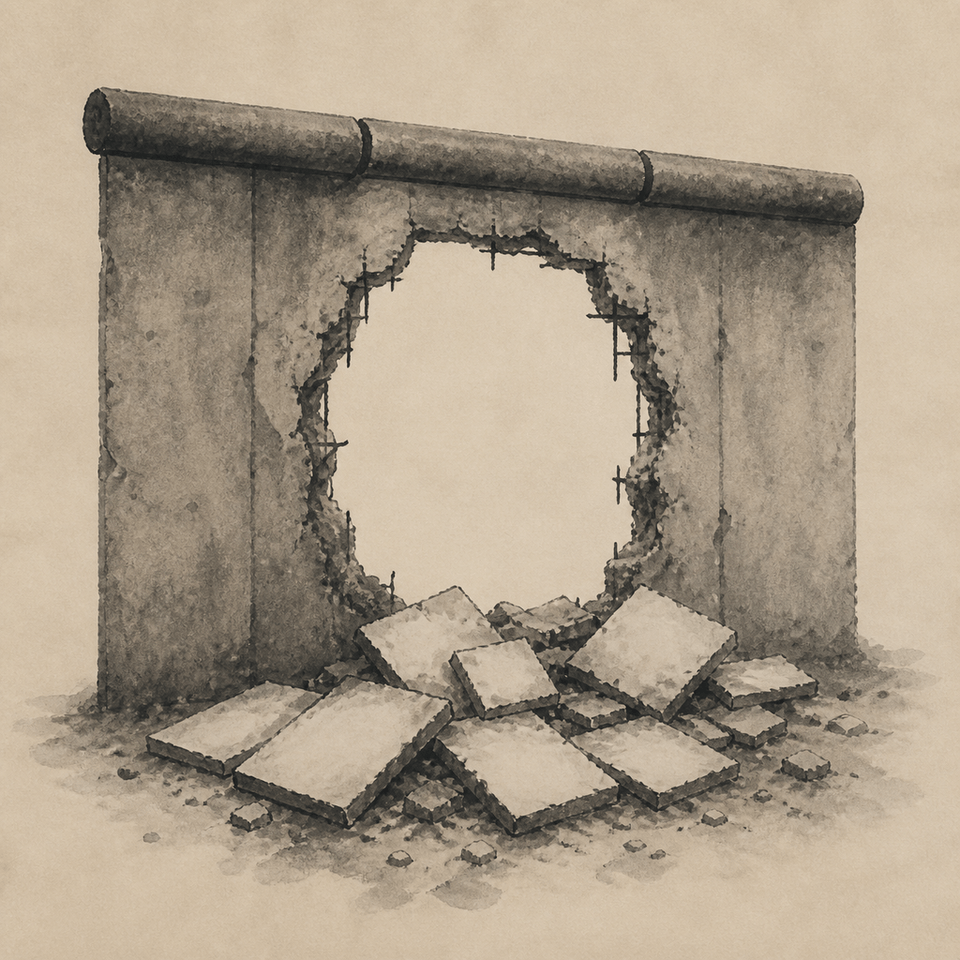
The Fall of the Wall
On the evening of November 9, 1989, an East German party spokesman named Günter Schabowski, fumbling answers at a routine press conference, mistakenly announced that travel restrictions to West Berlin had been lifted immediately — when the new rules were meant to take effect the next day, with paperwork. Berliners on both sides of the Wall heard him on live television, walked to the checkpoints, and demanded to be let through. Border guards at Bornholmer Straße, with no orders and no idea what to do, eventually raised the barriers. By morning, citizens were standing atop the Wall with hammers, taking it down piece by piece while the regime that built it looked on, paralyzed.
The fall of the Wall was the visible moment of a process that had been gathering speed for years and would accelerate after — set up by Gorbachev's glasnost and perestroika, and above all by his quiet abandonment of the Brezhnev Doctrine: Moscow would no longer send tanks to prop up its satellites. Once that guarantee was gone, the satellites unravelled. Poland's Solidarity won semi-free elections in June; Hungary cut its border fence with Austria that summer, opening a hole through which tens of thousands of East Germans fled west; and weekly Monday demonstrations in Leipzig swelled into the hundreds of thousands. Across 1989 and 1990, one Soviet-aligned Communist regime after another fell across eastern Europe — most peacefully, only Romania bloodily, with Ceaușescu executed on Christmas Day. Within two years the Soviet Union itself dissolved, by signature, without a war, after a failed hardliner coup against Gorbachev in August 1991 left Yeltsin and the republics in charge. Germany was reunified within eleven months, on October 3, 1990. The Warsaw Pact was disbanded. NATO then expanded eastward — which Moscow would later insist it had been verbally promised would not happen, a claim Western officials dispute and no binding document records. The United States was, briefly, the only superpower left standing, and Francis Fukuyama announced — with characteristic confidence — that liberal democracy was the end of history. Western intelligence had tracked the system's decay, but not the timing and speed of the cascade.