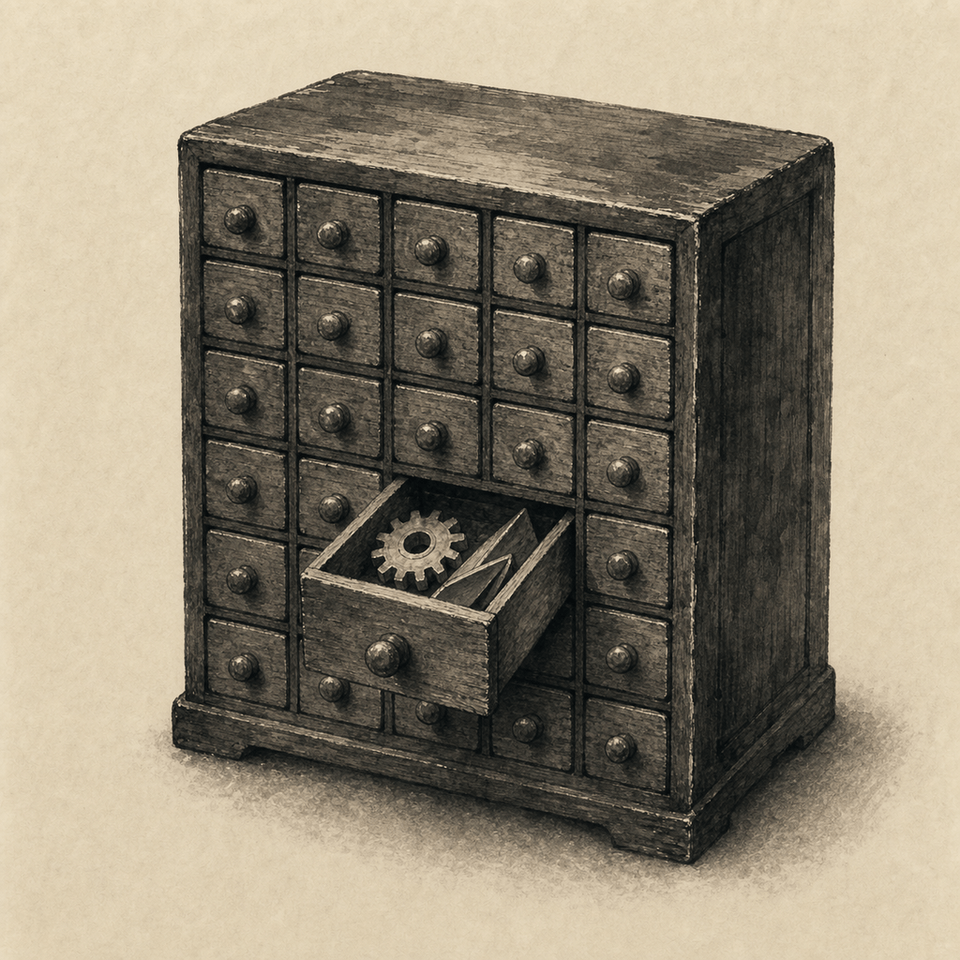
The Encyclopaedia
Between 1751 and 1772, two French editors — Denis Diderot and Jean d'Alembert — published seventeen folio volumes of text and eleven of engraved plates, totalling 71,818 articles by more than 140 contributors, with the explicit aim of gathering the entire knowledge of mankind into a single accessible reference. Voltaire, Rousseau, Montesquieu, and Quesnay wrote for it; d'Alembert quit in 1759 under the pressure, leaving Diderot to steer it nearly alone for thirteen years. The Encyclopédie was banned by royal decree, placed on the Vatican's Index, denounced from pulpits, its privilege revoked — and stands, in the assessment of nearly every historian of ideas, as the most successful single intellectual project of the Enlightenment.
The Encyclopédie was not just a reference work. It was an argument, made entries-deep, that knowledge belongs to humanity rather than to authorities — the church, the crown, the guilds. Its very organization advanced the case: d'Alembert's Preliminary Discourse arranged all knowledge under memory, reason, and imagination — not under theology, which scholasticism had crowned as the queen of the sciences. Articles on religion treated Christianity comparatively alongside other faiths. Articles on politics described monarchy as one form of government among others. Articles on craft showed in granular detail how a button or a stocking was made, dignifying manual labour the way scholastic tradition had dignified theology, and reflecting Diderot's conviction that the mechanical arts were a form of reason. Cross-references — Diderot's masterstroke — were used as covert weapons: under Anthropophages (cannibals), a renvoi sent the reader to Eucharist and Communion; an innocent-looking entry could quietly point toward an incendiary one. To get past the censors, the most subversive content was buried in dull-sounding articles where the censeur royal would not think to look — and after the 1759 ban, the printer Le Breton secretly cut the boldest passages from the late volumes, a betrayal Diderot discovered only after publication. The work was, in effect, a mass-distribution machine for Enlightenment values, sold by subscription and smuggled into roughly four thousand sets — and thence into bourgeois and aristocratic libraries across Europe, all the way to Catherine the Great, who bought Diderot's own library and paid him to keep it.