The Cosmic Distance Ladder
- Leavitt's period-luminosity law for Cepheidsnot yet tested
- Parallax, the parsec, and Gaia's billion starsnot yet tested
- TRGB and Type Ia supernovae as standard candlesnot yet tested
- Dark energy and the two ends that disagreenot yet tested
In 1908, Henrietta Swan Leavitt, a deaf American astronomer at the Harvard College Observatory and one of the Harvard Computers, was studying a class of pulsing stars in the Small Magellanic Cloud. These were Cepheid variables — stars whose brightness swells and fades on a steady, clockwork cycle. Leavitt noticed that the brighter ones took longer to complete a cycle, and because every star in that cloud lay at roughly the same distance from Earth, how bright a star looked was a fair stand-in for how bright it truly was. She had found the period-luminosity relation: time a Cepheid's pulse and you know its true brightness — and once you know a star's true brightness, how faint it appears tells you how far away it is. Leavitt's law, published in 1912, turned astronomy from a cataloguing trade into quantitative cosmology. She received almost no recognition in her lifetime.
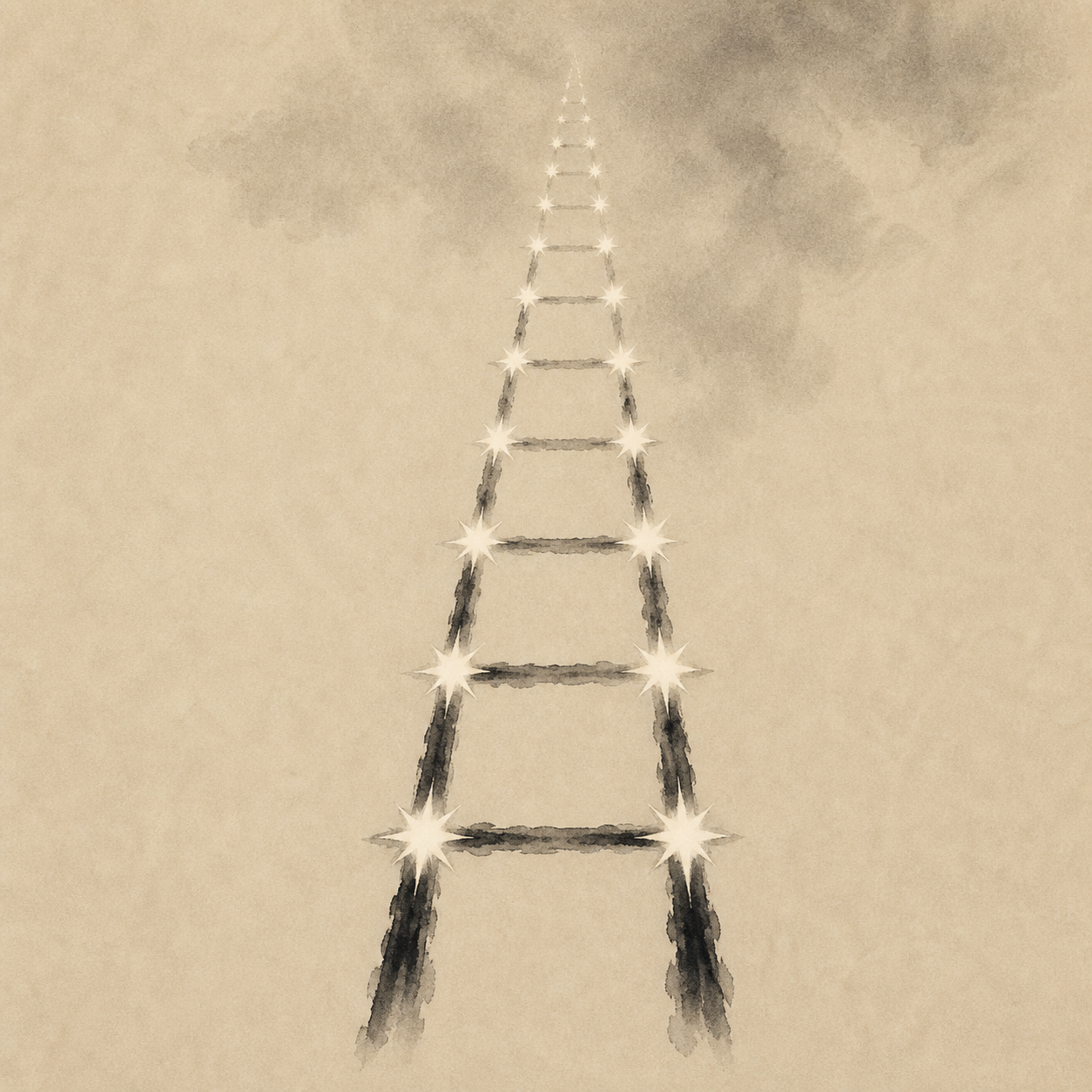
The power of the ladder, and its danger, is that each rung is calibrated using the one below it: an error low down propagates all the way up and shifts the final value of the Hubble constant. The bottom rung is parallax — the tiny back-and-forth shift in a nearby star's apparent position as Earth swings from one side of its orbit to the other. It is pure geometry, free of assumptions, and it sets the basic unit of cosmic distance, the parsec (about 3.26 light-years). The Gaia spacecraft has now measured parallaxes for nearly one and a half billion stars with extraordinary precision. Cepheids are the next rung up: Leavitt's law converts their pulse period into a true brightness, and Hubble and JWST can pick them out in galaxies tens of millions of light-years away. Beyond the reach of individual stars, the ladder switches to Type Ia supernovae — the thermonuclear detonation of a white dwarf (the dense, Earth-sized ember a Sun-like star leaves when it dies) once it tips past the Chandrasekhar limit, the ~1.4-solar-mass ceiling above which such an ember can no longer hold itself up. These explosions all peak at very nearly the same true brightness, which makes each one a standard candle — an object of known luminosity whose apparent faintness gives its distance — visible clear across much of the observable universe. It was exactly these supernovae, seen fainter than expected in 1998 by Perlmutter, Riess, and Schmidt, that revealed dark energy. At the top rung, Hubble's law turns a galaxy's redshift — the stretching of its light to redder wavelengths as cosmic expansion carries it away — into a distance. Today the two ends of the ladder disagree: distances built up from nearby Cepheids and supernovae yield a faster expansion rate than the value inferred from the early-universe afterglow, a standoff known as the Hubble tension, the central open question of observational cosmology in the 2020s.