The Classical Orders
- Doric, Ionic, and Corinthian capitalsnot yet tested
- Proportion of column, capital, and entablaturenot yet tested
- Vitruvius and the Renaissance codifiersnot yet tested
- Ornament and Crime versus postmodern revivalnot yet tested
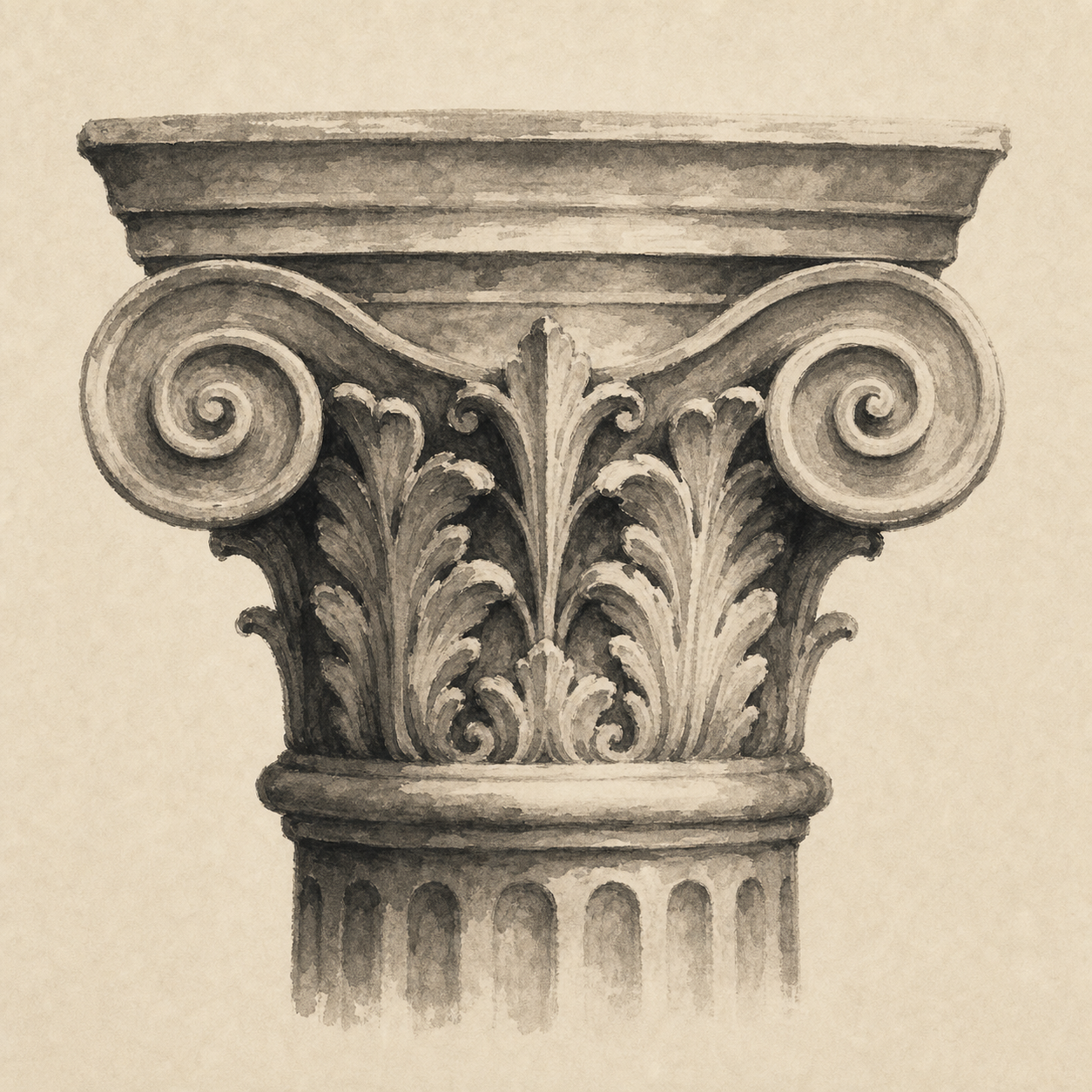
Around 25 BCE, Marcus Vitruvius Pollio, a Roman engineer and architect, completed De architectura — the only complete work on architecture to survive from classical antiquity. The treatise's most influential contribution was its codification of the three Greek orders: Doric (austere, the columned temple of the Parthenon), Ionic (slender, with the scrolled volute capital of the Erechtheion), and Corinthian (decorated with acanthus leaves, the choice of imperial Rome). The Romans added the simplified Tuscan and the elaborated Composite. The order — the proportional vocabulary of column, capital, and entablature — became the grammar of Western classical architecture for two and a half thousand years, until the modernist break of Le Corbusier and the Bauhaus.
An order is not merely decorative; it is a system of architectural proportion. Each order has a base, a shaft (sometimes fluted), a capital, and an entablature consisting of architrave, frieze, and cornice. The Greeks even built in subtle optical refinements — a slight swelling of the shaft (entasis) and an upward-bowing stylobate — to counteract the way truly straight lines look concave, so that the eye reads the temple as ruler-straight. The proportions — column height as a multiple of base diameter, column spacing, entablature height — are specified by each: Doric is robust at 5–7× diameter, Ionic slimmer at 8–9×, Corinthian most slender at 9–10×. Vitruvius gave the proportions; later treatises by Sebastiano Serlio, Giacomo Vignola, and Andrea Palladio's Quattro Libri (1570) systematized them for the Renaissance. What made the system durable across so many cultural conditions is that it does three things at once. It embeds proportional reasoning — the consonant musical intervals share the same small-integer ratios, and the logic carried over from architecture into music theory and perspective painting. It scales gracefully from the small temple to the large public building (the Pantheon, St. Peter's, the US Capitol). And it provides an internationally legible vocabulary: a Greek temple, a Roman forum, a Renaissance palazzo, and a Beaux-Arts railway terminal all speak the same language of column-and-entablature, making classical architecture the default register of public seriousness across Western cities for two millennia. The modernist objection — Adolf Loos's Ornament and Crime (1910), then Le Corbusier and the Bauhaus — was that the orders were historical decoration without functional rationale, that form should follow function, and that ornament was dishonest. The postmodernist response from the 1970s — Venturi, Stern, Moore, Graves — argued that rejecting them stripped architecture of meaning.