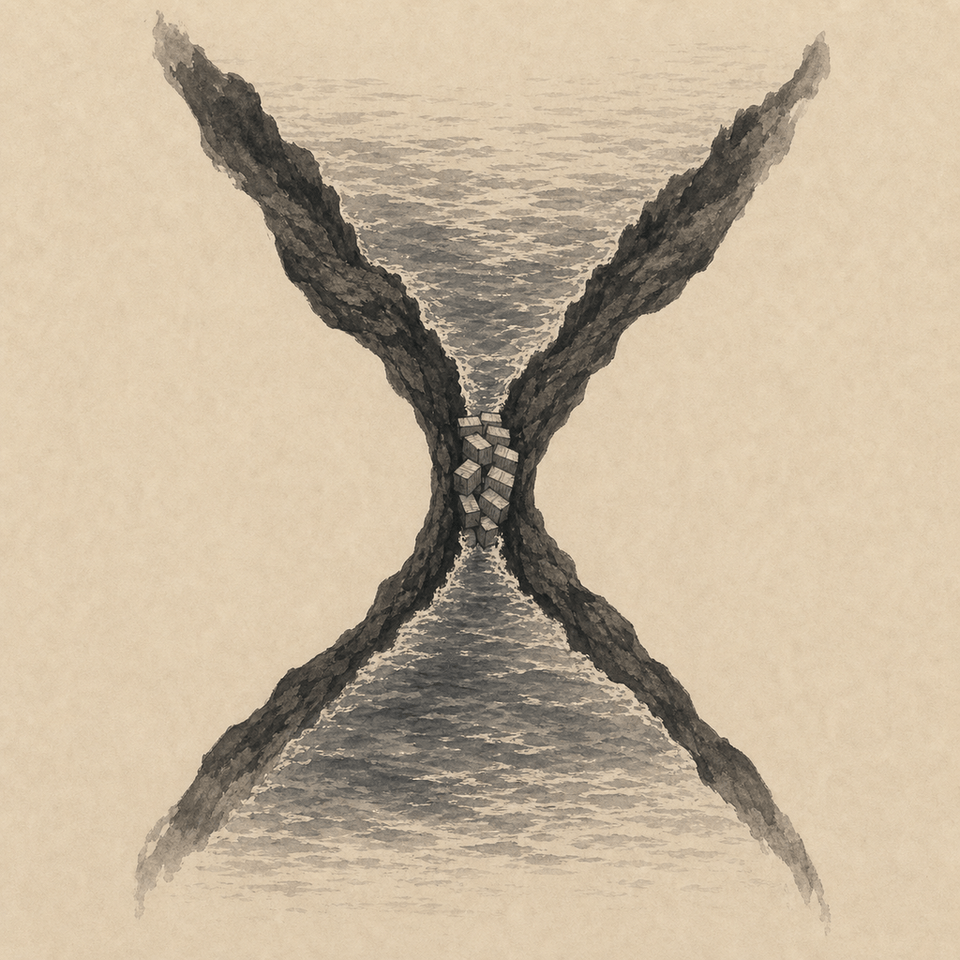
The Choke Points
The world's maritime trade — about 80 percent of all goods moved by volume — passes through perhaps a dozen narrow waterways, none of them more than a few miles wide at the pinch. The Strait of Hormuz, between Iran and Oman, narrows to roughly 21 nautical miles and carries more than a quarter of the world's seaborne oil. The Strait of Malacca, between Indonesia and Malaysia, funnels the trade between East Asia and the Middle East through a channel that at one point shrinks to under two miles. The Suez Canal and the Bab-el-Mandeb govern Mediterranean–Red Sea–Indian Ocean traffic; the Panama Canal stitches together the world's two largest oceans across 51 miles of locks. Block one for a week and supply chains stutter; keep it closed and costs, shortages, and recession risks multiply.
Choke points are the physical geography that abstract globalization rests on. They were prized by 19th-century imperial planners — Britain seized control of Suez in 1882 and held Singapore, Gibraltar, and Aden precisely to command these gates — and they remain the spine of 21st-century naval doctrine. Preserving freedom of navigation through them is a central mission of the US Navy, an inheritance of the Pax Britannica it assumed after 1945. Conflicts that look regional — Houthi attacks on Red Sea shipping that cut Suez traffic by more than half in 2024, Iranian threats to mine Hormuz, Chinese naval exercises in the South China Sea — are also contests over the world's most consequential infrastructure. The 2021 grounding of the Ever Given in the Suez Canal, which wedged 220,000 tons of ship sideways and blocked traffic for six days, held up an estimated $9–10 billion of trade per day and stranded over 400 vessels. The vulnerability recurs in every supply-chain reform proposal; the cure is hard, because building redundant infrastructure — alternative ports, the proposed Thai Kra Canal, pipelines bypassing Hormuz, the India–Middle East–Europe rail corridor — is enormously expensive and diplomatically fraught. Geography offers few spare gates, and the existing ones depend on security, diplomacy, and continuous operation.