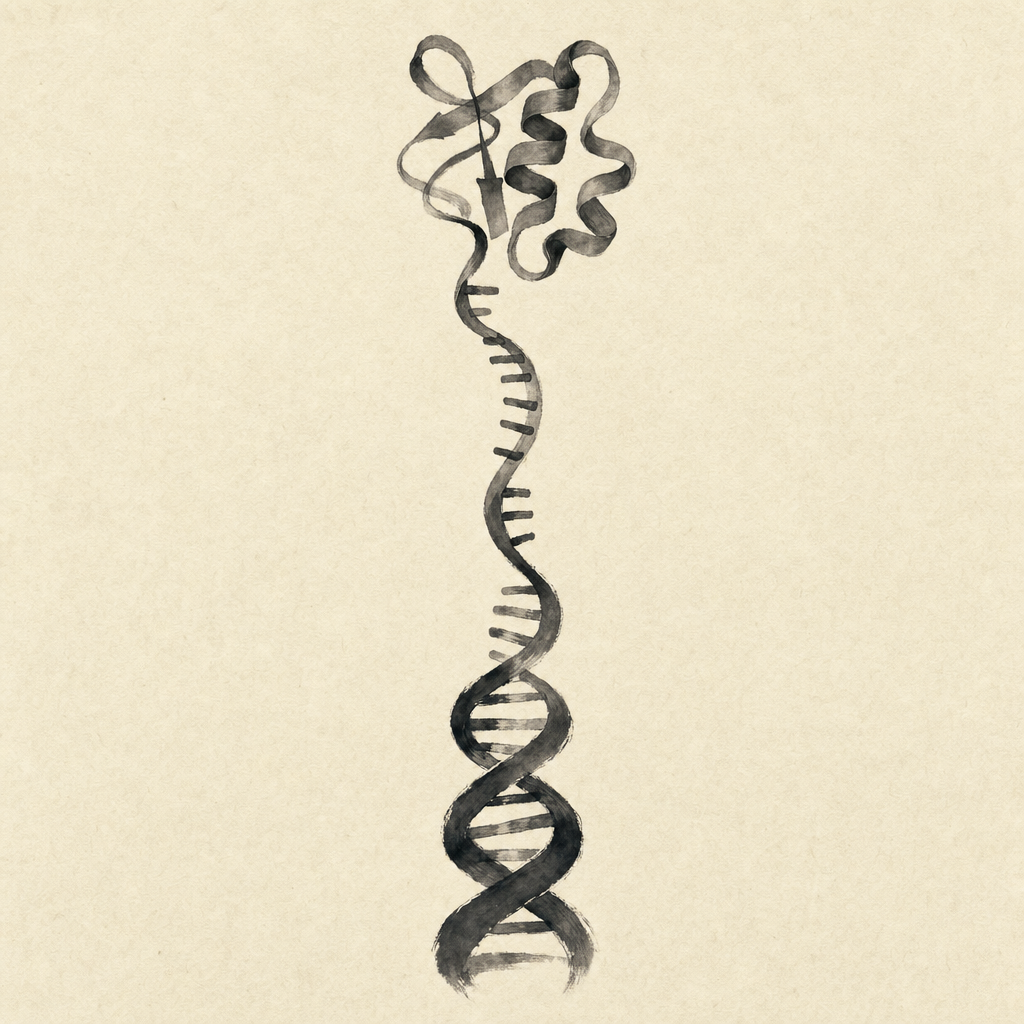
The Central Dogma
- DNA → RNA → protein flownot yet tested
- Transcription (DNA → mRNA)not yet tested
- Translation (mRNA → protein) & ribosomesnot yet tested
- The genetic code (codons & amino acids)not yet tested
In 1957, four years after his work on the structure of DNA, Francis Crick proposed what he provocatively called the Central Dogma of molecular biology: DNA is transcribed into RNA, and RNA is translated into protein, and information does not flow back from protein to nucleic acid. The genetic code goes one way. Crick later admitted he had misused the word — he meant a grand, sweeping idea, but 'dogma' properly names something held without proof, the opposite of his intent. The name stuck anyway, and so did the framework: for the first time heredity had a direction and a mechanism rather than merely a pattern. The dogma turned out to be approximately true, with important exceptions, and has been the organizing skeleton of molecular biology ever since.
The mechanism is one of the great miracles of biological evolution. DNA stores hereditary information in a double-helical sequence of four bases. RNA (specifically messenger RNA) is transcribed from DNA by RNA polymerase, carrying a single-stranded copy out of the nucleus. Ribosomes read the mRNA in three-letter codons (each specifying one amino acid) and assemble proteins — the working molecules of the cell — by linking amino acids in the specified order. The translation runs on a code: each of the 64 possible three-letter codons maps to one of twenty amino acids or to a stop signal, a dictionary that is redundant (several codons per amino acid) and very nearly universal across all life — a bacterium can read a human gene. Crick had predicted the missing piece before it was found: an adaptor molecule that recognizes a codon at one end and carries the matching amino acid at the other, since nothing about a nucleic-acid triplet physically resembles an amino acid. That adaptor turned out to be transfer RNA. His careful claim was always about information, not molecules — he allowed RNA→DNA and never ruled out the detours cells actually use; what he forbade was information flowing back out of protein into sequence, and that prohibition still stands. The exceptions to simple one-way flow are now well-characterized: retroviruses (including HIV) reverse-transcribe RNA back into DNA (David Baltimore and Howard Temin, 1970, Nobel 1975); prions propagate by protein-to-protein conformational change without nucleic-acid involvement; epigenetics allows heritable phenotypic changes through DNA methylation and histone modification rather than sequence change. The central dogma has been the framework underneath every twentieth- and twenty-first-century molecular biology breakthrough: gene cloning, polymerase chain reaction, recombinant DNA, the Human Genome Project, RNA interference, CRISPR-Cas9, mRNA vaccines, and the recent revolution in protein-structure prediction (AlphaFold).