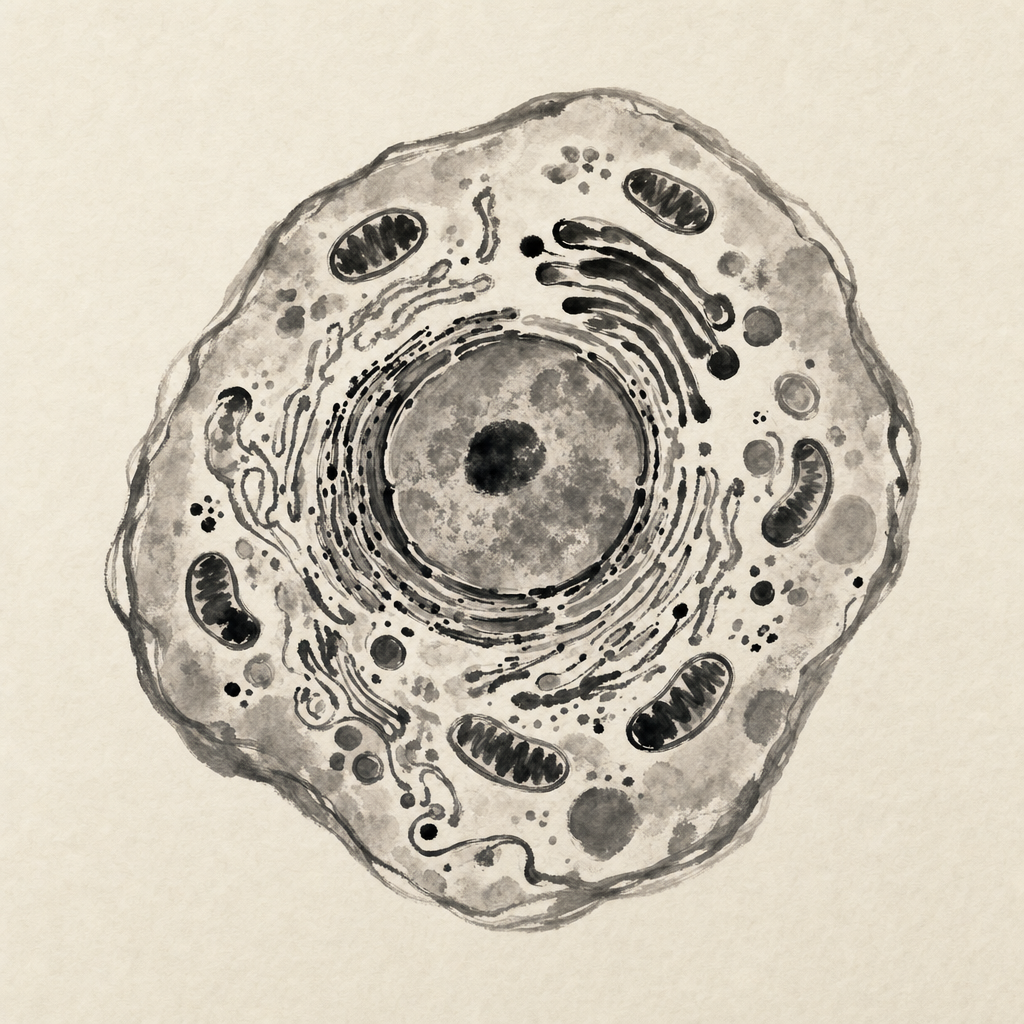
The Cell
- Cell theory & the basic unit of lifenot yet tested
- Organelles (nucleus, mitochondria, …)not yet tested
- Cell membrane & phospholipid bilayernot yet tested
- Prokaryotes vs eukaryotes; unicellular vs multicellularnot yet tested
In 1665, the English natural philosopher Robert Hooke published Micrographia — a folio-sized illustrated book of observations made through one of the first practical compound microscopes. Examining a thin slice of cork, Hooke saw the wood was built of tiny rectangular compartments that reminded him of the cells (small monastic rooms) of a monastery. He named them after the rooms, and the name stuck. Two centuries later, after Anton van Leeuwenhoek discovered single-celled organisms in pond water (1670s) and Theodor Schwann and Matthias Schleiden formulated the cell theory (1838–39) — all living things are composed of cells; the cell is the fundamental unit of life; cells arise only from preexisting cells (Virchow, 1855) — biology had a unifying observational claim that organized everything from bacteria to whales.
A cell is a self-bounded chemical system that maintains internal conditions far from thermodynamic equilibrium and reproduces by dividing in two. The boundary is a phospholipid bilayer that acts as a near-perfect electrical insulator and a selective filter; inside, ion pumps maintain gradients that store free energy used for everything from action potentials to ATP synthesis, and the universal energy currency itself, ATP, is spent at rates of around ten million molecules per second in an active cell. Living matter is not a substance but a process — a steady refusal to come to equilibrium, paid for by a continuous flow of energy and matter through the membrane.
The deepest structural fact about life is that there are two kinds of cell, separated by an enormous evolutionary gap. Prokaryotes — bacteria and archaea — are small, lack a nucleus, carry their DNA loose in the cytoplasm, and have been around for about 3.8 billion years. Eukaryotes are an order of magnitude larger, package their DNA in a membrane-bound nucleus, and contain organelles: mitochondria, chloroplasts, endoplasmic reticulum, lysosomes, and a cytoskeleton. The reason for the elaborate inner architecture is Lynn Margulis's endosymbiotic theory, fully accepted by the 1980s: mitochondria and chloroplasts are descendants of free-living bacteria engulfed by an ancestral host cell and never digested. They still carry their own circular DNA, their own ribosomes, and their own division machinery. Multicellularity arose several times independently after the eukaryotic chimera was assembled, with cells specializing into tissues through differential gene expression. The human body has on the order of 37 trillion cells across roughly 200 distinct cell types.