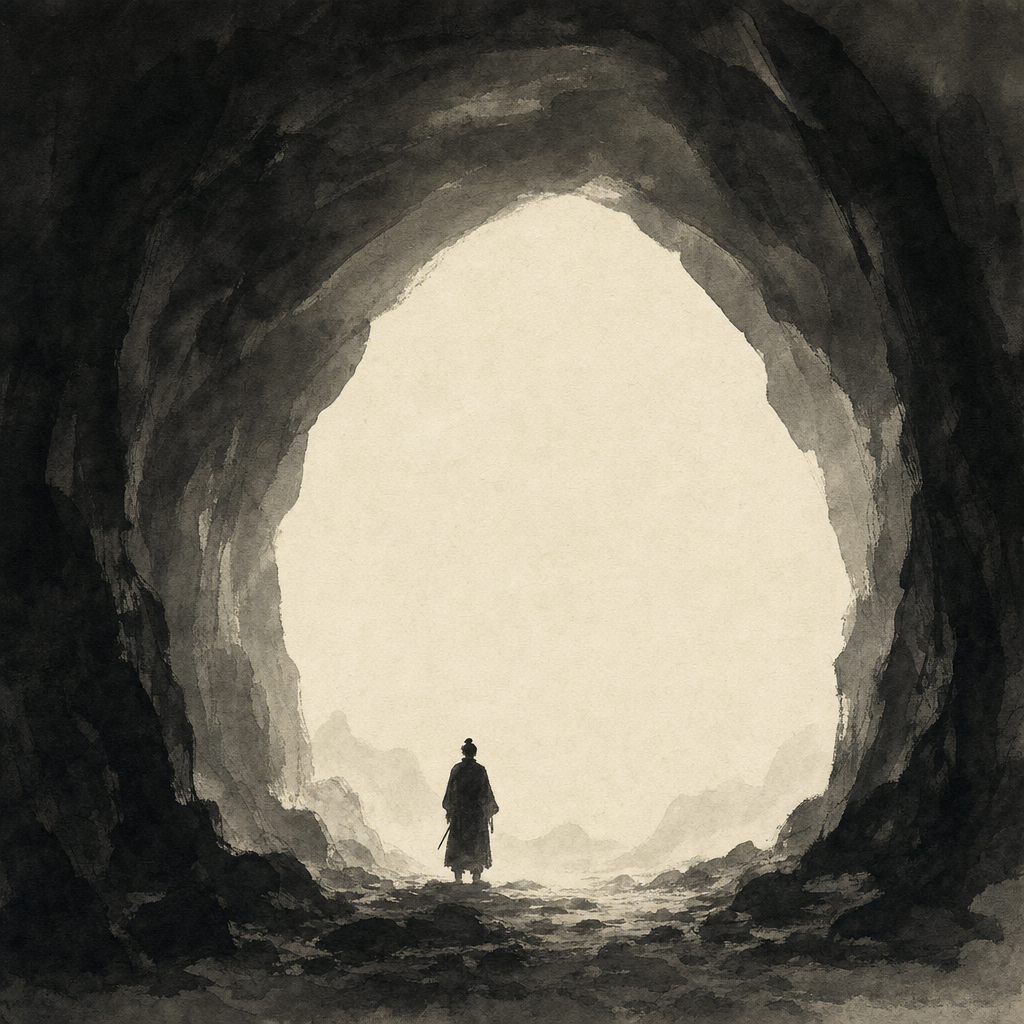
The Cave
- Shadows on the wall, sun outsidenot yet tested
- Forms, and the painful climb to reasonnot yet tested
- Socrates, Plato, and the Academynot yet tested
- The appearance-vs-reality problemnot yet tested
Around 375 BCE, in Book VII of the Republic, Plato put a thought experiment into the mouth of Socrates that has outlived nearly every other image in Western philosophy. Imagine prisoners chained from birth in a cave, their heads fixed so they face only a wall. Behind them burns a fire, and between fire and prisoners runs a walkway along which figures carry statues and objects like puppeteers above a screen. All the prisoners ever see are the shadows these objects throw on the wall, and these they name and rank as the whole of what exists — they have known nothing else. One prisoner is freed, dragged up out of the cave into sunlight, slowly comes to see real objects, and finally the sun itself. He returns to tell the others. They mock him and would kill him if they could. The allegory is two and a half millennia old and has not aged.
The cave is Plato's central image for the relation between appearance and reality, between the world we receive through the senses and the world as it actually is. The escaped prisoner is the philosopher; the journey upward is the soul's ascent through reason. That ascent is staged and painful: blinded at first by the firelight, then by the open sky, the freed man can look only at shadows and reflections in water before his eyes adjust to things themselves, and last of all to the sun — which is the Form of the Good, the source that makes both being and knowing possible, just as sunlight makes seeing possible. The structure makes several claims at once: that ordinary perception is systematically misleading, that reality is accessible only through painful disciplined inquiry, that those who have seen reality have a political duty to return to the cave even though doing so is dangerous, and that those still in the cave will resist being freed because their identities are bound up with the shadow-world. The returning philosopher, his eyes no longer suited to the dark, fumbles among the shadows and seems to the others a fool who has ruined himself by leaving — so the very people he means to free count him their enemy, an outcome in which Plato's readers have always heard the trial of Socrates. The allegory is an early formulation of what philosophers now call the epistemic problem of perception, the political problem of philosophy, and the ethical problem of the unwelcome truth-teller. Plato's metaphysics — the existence of timeless Forms, the secondary status of the perceptual world — is rejected by most modern philosophers, but the structure of the allegory has migrated into countless successor frames: Bacon's idols, Kant's noumena and phenomena, Marx's false consciousness, Nietzsche's perspectivism, the modern philosophy of science's distinction between observation and theory.