The Big Bang
- Hubble's law and the receding galaxiesnot yet tested
- Running the expansion back to a single pointnot yet tested
- Inflation, nucleosynthesis, and the CMBnot yet tested
- Dark matter, dark energy, and the Hubble tensionnot yet tested
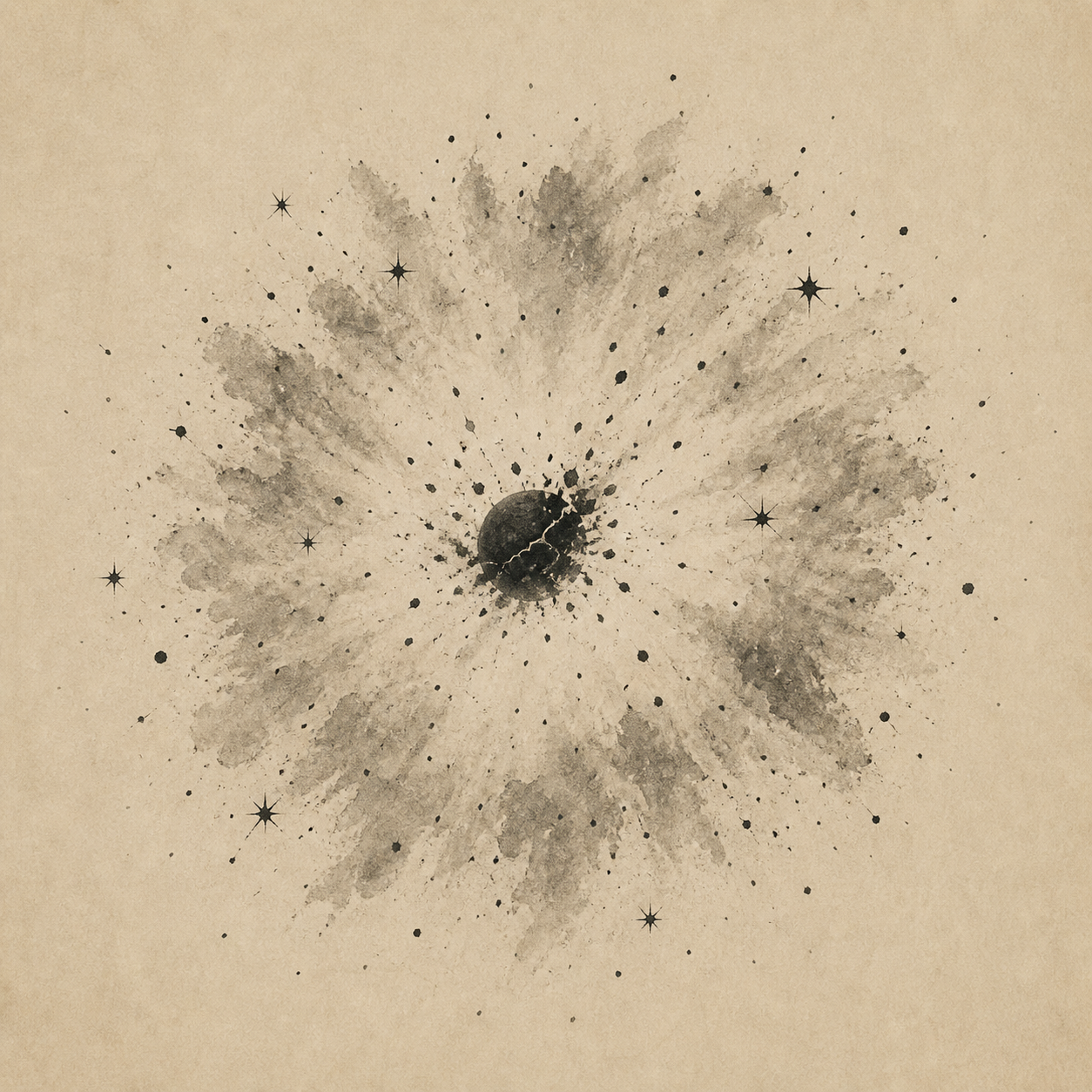
In 1929, working at the Mount Wilson Observatory with the largest telescope in the world, Edwin Hubble compiled a striking dataset. He had been measuring distances to galaxies — using Henrietta Leavitt's 1912 period–luminosity law for Cepheid variables, stars that pulse brighter and dimmer on a regular cycle that betrays their true brightness — and the redshifts of their light: the stretching of a receding object's light toward longer, redder wavelengths, which grows with distance. The pattern was unmistakable, and it became known as Hubble's law: the further away a galaxy was, the faster it was receding. There was only one explanation — the universe was expanding. Run the expansion backward in time, and at some finite past moment, everything was at a single point. The universe had a beginning. The moment has been called the Big Bang — a term coined by Fred Hoyle in a 1949 BBC broadcast, and not, he always insisted, in mockery. Hoyle lost the argument; the term stuck.
The universe is expanding — not into anything, but intrinsically: the distance between galaxies stretching everywhere at once. Galaxy redshifts arise from this stretching. Hubble's constant, measured through the mid-2020s at 67–73 km/s/Mpc, sets the present rate. Run the expansion backward and everything crowds together, density and temperature climbing without limit, until at the very first moment you reach a singularity — a state of formally infinite density where general relativity itself breaks down. That first instant is inaccessible without a theory of quantum gravity we do not yet have. From there the standard chronology runs: a tiny fraction of a second in, cosmic inflation (Guth, 1980) stretches a quantum-scale region to cosmic size, explaining why the universe looks so flat and uniform and seeding the faint density ripples that later grow into galaxies. At about a millionth of a second, quarks bind into protons and neutrons. At three minutes, Big Bang nucleosynthesis forges the lightest nuclei — helium, deuterium, lithium — in proportions that match what we observe to high precision. At 380,000 years comes recombination: the universe cools enough for electrons to bind to nuclei, and light is suddenly free to travel. That released light still bathes the sky today as the cosmic microwave background (CMB) — the afterglow of the hot early universe, now cooled to a faint 2.7 K microwave glow filling all of space, its minute temperature ripples mapping the density structure at recombination. Within the first few hundred million years the first stars and galaxies light up. At 13.8 billion years: now. The standard cosmological model — ΛCDM, for dark energy plus cold dark matter plus ordinary matter — fits a vast array of observations with just six parameters, even though two of them (dark matter, dark energy) name things whose physical nature remains fundamentally unknown.