The Arch & Vault
- Compression-only spanning locked by the keystonenot yet tested
- Barrel, groin, and the Pantheon's concrete domenot yet tested
- The pointed arch and the flying buttressnot yet tested
- Hooke's hanging chain and the thrust linenot yet tested
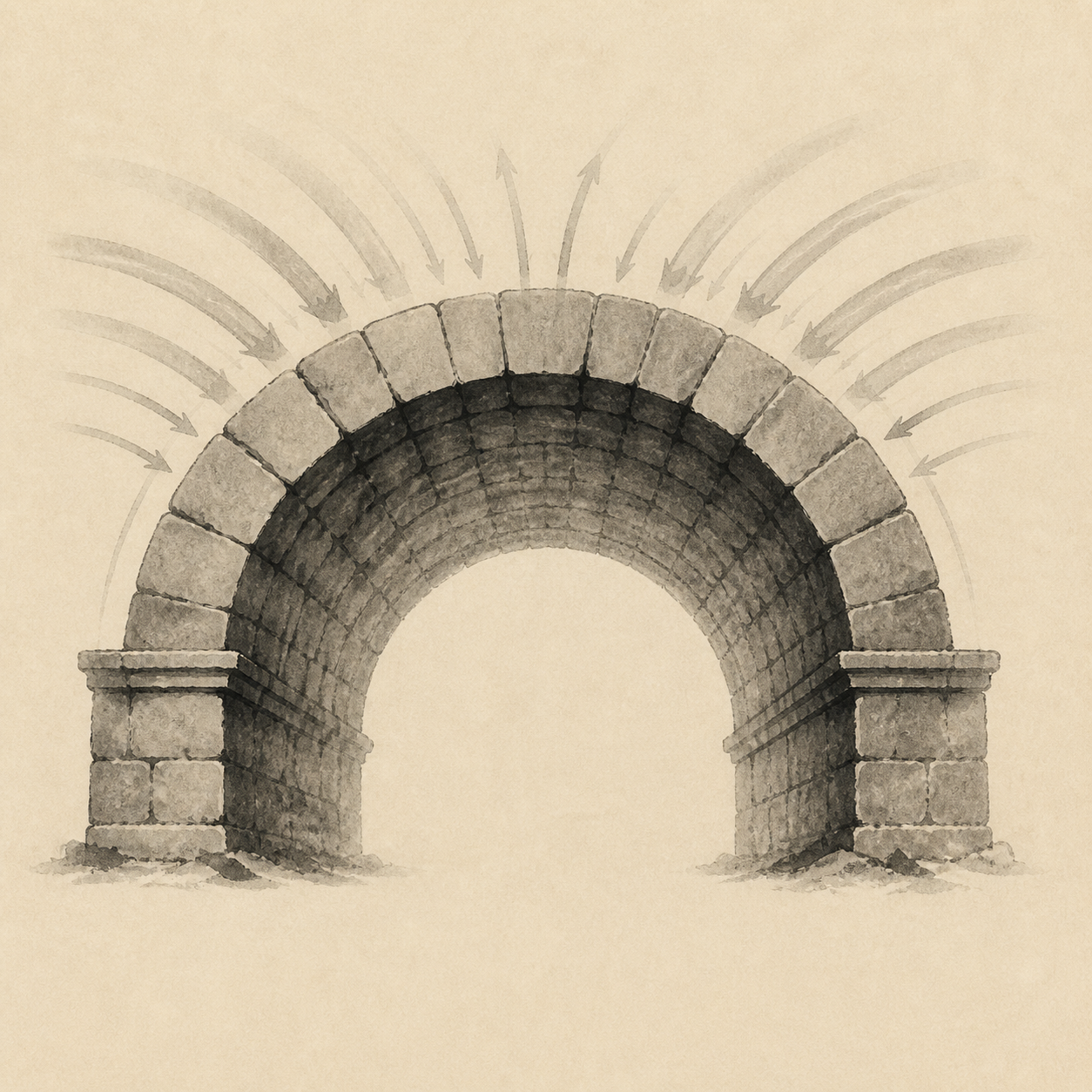
Around 200 BCE, Roman engineers — building on Etruscan and Mesopotamian precedents — perfected the semicircular arch. The technical achievement was non-obvious: a self-supporting curve of stone or brick held in place by compression alone. The keystone — the wedge-shaped stone at the top — locks the structure together; under its weight, the lateral thrust is absorbed by the abutments at each side. No mortar required, no internal tension, only compression — the failure mode stone is best at resisting. The arch let Romans span distances the post-and-lintel Greek temple could not, from sixty-foot aqueducts to the 43-metre dome of the Pantheon. The vault covered interior spaces without internal columns. A thousand years later, Gothic builders, beginning around 1140 CE with Abbot Suger's reconstruction of Saint-Denis, added the pointed arch and the flying buttress, letting cathedrals reach unprecedented heights with enormous windows, the wall no longer load-bearing and free to be filled with stained glass.
When a load is applied to the top of an arch the stones experience compression — they push against each other along the curve — and the line of thrust must stay within the masonry; if it exits the stone, the arch fails. Galileo in 1638 was the first to analyze stone-beam mechanics rigorously, and Robert Hooke in 1675 captured the underlying geometry in a Latin rebus: as hangs a flexible cable, so stands inverted the rigid arch. The catenary, the natural curve of a hanging chain, is the ideal arch shape under uniform load; real arches are approximations of catenaries that work because masonry tolerates some wandering of the thrust line. Vaults extend the principles into the third dimension: the Roman barrel vault is a continuous arch, the groin vault concentrates load at four corners and admits light from the sides, and the Gothic ribbed vault builds the structural ribs first in stone with a lighter web between them. Domes are the arch rotated about a vertical axis, producing the great single-volume interiors of the Pantheon, Hagia Sophia, Brunelleschi's Florence Cathedral, and Michelangelo's St. Peter's. The Gothic breakthrough was structural rather than ornamental. The pointed arch concentrated lateral thrust vertically, and the flying buttress transferred the residual force outside the building envelope to ground-anchored piers, producing thin walls, enormous windows, and vertical lift. Beauvais Cathedral's choir collapsed in 1284, its central tower in 1573 — medieval builders worked at the edge of what stone permitted. The arch's structural family broadened with iron and steel (the Brooklyn Bridge of 1883, the Sydney Harbour Bridge of 1932) and twentieth-century thin-shell concrete (Pier Luigi Nervi, Eduardo Torroja, Félix Candela) producing vaults no medieval builder could have approached.