Temperature & Heat
- Freezing, boiling, Kelvin, absolute zeronot yet tested
- Solid, liquid, gas, icenot yet tested
- Heat flows hot to coldnot yet tested
- Thermal expansion and the ideal gas lawnot yet tested
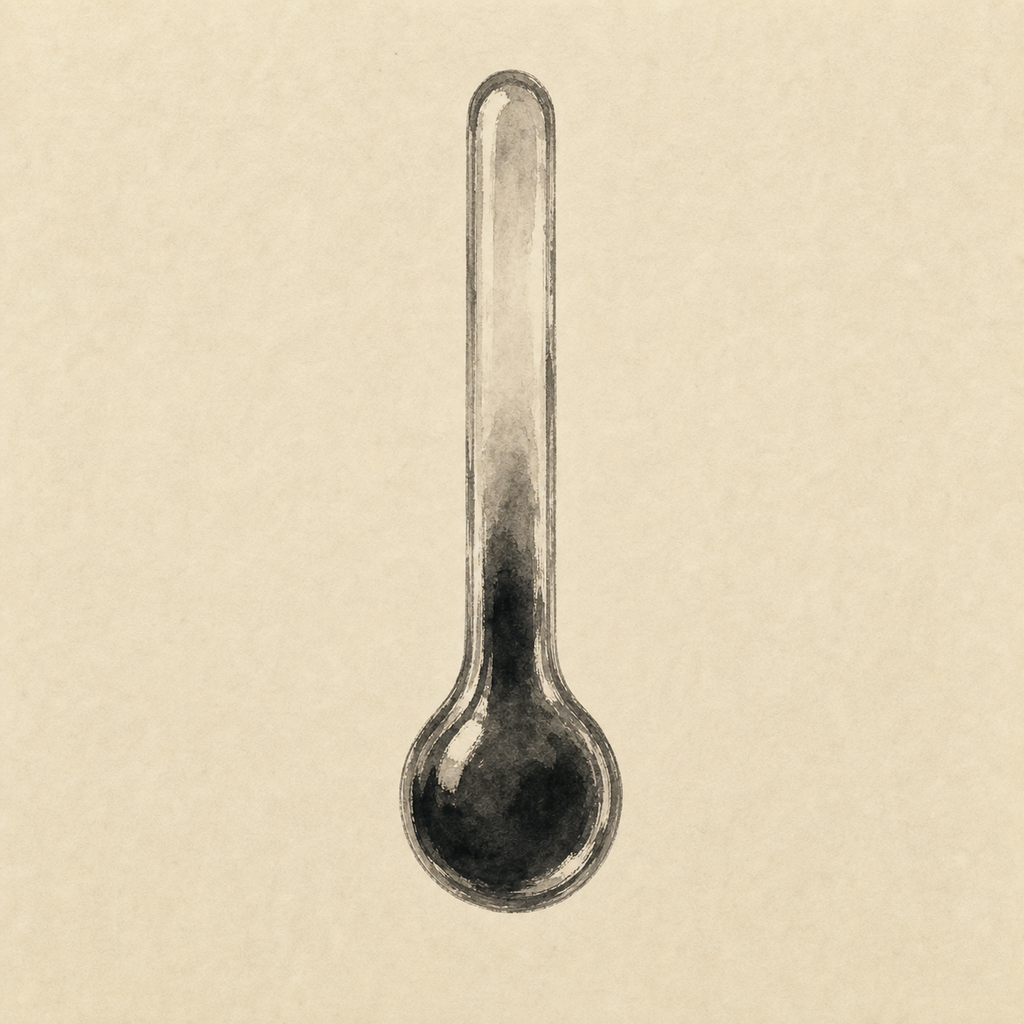
Galileo built the first thermoscope in the 1590s — a glass bulb whose air expanded or contracted with temperature, pushing a liquid column up or down. It was qualitative; it told you whether something was getting warmer, not by how much. The invention of temperature as a measurable number required fixed reference points (Celsius freezing/boiling, Fahrenheit) and a scale between them. The deeper question of what temperature actually was was not settled until the kinetic theory of gases in the late nineteenth century. Temperature, it turned out, measures the average kinetic energy of microscopic random motion. Cold means slow; hot means fast.
Temperature is a property of a system in thermal equilibrium that determines whether it will gain or lose heat when placed in contact with another. The zeroth law of thermodynamics formalises this: if two systems are each in thermal equilibrium with a third, they are with each other — the transitivity that makes temperature a well-defined property at all. Heat (Q) is energy in transit between systems at different temperatures. The kinetic theory of gases (Maxwell, Boltzmann) gave the microscopic interpretation: in an ideal gas, the average kinetic energy per molecule is (3/2)·k_B·T, where T is absolute temperature (Kelvin) and k_B ≈ 1.381 × 10⁻²³ J/K is Boltzmann's constant. Temperature is just a scaled average of microscopic motion. The Kelvin scale (Lord Kelvin, 1848) fixes zero at absolute zero where (classically) motion ceases; the third law says absolute zero cannot be reached in finitely many steps. The first law of thermodynamics — energy conservation including heat — is ΔU = Q − W. Specific heat (energy to raise unit mass by one degree) varies dramatically: water's exceptionally high specific heat makes oceans the planet's thermal flywheel. Latent heat — energy absorbed or released at a phase transition without temperature change — explains why ice water stays at 0 °C while ice melts. The Carnot cycle (Sadi Carnot, 1824) showed that no heat engine can be more efficient than the Carnot efficiency (1 − T_cold/T_hot), an upper limit no engineering can exceed.