Tango
- Conventillo syncretism in 1880s Buenos Airesnot yet tested
- Guardia Vieja, Golden Age, and Gardelnot yet tested
- Piazzolla's Nuevo Tango and the concert hallnot yet tested
- From national emblem to global heritagenot yet tested
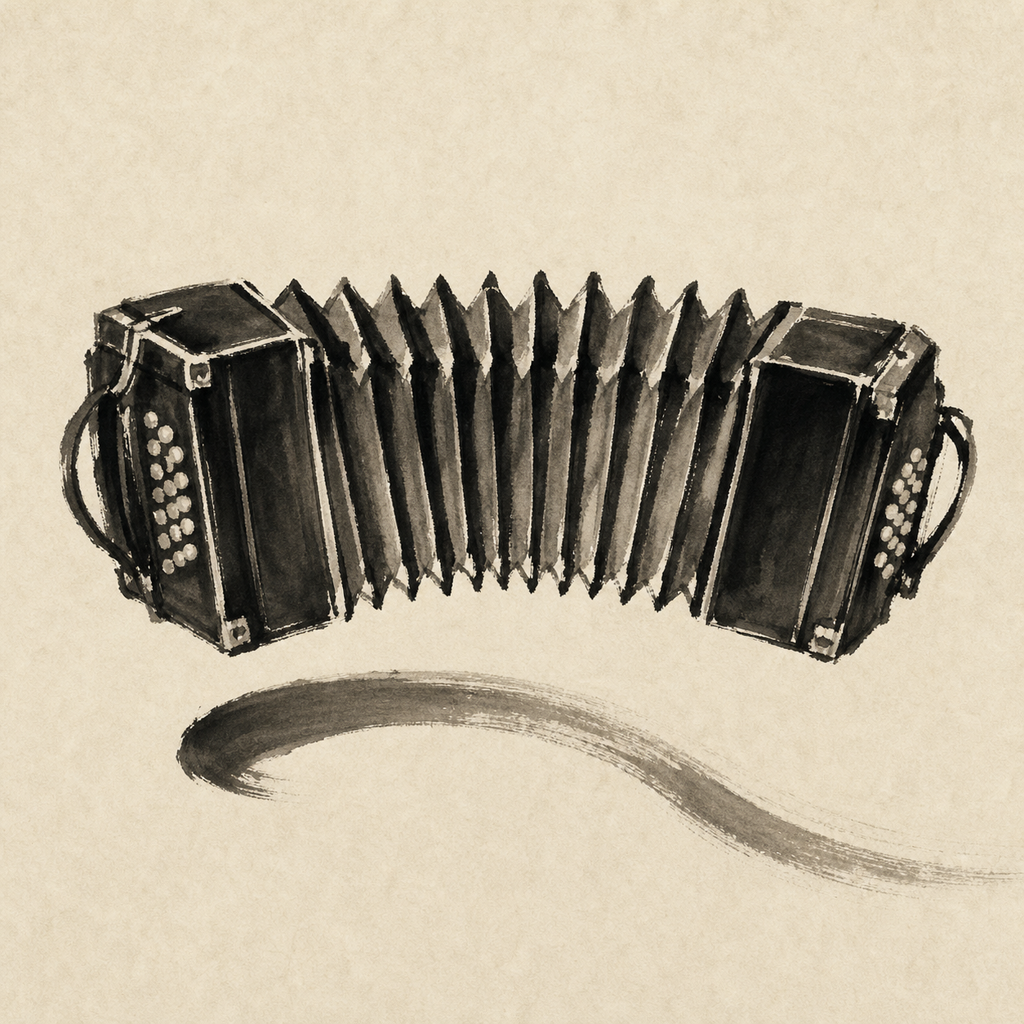
Tango coalesced in Buenos Aires between roughly 1880 and 1900 — in the immigrant tenements (conventillos) of the port neighbourhoods La Boca and San Telmo, in brothels and dance academies, out of a syncretism the city's demographic accident produced. Italian and Spanish working-class immigrants brought European song forms; Afro-Argentine percussion supplied the milonga and candombe rhythmic substrate; the Cuban habanera arrived by ship. Around 1870 the bandoneón — a German hand-pulled free-reed instrument designed for portable church music — reached the Río de la Plata with emigrants and sailors and became, against all design intent, the central voice of the music. By 1913 tango had crossed the Atlantic; Parisian high society took it up; bourgeois Buenos Aires, which had treated tango as something the underclasses did, reluctantly imported it back as respectable.
Three eras structure the tradition. The Guardia Vieja (~1900–1925) was instrumental, three-strain, harmonically simple, recorded extensively on early Victor and Odeon 78s. Vicente Greco, Roberto Firpo, and Francisco Canaro led the first wave of orchestras; Lorenzo Logatti's El Irresistible (1903) is one of the earliest tangos still in active repertoire. The Edad de Oro (Golden Age, ~1935–1955) is what most listeners mean by tango: the standard orquesta típica of two bandoneóns, two violins, piano, and bass, with a vocalist; an emphatically danceable rhythmic vocabulary; the era of Juan D'Arienzo's metronomic propulsion, Aníbal Troilo's lyricism, Carlos Di Sarli's spacious arrangements, and Osvaldo Pugliese's rhythmic intensity. Carlos Gardel (1890–1935), the singer — most likely born in Toulouse, France, though Argentina and Uruguay both claimed him — who became Argentina's first global star, was killed in a plane crash in Medellín at the peak of his fame; his voice anchors the canon. The Nuevo Tango of Astor Piazzolla (1921–1992) is the third era. Piazzolla studied composition with Nadia Boulanger in Paris in 1954; she told him to stop hiding his tango and write it instead. He returned to Buenos Aires and assembled the Quinteto Nuevo Tango — bandoneón, electric guitar, piano, violin, bass — and made music that fused tango with jazz harmony and twentieth-century chamber-music technique. Traditionalists rejected him for decades; the classical world adopted him from the 1980s; Libertango, Adiós Nonino, and Las cuatro estaciones porteñas are now standard concert repertoire performed by Yo-Yo Ma, Gidon Kremer, and the Kronos Quartet.