Synaptic Transmission
- The 20-nanometre gap signals must crossnot yet tested
- Calcium, vesicles, and neurotransmitter releasenot yet tested
- Ionotropic vs. metabotropic, excite vs. inhibitnot yet tested
- Synaptic plasticity and the drugs that exploit itnot yet tested
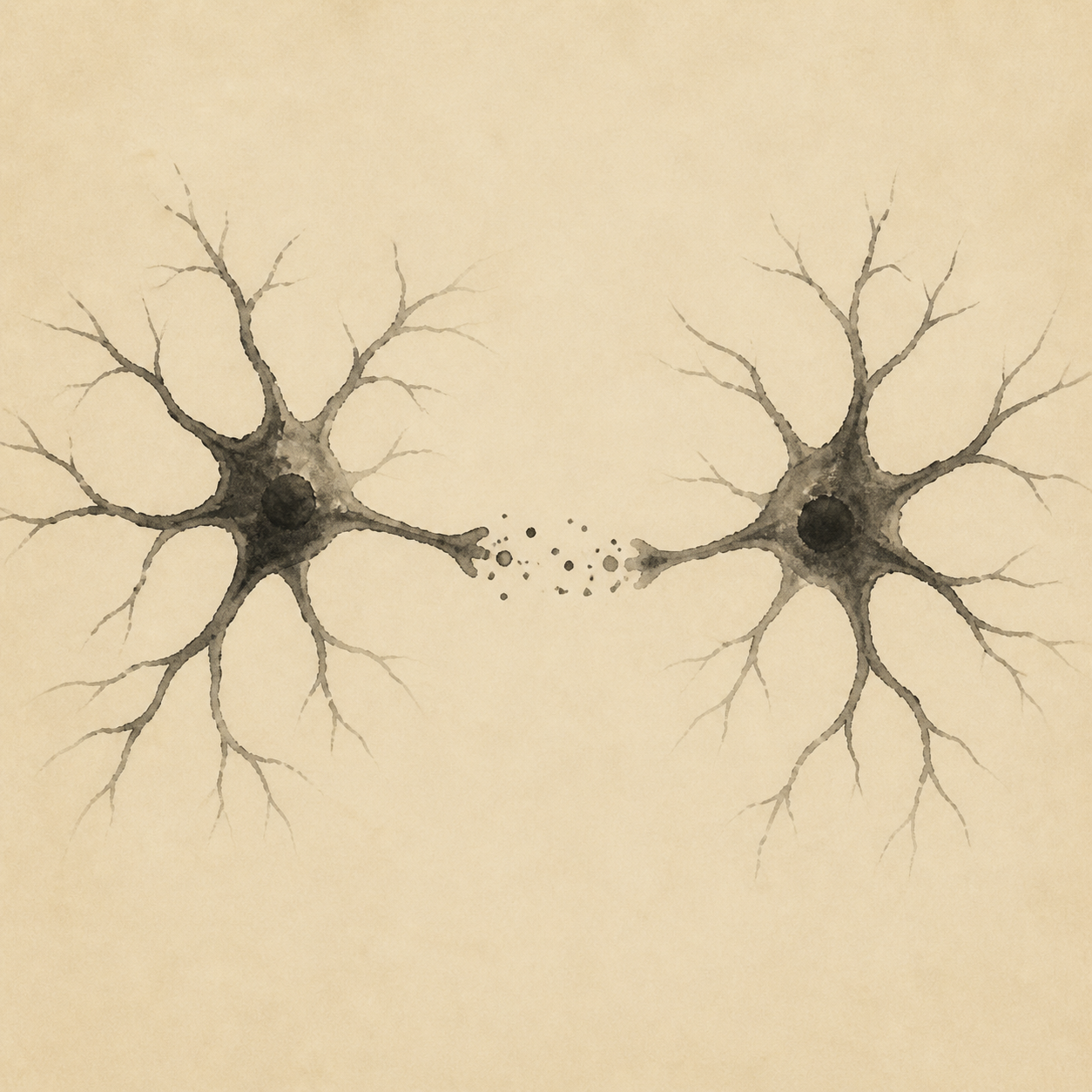
When an action potential reaches the end of an axon, it does not jump to the next neuron — axons and dendrites are not in physical contact. There is a gap, the synaptic cleft, about 20 nanometres wide. Otto Loewi dreamed the experiment that proved how signals cross: in 1921 on isolated frog hearts, he showed the vagus nerve slowed the heart by releasing a chemical substance (his Vagusstoff, later identified as acetylcholine) — Nobel 1936, shared with Henry Dale. Synaptic transmission — the chemical conversion of an electrical signal across the gap — is the fundamental signaling event of the nervous system, repeated on the order of a quadrillion times per second in a human brain. A typical neuron carries thousands of synapses, and it is in their ceaseless arithmetic of excitation and inhibition that thought, movement and memory are computed.
The sequence is choreographed and astonishingly fast. An action potential sweeps into the presynaptic terminal and opens voltage-gated calcium channels; the calcium influx triggers synaptic vesicles containing neurotransmitter molecules to fuse with the membrane and dump their contents into the synaptic cleft. The molecules diffuse across in microseconds and bind receptors on the postsynaptic membrane, where they open or close ion channels and so produce an excitatory or inhibitory postsynaptic potential. Ionotropic receptors are themselves ion channels (fast, direct). Metabotropic receptors couple to G-proteins and run intracellular cascades (slower, modulatory). Excitatory synapses depolarize the postsynaptic cell, nudging it toward firing; inhibitory synapses hyperpolarize it, holding it back. Glutamate dominates excitation in the mammalian brain; GABA dominates inhibition. Modulatory neurotransmitters — dopamine, serotonin, norepinephrine, acetylcholine — act mostly metabotropically over slower timescales, tuning whole circuits rather than relaying single messages. Not every synapse is chemical: at electrical synapses the two cells are bridged by gap junctions that pass current directly, near-instantaneously and bidirectionally — faster but far less flexible than their chemical counterparts. Released neurotransmitter is cleared by reuptake (transporters pumping it back — what SSRIs like fluoxetine block for serotonin), enzymatic degradation (acetylcholinesterase, blocked by sarin), or diffusion. Synaptic strength is not fixed: repeated activity can increase it (long-term potentiation) or decrease it (long-term depression) on timescales from seconds to lifetimes — the synaptic plasticity that is the cellular basis of learning and memory. The molecular detail is best understood for long-term potentiation at glutamate synapses: the NMDA receptor opens only when the cell is already depolarized and glutamate is present, making it a coincidence detector that strengthens exactly those connections active together — a chemical realization of Hebb's rule, that neurons which fire together wire together. Most psychiatric drugs act at synapses; the psychopharmacological revolution of the 1950s–60s — chlorpromazine, lithium, imipramine, benzodiazepines — was synaptic chemistry's clinical working-out.