Stereochemistry & Chirality
- Pasteur sorting tartrate's handed crystalsnot yet tested
- Enantiomers and the four-different-groups carbonnot yet tested
- L-amino acids, D-sugars, and thalidomidenot yet tested
- Single-enantiomer drugs and asymmetric catalysisnot yet tested
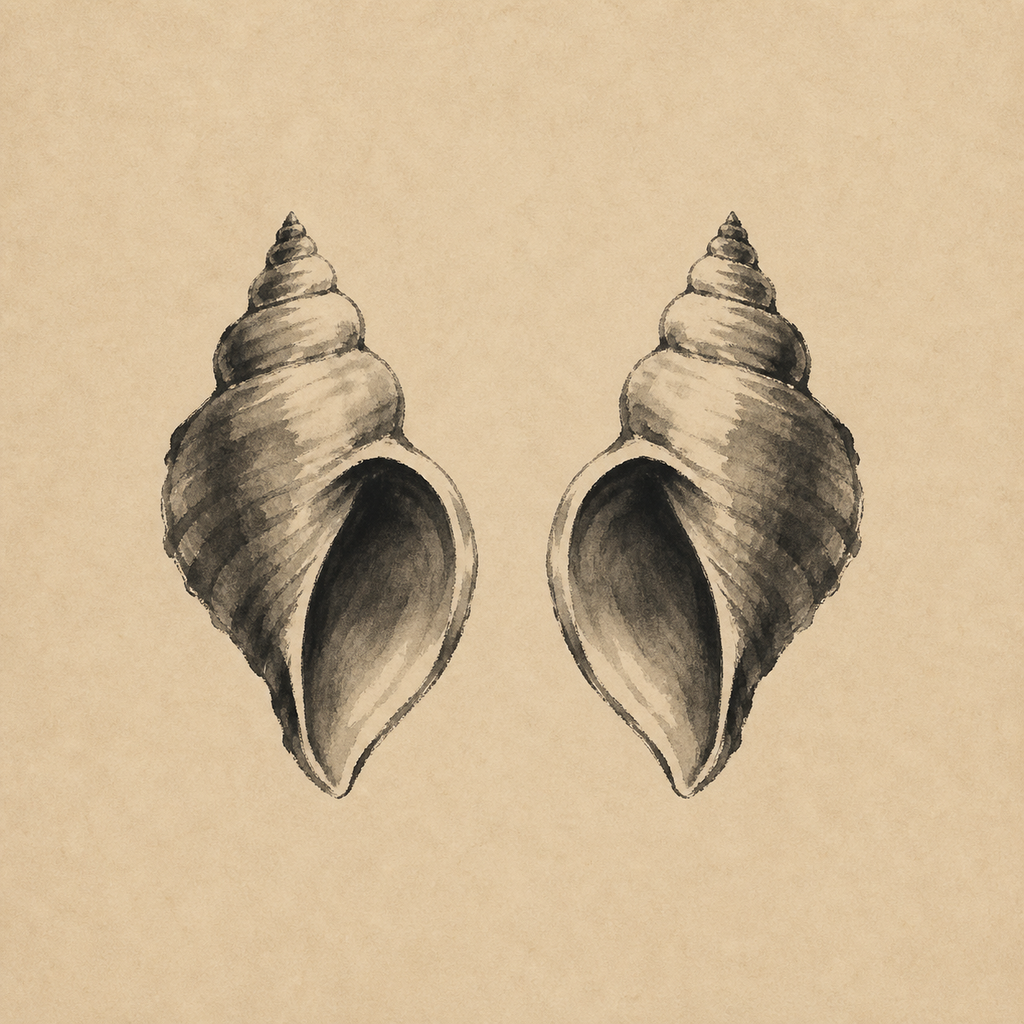
Louis Pasteur, twenty-six and working in 1848 in Antoine Balard's laboratory at the École Normale Supérieure in Paris, was crystallizing the sodium-ammonium salt of paratartaric acid — chemically identical to ordinary tartaric acid but optically inert. Under the microscope he noticed something no chemist had seen before: the salt was crystallizing in two distinct forms that were non-superimposable mirror images of each other, like a left and a right hand. He spent weeks sorting the crystals by hand, dissolved each pile separately, and measured the optical rotation. One solution rotated polarized light clockwise; the other rotated it counter-clockwise by the same angle. The mixed crystals had been inert because the two rotations cancelled. Molecular geometry could be handed — chirality, from the Greek for hand, was a real property of matter.
Two molecules with identical connectivity can differ only in their three-dimensional arrangement, and that difference can determine whether a substance is a drug or a poison. Enantiomers are stereoisomers that are non-superimposable mirror images; diastereomers are stereoisomers that are not. A chiral centre — usually a carbon bonded to four different substituents — is the local source of the asymmetry; a molecule with n centres has up to 2ⁿ stereoisomers. The Cahn-Ingold-Prelog convention assigns each centre an R or S descriptor by ranked substituents. Pasteur's discovery sat dormant for a quarter-century until Jacobus van 't Hoff and Joseph-Achille Le Bel proposed independently in 1874 that the tetrahedral geometry of carbon was the geometric source of chirality; van 't Hoff received the first Nobel Prize in Chemistry in 1901. The biological consequences are enormous because biology itself is chiral. Proteins use L-amino acids; DNA, RNA, and most metabolic intermediates run on D-sugars. Receptors and enzymes are themselves chiral, discriminating enantiomers by factors of thousands. (R)-carvone smells of spearmint; (S)-carvone smells of caraway. The thalidomide tragedy of 1957–1962 is the canonical drug example: Chemie Grünenthal's racemic sedative contained one enantiomer with the intended effect and another that was a potent teratogen, producing limb-deformity birth defects in roughly ten thousand infants before the drug was withdrawn — though the two enantiomers interconvert under physiological conditions, so a single-enantiomer formulation would not have prevented the disaster. The 2001 Nobel in Chemistry went to William Knowles, Ryōji Noyori, and K. Barry Sharpless for asymmetric catalysis — methods that yield one enantiomer preferentially, now central to industrial pharmaceutical chemistry.