Special Relativity
- Einstein and the speed-of-light limitnot yet tested
- E = mc² and mass-energynot yet tested
- Time dilation and invariant framesnot yet tested
- The Lorentz factor γnot yet tested
Maxwell's equations (1865) had an embarrassment built in: they predict that the speed of light is c regardless of the motion of the source or observer. This contradicted Newtonian mechanics, in which velocities should add. For forty years, physicists tried to reconcile the two by positing an aether. The Michelson-Morley experiment (1887), designed to detect Earth's motion through it, found nothing. In 1905, Albert Einstein — a 26-year-old patent clerk in Bern — proposed a different fix: take Maxwell's equations seriously and revise mechanics to match. The result was special relativity.
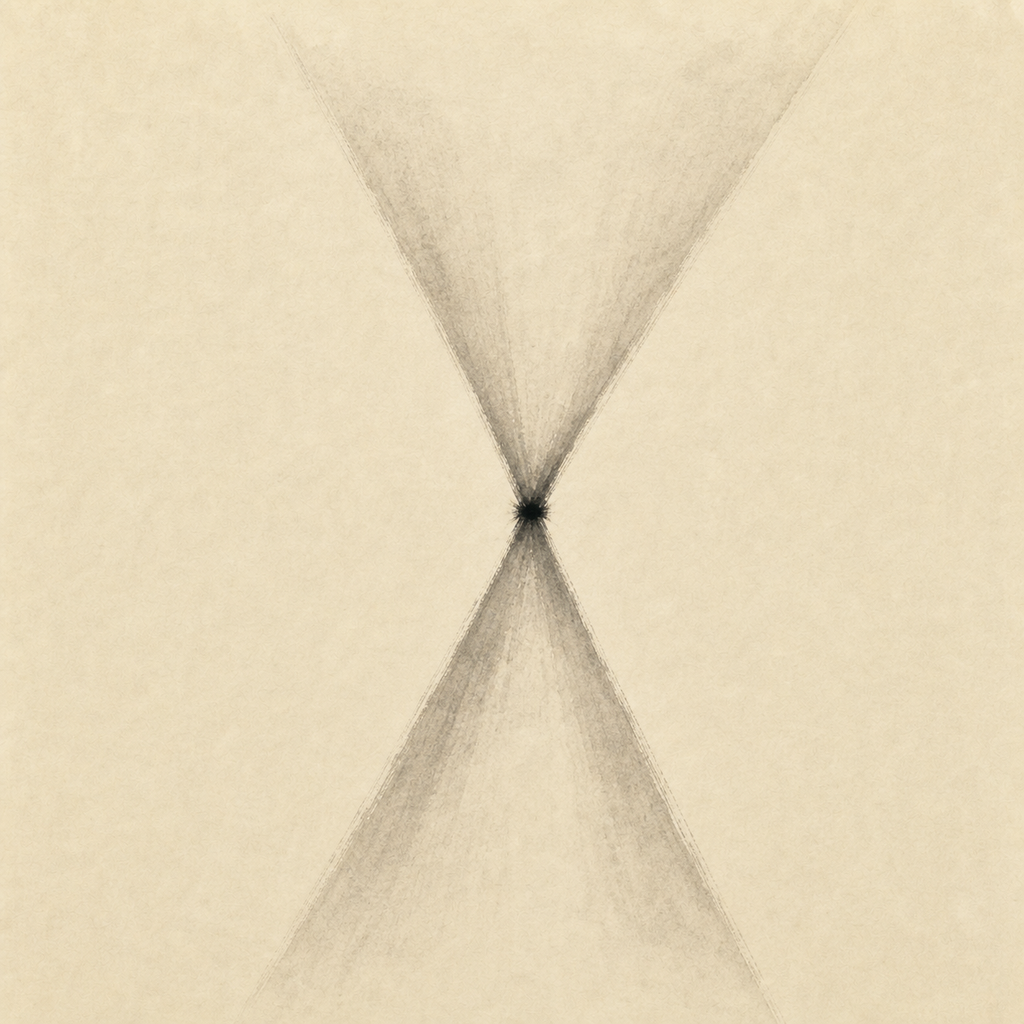
Special relativity rests on two postulates: (1) the laws of physics are the same in all inertial frames; (2) the speed of light is the same in all inertial frames. The first generalizes Galilean relativity; the second contradicts it. Together they force radical revisions of how space and time work. Time dilation: a moving clock runs slow by γ = 1/√(1 − v²/c²). At v = 0.87c, γ = 2; clocks tick half-speed. Length contraction: a moving object shortens along its direction of motion by the same factor. Relativity of simultaneity: two events one observer judges simultaneous, another in relative motion judges sequential. Mass-energy equivalence: E = mc² — mass is a form of energy, conversion factor c² (≈ 9 × 10¹⁶ J/kg) — derived as a consequence of the two postulates, not assumed. Lorentz transformations replace the classical Galilean transformations; they preserve the spacetime interval Δs² = c²Δt² − Δx² − Δy² − Δz², the single invariant SR puts in place of separate time and space distances. Four-vectors (position, velocity, momentum, energy-momentum) repackage what classical mechanics treated separately. Causality is preserved by the light cone structure: events outside each other's light cones cannot be causally connected, and SR forbids faster-than-light signals. The effects are imperceptible at everyday speeds — γ ≈ 1 + 3 × 10⁻¹³ at jet speeds — but real and measurable. The 1971 Hafele-Keating experiment flew atomic clocks around the world and found exactly the predicted time-dilation.