Spacetime
- Time as a fourth coordinate alongside spacenot yet tested
- The invariant interval every observer agrees onnot yet tested
- Light cones and timelike, spacelike, null eventsnot yet tested
- Worldlines, proper time, and the move to curved spacetimenot yet tested
On September 21, 1908, in Cologne, the mathematician Hermann Minkowski — Einstein's former teacher at Zurich Polytechnic — gave a lecture titled Raum und Zeit. It opened with one of the most famous declarations in twentieth-century physics: "Henceforth, space by itself, and time by itself, are doomed to fade away into mere shadows, and only a kind of union of the two will preserve an independent reality." Minkowski had reformulated special relativity as the geometry of a four-dimensional manifold. Time was no longer a parameter outside the system; it was another coordinate, indistinguishable in principle from space except by a sign in the metric. Spacetime — Minkowski's coinage — became the canvas on which all subsequent relativistic physics would be painted.
A point in spacetime is an event — a position in space attached to a moment in time — and the structure that makes spacetime work is the invariant interval Δs² = c²Δt² − Δx² − Δy² − Δz² between any two events. The minus signs in front of the spatial coordinates are doing the work: they give spacetime its Lorentzian metric rather than the Euclidean one of ordinary geometry, and Lorentz transformations preserve Δs² even though they shuffle space and time into each other. Two observers in relative motion will disagree about the elapsed time between two events and disagree about the distance, but they will agree on Δs². The sign of that quantity classifies pairs of events into the three causal categories: timelike, where the two events can be connected by a slower-than-light worldline; spacelike, where no signal can reach from one to the other; and null, where they are connected by a light ray. The light cone at each event bounds its causal past and its causal future, and the entire content of relativistic causality reduces to that geometric fact.
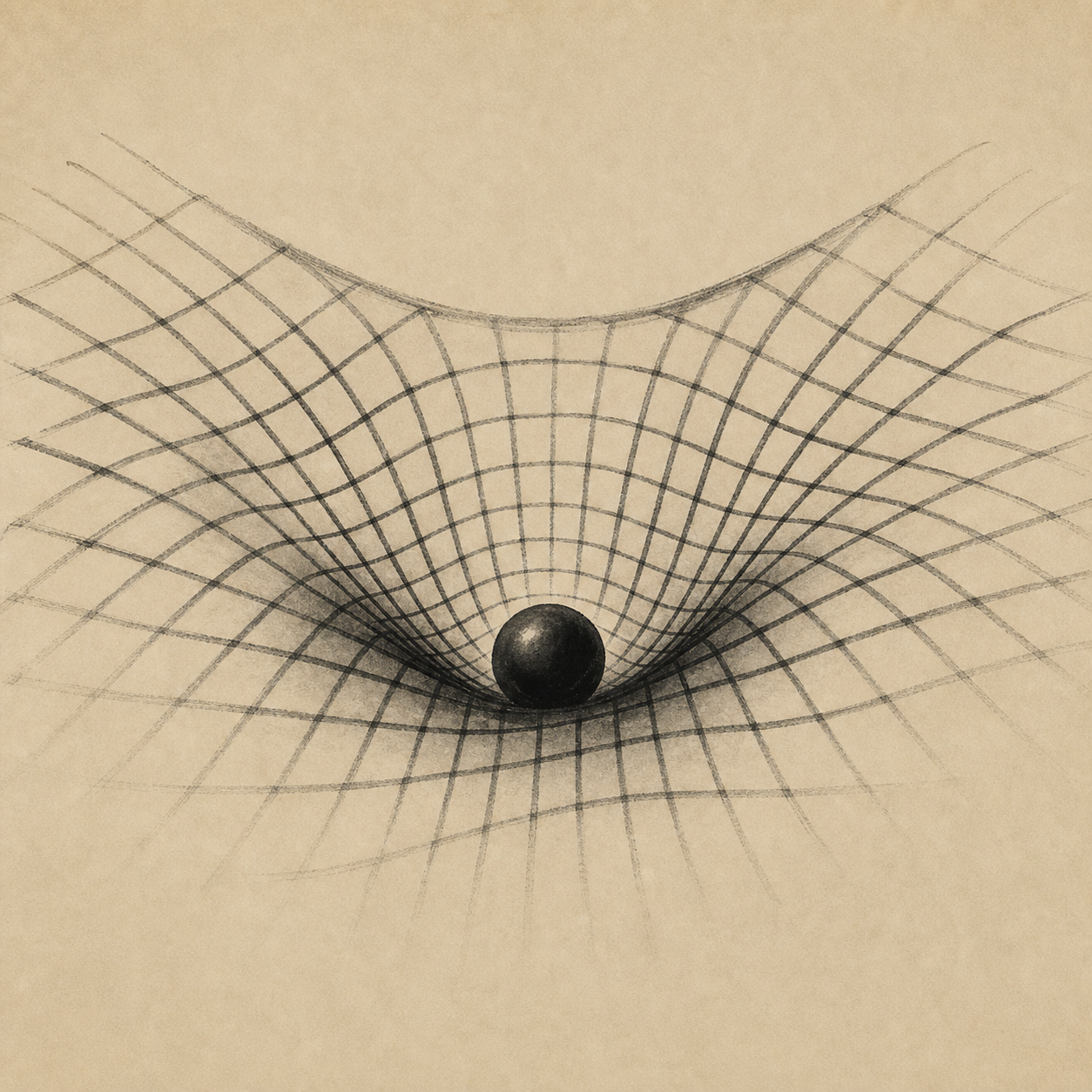
Worldlines — particle trajectories through spacetime — are timelike curves, and the proper time a clock reads along a worldline is the integral of the interval along its path. Different worldlines connecting the same two events accumulate different proper times, which is the geometric content of the twin paradox: the accelerating twin's worldline is shorter than the inertial twin's, so less time elapses on the moving clock. Special relativity is the geometry of flat spacetime; general relativity generalizes to curved spacetime, with the curvature determined by the energy-momentum content via the Einstein field equations. The move from special to general is exactly the move from a flat Lorentzian manifold to one whose shape is dictated by what it contains.