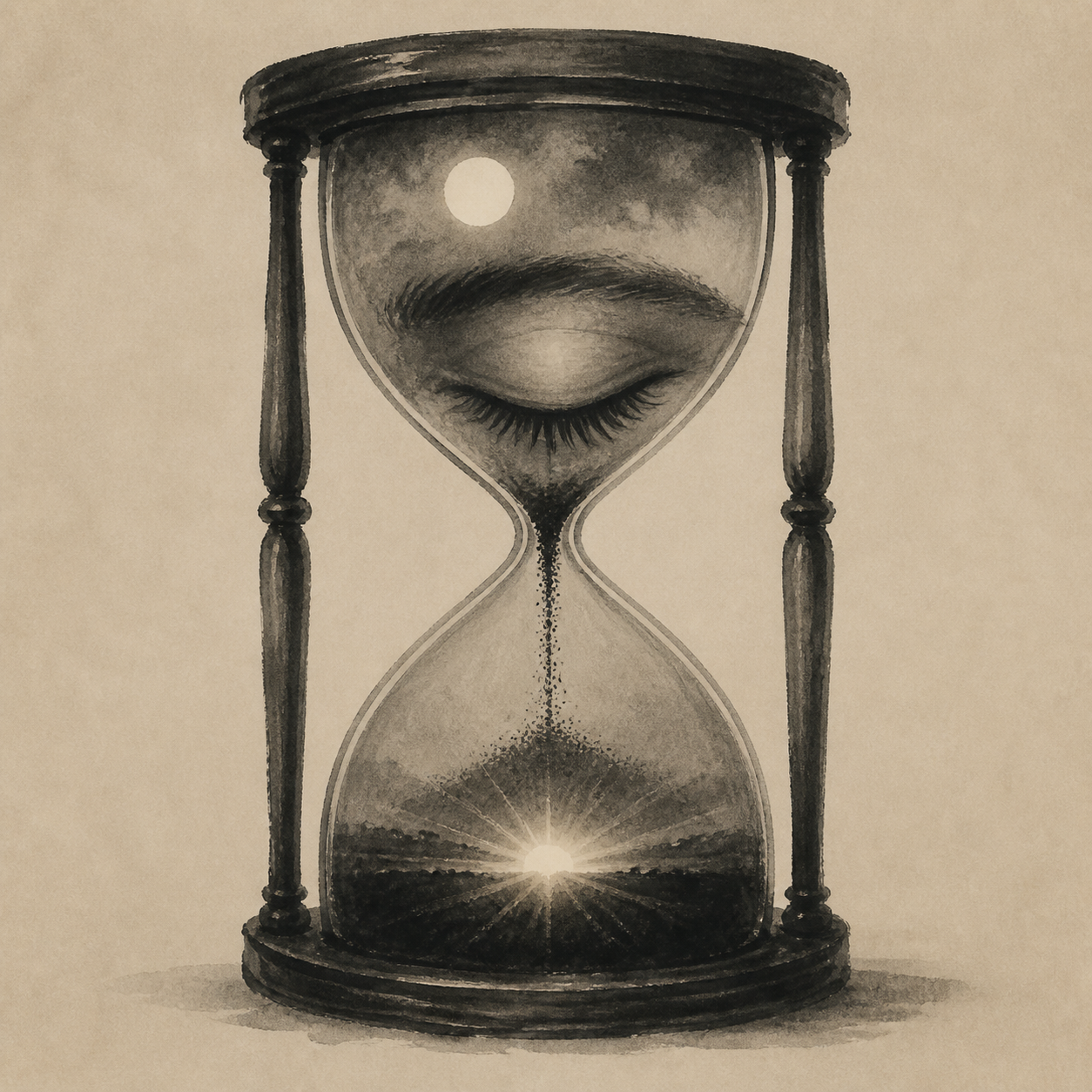
Sleep & Circadian Rhythms
- REM sleep and where dreams happennot yet tested
- REM atonia: paralysis during dreamsnot yet tested
- Lucid dreaming and dream awarenessnot yet tested
- Wakefulness as a global brain statenot yet tested
In 1971, Ronald Konopka and his Caltech advisor Seymour Benzer published a PNAS paper announcing they had isolated Drosophila mutants with abnormal circadian rhythms. Most flies emerged from their pupal cases around dawn; the mutants emerged at random, every 19 hours, or every 28. Konopka and Benzer mapped the affected gene and named it period. They had found, for the first time, a single gene whose mutation altered a biological clock — time-keeping was a molecular property of cells. Across the next forty years, Jeffrey C. Hall, Michael Rosbash, and Michael W. Young worked out the feedback loop by which period and partner genes (timeless, clock, cycle) produce 24-hour oscillations. The mechanism is deeply conserved; they shared the 2017 Nobel.
The suprachiasmatic nucleus — a cluster of about 20,000 neurons sitting above the optic chiasm — is the body's master clock. Its intrinsic period is close to but not exactly 24 hours, and it is entrained to the external light-dark cycle through intrinsically photosensitive retinal ganglion cells expressing melanopsin that project directly to the SCN. The ipRGCs peak near 480 nm blue, which is why evening blue-rich screen light delays sleep onset. The SCN coordinates peripheral clocks throughout the body via cortisol (peaks just before waking), melatonin (rises in the evening), and autonomic outputs; tissue clocks govern insulin sensitivity, blood pressure, and immune trafficking. Shift workers — about 20 % of the global workforce — live in chronic phase-mismatch and have elevated rates of type 2 diabetes, cardiovascular disease, and certain cancers; IARC classified shift work as a probable carcinogen in 2007. Sleep itself is structured. The EEG cycles roughly every 90 minutes between NREM Stage 3 slow-wave sleep — dominant in the first half of the night, when growth hormone is secreted and declarative memory is consolidated — and REM, dominant in the second half and where most narrative dreaming occurs. Nedergaard's group introduced the glymphatic system in 2012 (Iliff et al., Science Translational Medicine); a 2013 Science paper (Xie et al.) then showed this brain-wide cerebrospinal-fluid flow, which clears amyloid-beta, is substantially upregulated during slow-wave sleep. Matthew Walker's Why We Sleep (2017) overstated some findings, but the core correlations — between short habitual sleep and Alzheimer's, type 2 diabetes, cardiovascular disease, and depression — are robust.