Self-Organization
- Order from energy flow far from equilibriumnot yet tested
- Many components, local rules, feedback, energy flownot yet tested
- Bénard cells, flocks, slime moulds, termite moundsnot yet tested
- Self-organized criticality and its overclaimingnot yet tested
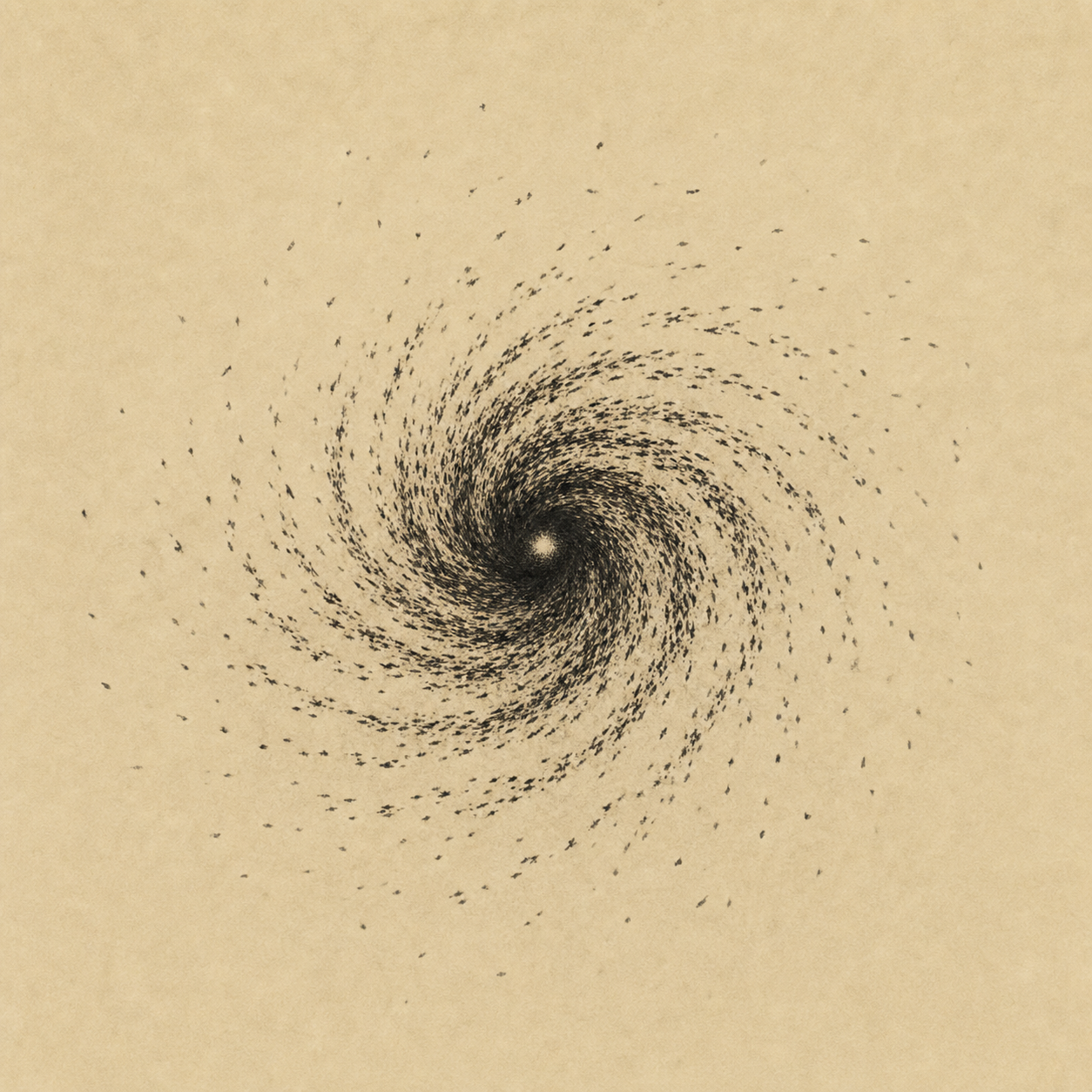
In 1900, Henri Bénard observed something that would puzzle physicists for the next half-century. When a thin layer of fluid is heated uniformly from below, spontaneously — without any external organizing force — it forms a regular pattern of hexagonal convection cells. Order from heat. The puzzle was thermodynamic: the second law says closed systems tend toward disorder, yet here was a system, given heat, organizing itself. The resolution came from Ilya Prigogine (Nobel 1977): the second law applies to closed systems, but the Bénard cell is open — energy flows through it, and entropy is exported to the environment. Far from equilibrium, open systems can produce dissipative structures — stable patterns of organization maintained by continuous energy flow. Prigogine's framework became one of the foundational ideas of self-organization: order can arise spontaneously from local interactions without central control.
The conditions for self-organization are now well-understood. The system must contain many components with nonlinear interactions, and there must be energy or information flowing through it, which is what keeps the system far from equilibrium. Feedback connects output back to input, and the rules of interaction are local: agents respond to their neighbours, not to the global state. When all four conditions hold, structure can appear without anyone designing it. The Belousov-Zhabotinsky reaction produces concentric rings and spiral waves instead of going monotonically to equilibrium. Slime moulds aggregate from single cells into a macroscopic problem-solving organism when food is scarce. Flocks of starlings produce coordinated complex motion from three local rules per bird (separation, alignment, cohesion — Craig Reynolds's 1987 Boids is the canonical simulation). Termite mounds with elaborate ventilation systems get built by termites following local pheromone rules; sand dunes migrate at kilometre scale from wind plus local sand-sand interactions; crystals grow from atoms following local bonding rules. The theoretical apparatus has accumulated since Prigogine. Synergetics (Hermann Haken) gave a formal framework for collective behaviour in non-equilibrium systems. Cellular automata — von Neumann through Conway's Game of Life and Stephen Wolfram's A New Kind of Science — showed that complex order can emerge from extremely simple local rules. Stuart Kauffman's autocatalytic sets model chemical networks that catalyze their own production. Self-organized criticality (Bak, Tang, Wiesenfeld, 1987) proposed that natural systems evolve toward critical states where avalanches of all sizes occur — a unifying account for power-law statistics observed across earthquakes, forest fires, and financial markets. The framework has sometimes been overclaimed: not every power law comes from self-organized criticality, and every real example involves energy flow, initial structure, and constraints.