Second Temple Judaism
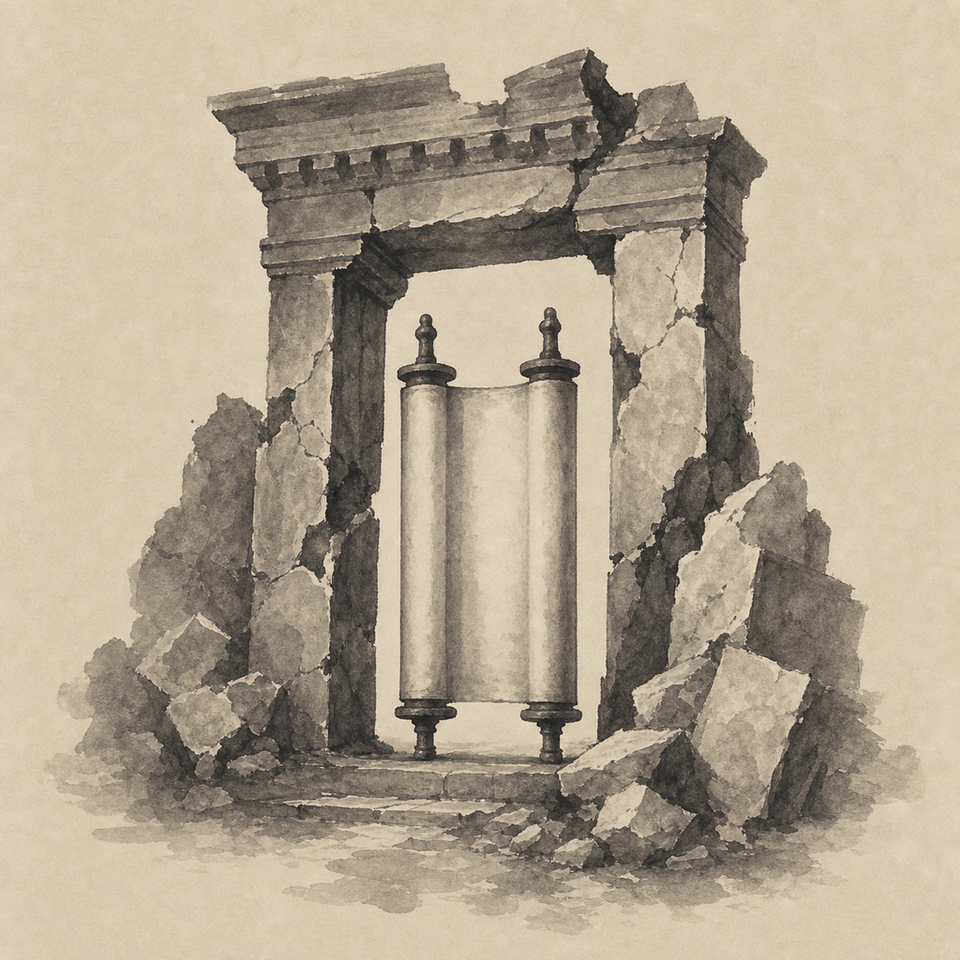
From the Second Temple's rebuilding around 516 BCE to its destruction by Rome in 70 CE, Judaism was organized around a single building. Sacrifice could be performed nowhere else; pilgrimage pointed to it; the three annual festivals required it; the priesthood existed to staff it. Yet beneath that one altar the period seethed with rival movements — Pharisees, Sadducees, Essenes, Zealots — and a sharpening expectation that God was about to act in history. When the Roman general Titus burned the Temple, a faith whose covenant ran through that altar should, by every theological logic, have ended. It did not. The destruction instead triggered the most consequential religious reinvention of the ancient world — a deliberate exchange of stone for text that would let a people outlive every empire that conquered them.
The era was shaped by the slow shock of Hellenization — Greek language, gymnasia, and philosophy pressing against ancestral law. When the Seleucid king Antiochus IV banned the Torah and defiled the sanctuary, the Maccabean revolt of the 160s BCE won a brief independence and made resistance itself a sacred memory. Out of this pressure grew the institutions that proved portable: the synagogue, a house of reading that needed no priest; a fixed scripture one could carry and study; and a messianic hope the rival sects each answered in their own key. So the teachers who emerged from the catastrophe — the Pharisees, regrouping at the coastal academy of Yavneh under figures like Yohanan ben Zakkai, who legend says was smuggled out of the besieged city in a coffin — built on foundations already laid. They redefined Judaism as a religion of Torah study, prayer, and ethical practice that could be conducted anywhere ten adult men assembled. The Temple was replaced by the synagogue; the hereditary priest by the trained rabbi, chosen by learning rather than birth; the burnt offering by the recited word, prayer framed as a substitute for sacrifice. After the failed Bar Kokhba revolt of 132–135 CE, the centre of gravity shifted to study. The rabbis compiled the Mishnah (c. 200 CE) under Judah ha-Nasi, then the Jerusalem and Babylonian Talmuds — vast corpora of interpretation and unresolved argument that turned the law itself into a portable homeland. A faith tied to one hill in one province became, paradoxically, strongest in diaspora: stateless, scattered, often persecuted, yet coherent because every community studied the same texts by the same method and answered to scholars rather than to a place. The strategy held for two thousand years.