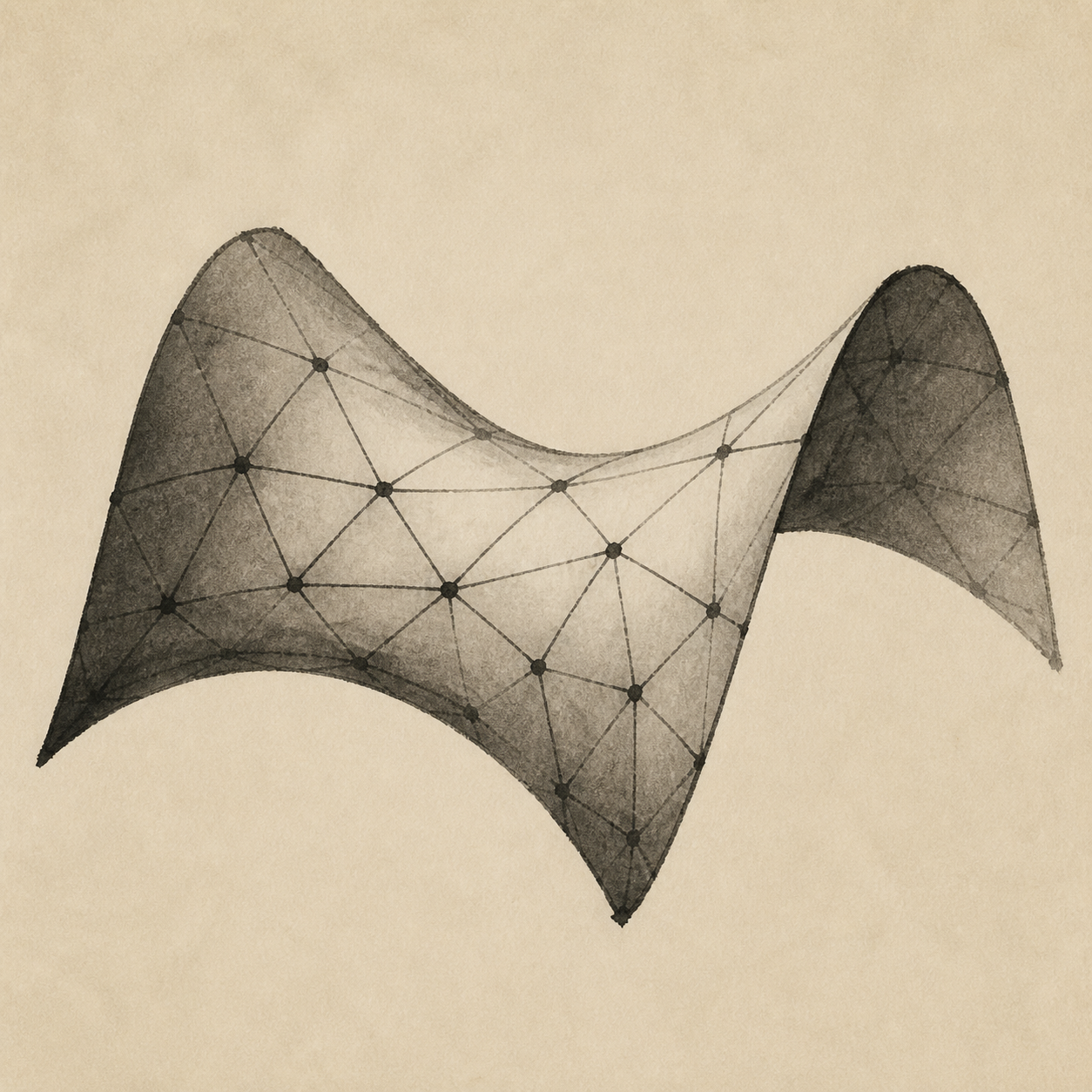
Riemannian Geometry
- A varying inner product on each tangent spacenot yet tested
- Geodesics as locally shortest straight linesnot yet tested
- Riemann, Ricci, and scalar curvaturenot yet tested
- Intrinsic curvature without an ambient spacenot yet tested
On June 10, 1854, a twenty-seven-year-old Bernhard Riemann delivered his Habilitationsvortrag at the University of Göttingen — the lecture required to become a Privatdozent, an unpaid junior lecturer. The aging Carl Friedrich Gauss, who had chosen the topic, sat in the audience. Riemann's lecture, On the Hypotheses Which Lie at the Foundations of Geometry, was thirty minutes long, contained no equations, and was incomprehensible to almost everyone present except Gauss. In it, Riemann proposed something audacious: geometry is not necessarily flat or Euclidean. The local rules of distance can vary continuously across a space, and the result is a class of intrinsically curved geometries — Riemannian manifolds — that were, sixty years later, exactly what Einstein needed to write down general relativity.
A Riemannian manifold is a smooth manifold (a topological space that locally looks like ℝⁿ, with a compatible smooth structure) equipped with a Riemannian metric: a smoothly varying inner product on the tangent space at each point. The metric specifies, locally, what "distance" and "angle" mean — and crucially, the specification can change from point to point. From this minimum, the geometry unspools. Length of a curve: integrate the speed (computed from the metric) along the curve. Geodesics: locally length-minimizing curves — the natural "straight lines" of the manifold; on the sphere, they are great circles; in spacetime, they are the paths of objects in free fall. Christoffel symbols describe how the local frame rotates as you move. The Levi-Civita connection is the unique torsion-free connection compatible with the metric. Curvature tensors — Riemann, Ricci, scalar — are increasingly contracted measures of how the geometry deviates from flatness. The Gauss-Bonnet theorem (in 2D) states that the integral of Gaussian curvature over a closed surface equals 2π times the Euler characteristic — geometry encoding topology, one of the deepest results in classical differential geometry. Sectional curvature generalizes Gaussian curvature to higher dimensions. Geodesic completeness, conjugate points, Jacobi fields, cut loci — the technical apparatus of working Riemannian geometry. The framework distinguishes intrinsic geometry (what an ant on the surface can determine without leaving it) from extrinsic geometry (how the surface sits in an ambient space) — and Riemann's profound insight was that intrinsic geometry is enough. We do not need to embed our universe in a higher-dimensional space to make sense of its curvature.