Real Numbers
- √2 and lengths that are no ratio of integersnot yet tested
- Dedekind cuts and Cauchy sequencesnot yet tested
- Completeness: bounded sets have a least upper boundnot yet tested
- Cantor's diagonal and the unspeakable realsnot yet tested
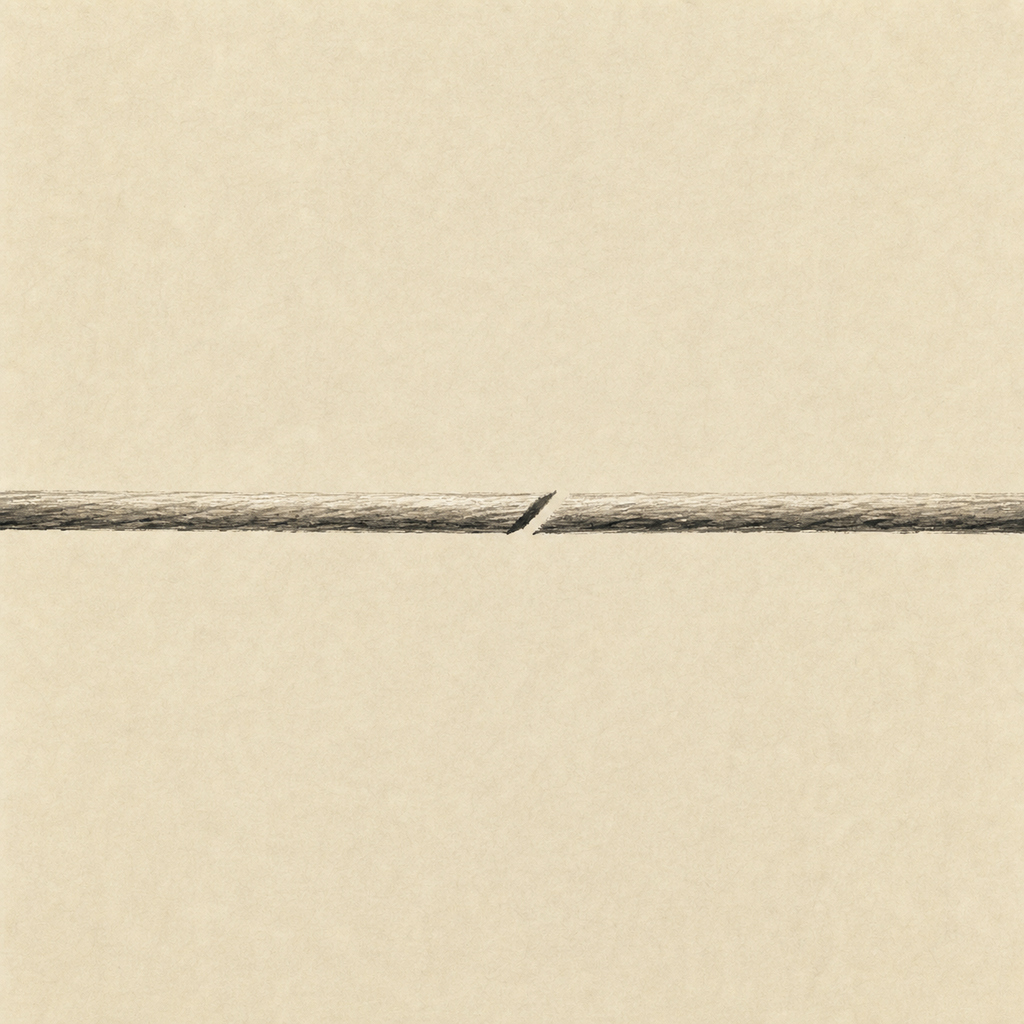
The Greeks knew about incommensurable lengths by the fifth century BCE. The diagonal of a unit square has length √2, and √2 — the Pythagoreans discovered, to their reported horror — cannot be written as a ratio of whole numbers. Two and a half thousand years later, working analysts were still casually using "real numbers" without anyone having a precise definition of what one was. Calculus rested on a foundation that nobody had built. The repair took the whole of the nineteenth century — Bolzano and Cauchy first, then Weierstrass, Dedekind, and Cantor in a thirty-year burst at its end — and required, finally, an honest answer to the question what is the continuum?
Two equivalent constructions emerged. Dedekind cuts (1872): a real number is a partition of the rational numbers into a lower set and an upper set, where every rational below the cut is in the lower set and every rational above is in the upper. The cut at √2 puts rationals whose square is less than 2 below, and the rest above; the real number is the cut. Cauchy sequences (Cantor, same year): a real number is an equivalence class of rational sequences whose terms eventually get arbitrarily close to each other. Either definition gives the same object — an ordered field with the completeness property: every set of reals that is bounded above has a least upper bound. Completeness is the axiom that distinguishes the reals from the rationals, and it is exactly what calculus needs. Without it, sequences could converge "almost" without converging anywhere; intermediate-value statements could fail; the foundations of analysis simply do not work. Cantor also showed that the reals are uncountable: there is no way to list them in a sequence indexed by the natural numbers — his diagonal argument from 1891 is one of the most cited proofs in mathematics, and it implies that almost every real number cannot be described by a finite expression. Most reals are, in this sense, unspeakable: they exist, the theory needs them, but no human or computer can ever write one down.