Radiometric Dating
- Becquerel to Boltwood: rocks become clocksnot yet tested
- Half-life as a constant of naturenot yet tested
- Carbon-14, K-Ar, and uranium-lead by timescalenot yet tested
- Concordia and cross-system agreementnot yet tested
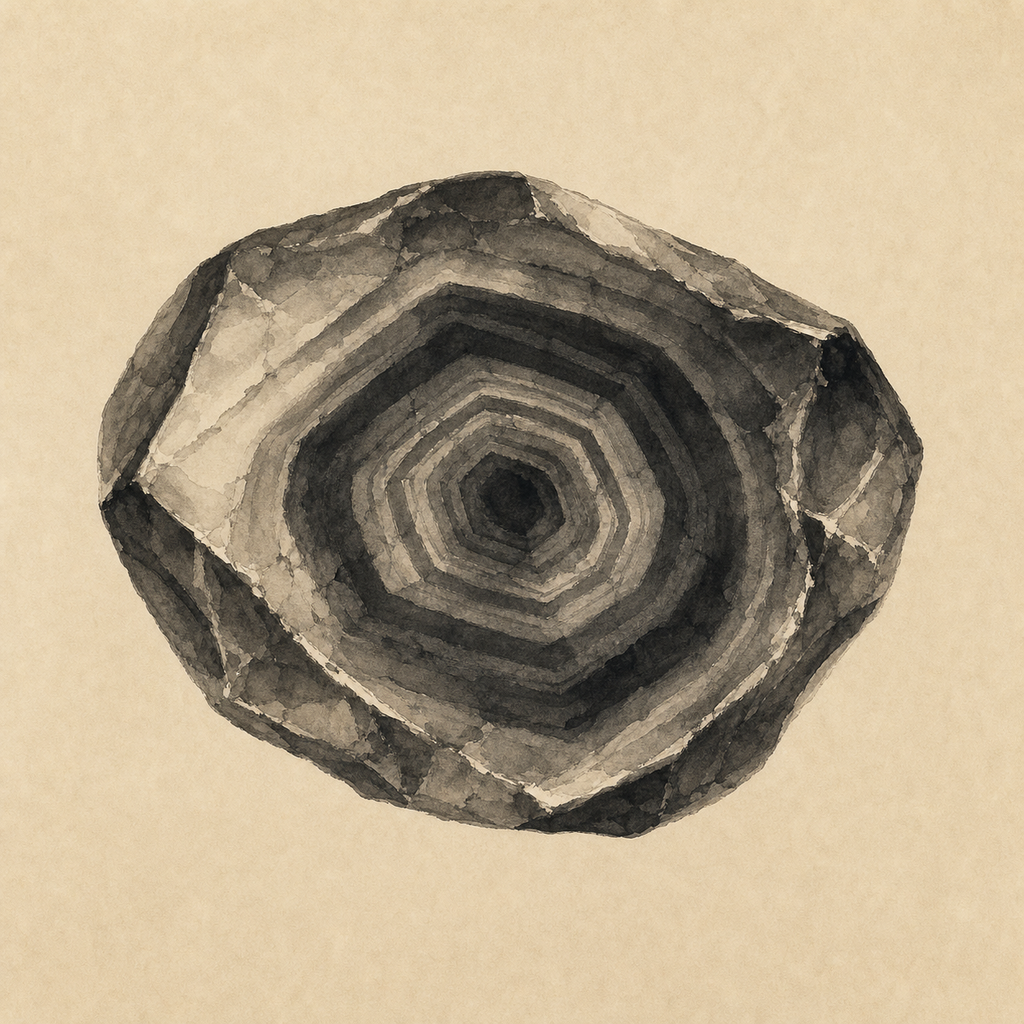
Henri Becquerel discovered radioactivity in 1896 — uranium salts, left in a drawer with a wrapped photographic plate, fogged the plate without exposure to light. Marie and Pierre Curie identified the responsible elements (radium, polonium) and the basic phenomenology of radioactive decay. Ernest Rutherford showed that decay rates were exponential, with a half-life characteristic of each radioactive isotope. The physical implication did not become clear until 1907, when Bertram Boltwood dated uranium minerals by measuring their ratio of uranium to lead — the daughter product — and obtained ages running up to ~2.2 billion years (the youngest of his samples came in near 410 million years). In one stroke, the rocks had become clocks. Lord Kelvin's thermodynamic argument that Earth was at most ~100 million years old collapsed within a decade.
Radiometric dating works because radioactive decay rates are constants of nature. Each isotope has a half-life — the time for half a sample to decay to its daughter product — fixed by nuclear physics and unaffected, to extremely high precision, by temperature, pressure, chemistry, or any other environmental variable. Measure the ratio of remaining parent to accumulated daughter, knowing the half-life, and arithmetic gives the age. Different isotope systems are useful at different time scales. Carbon-14, with a half-life of 5,730 years, dates organic material from a few hundred to about fifty thousand years old. Potassium-argon and the more-refined argon-argon method work on volcanic rocks from a few hundred thousand years to billions; the East African hominin fossil sites are dated this way. Uranium-lead, with two parallel decay chains running on the same crystal (U-238 → Pb-206 with half-life 4.5 Gyr, U-235 → Pb-207 with half-life 0.7 Gyr), is the gold standard for very old rocks: zircon crystals retain uranium and reject lead at formation, so any subsequent lead is necessarily radiogenic, and the two chains give an internal consistency check. Uranium-thorium dates marine carbonates back ~500 Kyr; rubidium-strontium and samarium-neodymium date the oldest meteorites and Earth rocks. What makes radiometric dating credible is cross-validation. Different isotope systems applied to the same sample yield the same age. Concordia diagrams in U-Pb zircon dating plot Pb-206/U-238 against Pb-207/U-235; a sample that has remained closed lies on the concordia curve. The Patterson 1956 measurement of Earth's age used five different isotope ratios in five different meteorites, all converging on 4.55 Gyr. The standard objections — that decay rates might have varied in deep time, that contamination is undetectable — have been examined repeatedly and refuted: nuclear physics constrains decay-rate variation to parts in 10⁹; cross-validation across isotope systems would diverge if any one had drifted. The technology is among the best-validated measurement systems in any science.